组成图示
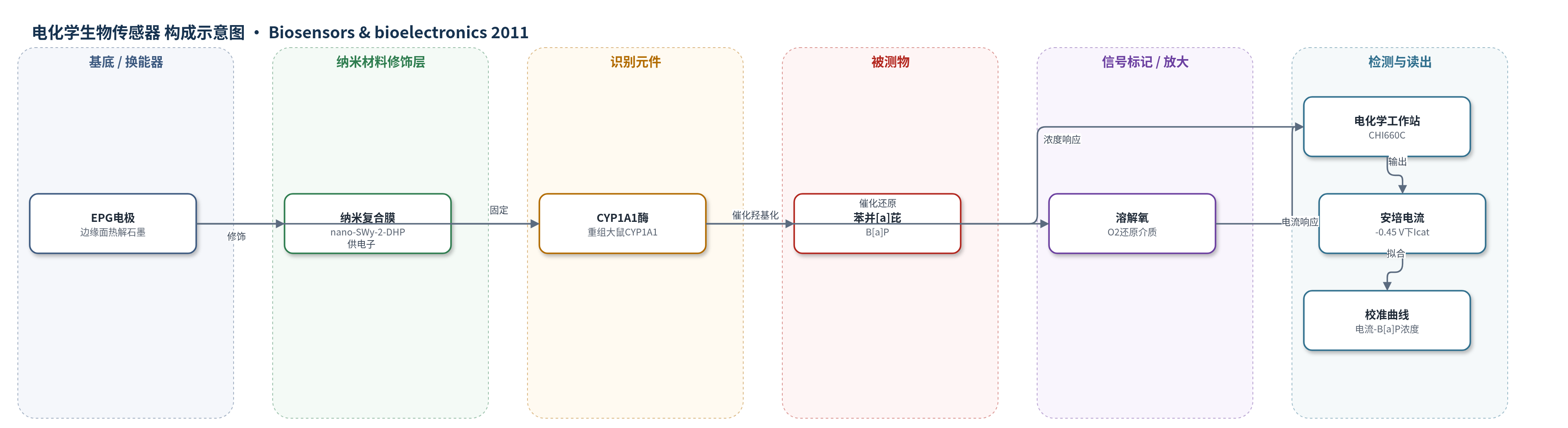
点击图片查看大图 · 依据论文自动绘制
传感器类型
电化学生物传感器
检测对象
苯并[a]芘(benzo[a]pyrene, B[a]P);样品基质:pH 7.0磷酸盐缓冲液(空气饱和)
检测原理
重组CYP1A1固定于nano-SWy-2-DHP/EPG界面,纳米蒙脱石与DHP促进血红素P-FeIII/P-FeII直接电子转移。在-0.45 V工作电位下,电极将P-FeIII还原为P-FeII;P-FeII与底物苯并[a]芘(B[a]P)反应生成羟基化B[a]P并再生P-FeIII,P-FeIII再接受电子,形成催化循环。空气饱和缓冲液中的溶解氧参与/伴随电催化还原,使还原峰电流随B[a]P浓度升高而增大。安培法在稳态电流下读取信号,电流与B[a]P浓度在3.31–16.56 μM内线性相关。
检测灵敏度
LOD: 0.58 μM;线性范围: 3.31–16.56 μM;灵敏度: 58.57 μA mM−1;r = 0.996
效应效果
传感器在3.31–16.56 μM范围内对B[a]P线性响应,稳态电流50 s内达到,表明扩散快、酶活性高。重现性良好,6.624 μM B[a]P连续7次测定变异系数3.5%;室温保存10 d后保持87%初始活性。固定化CYP1A1的Kapp m为46.27 μM,约为天然NADPH支持体系HPLC法值19 μM的2倍,提示膜中酶亲和力略降。该传感器无需NADPH-P450还原酶,可直接电化学驱动P450催化,作者认为可用于环境致癌物B[a]P的简单、通用检测。
传感器的构成
- 基底电极:边缘面热解石墨电极(EPG),抛光后作为工作电极,提供导电基底与电子转移界面。
- 纳米修饰层:纳米钠蒙脱石(nano-SWy-2)与二正十六烷基磷酸酯(DHP)复合膜,固定CYP1A1并促进直接电子转移。
- 识别元件:重组大鼠细胞色素P450 1A1(CYP1A1),由ompA-1A1/pCW在大肠杆菌DH5α中表达,催化B[a]P羟基化。
- 信号介质:溶解氧(O2),在空气饱和缓冲液中参与CYP1A1电催化还原,其还原电流随B[a]P浓度变化。
- 缓冲介质:pH 7.0磷酸盐缓冲液,维持酶活性与电化学测试环境。
中文摘要
利用质粒pCW,通过N端融合细菌信号肽ompA构建ompA-1A1/pCW,在大肠杆菌中高水平表达大鼠细胞色素P450 1A1(CYP1A1)。与仅优化5′端密码子的1A1/pCW相比,ompA融合体表达量更高,细菌膜组分中活性P450回收率显著改善。将ompA-1A1/pCW表达的CYP1A1从细菌膜组分收集,固定于纳米钠蒙脱石(nano-SWy-2)与二正十六烷基磷酸酯(DHP)复合膜中,在边缘面热解石墨电极(EPG)上实现直接电化学。循环伏安法显示固定化CYP1A1在pH 7.0无氧磷酸盐缓冲液中呈现一对氧化还原峰,表观电位约-0.36 V,并保持生物活性,可催化溶解氧还原。向空气饱和溶液中加入苯并[a]芘(B[a]P)后,溶解氧还原峰电流增大,表明CYP1A1对B[a]P具有电催化作用。安培法测得B[a]P线性范围3.31–16.56 μM,灵敏度58.57 μA mM−1,表观米氏常数46.27 μM。
英文摘要
Using the plasmid pCW, high-level expression of rat cytochrome p4501A1 (CYP1A1) has been achieved by making NH(2)-terminal translational fusions to bacterial leader sequences ompA (ompA-1A1/pCW). The construct ompA-1A1 was compared with an expression construct in which the Ala codon GCT was placed in the second position and 5'-terminal codons were maximized for A T content (1A1/pCW). Both constructs produced spectrally active, functional protein. However, the ompA-1A1 fusion gave higher levels of expression, and a marked improvement in the recovery of active P450 in bacterial membrane fractions, when compared with the construct 1A1/pCW. The expressed 1A1 from the construct ompA-1A1/pCW in bacterial membrane fractions were collected and immobilized in nano-Na-montmorillonite (nano-SWy-2) and dihexadecylphosphate (DHP) composite film. The direct electrochemistry of CYP1A1 in a nano-SWy-2-DHP film on an edge-plane pyrolytic graphite electrode (EPG) has been obtained and the catalytic activity of the enzyme to benzo[a]pyrene has been investigated by the cyclic voltammetry. The immobilized CYP1A1 displayed a pair of redox peaks with a formal potential of -0.36 mV in pH 7.0 O(2)-free phosphate buffers at scan rate of 1 V s(-1). The CYP1A1 in the nano-SWy-2-DHP film retained its bioactivity and could catalyze the reduction of dissolved oxygen. Upon the addition of its substrate benzo[a]pyrene (B[a]P) to the air-saturated solution, the reduction peak current of dissolved oxygen increased, which indicates the catalytic behavior of CYP1A1 to B[a]P. By amperometry a calibration linear range for B[a]P was obtained to be 3.31-16.56 μM with a sensitivity of 58.57 μA mM(-1). And the apparent Michaelis-Menten constant for the electrocatalytic activity of CYP1A1 was estimated to be 46.27 μM for B[a]P.