组成图示
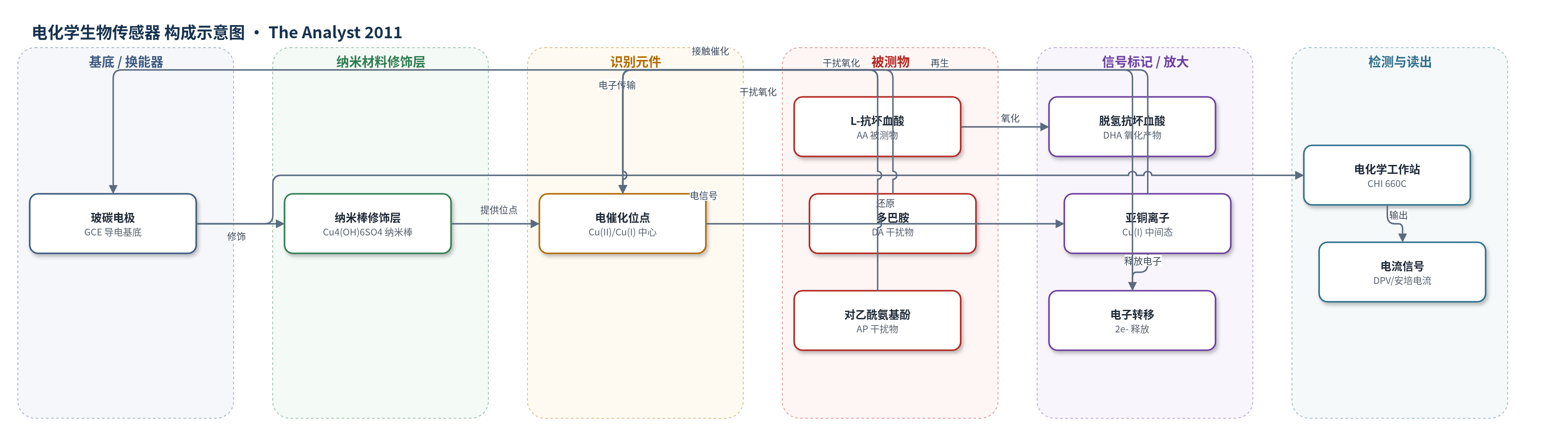
点击图片查看大图 · 依据论文自动绘制
传感器类型
电化学生物传感器
检测对象
L-抗坏血酸(L-ascorbic acid, AA);样品基质:0.1 M 磷酸盐缓冲液(PBS,pH 7.7)
检测原理
Cu4(OH)6SO4 纳米棒修饰在玻碳电极上,其 Cu(II)/Cu(I) 中心作为本征电催化位点直接作用于 L-抗坏血酸(AA)。AA 在电极表面被 Cu(II) 氧化为脱氢抗坏血酸(DHA),同时 Cu(II) 被还原为 Cu(I);随后 Cu(I) 在电极上再氧化为 Cu(II) 并释放电子,电子经纳米棒和 GCE 传输至电化学工作站,形成氧化电流。AA 浓度升高时,催化氧化速率和电子转移量增加,电流随之线性增大。纳米棒的三维多孔网络提高比表面积、促进 AA 传质与电子转移,降低过电位,实现无介质、无酶的安培检测。
检测灵敏度
LOD: 6.4 mM (S/N = 3);线性范围: 0.017–6 mM;灵敏度: 17.53 mA mM^-1;R^2 = 0.9965
效应效果
该传感器响应时间小于 8 s,在 0.5 mM 多巴胺(DA)和对乙酰氨基酚(AP)存在下,AA 的稳态电流分别仅增至初始值的 101% 和 102%,且 AA、DA、AP 阳极峰电位可区分,显示高选择性。电极在氮气中保存,连续数月重复测量时响应保持初始值的 99%,长期稳定性良好。作者认为其检出限低于其他 AA 传感器、线性范围相当,且无需电子转移介质,制备简单、成本低,适用于医学、生物技术及环境化学中的无酶 AA 检测。
传感器的构成
- 基底/换能器电极:玻碳电极(GCE),提供导电基底并促进电子从催化层向电极传输
- 纳米材料修饰层:Cu4(OH)6SO4(brochantite)纳米棒,共沉淀法修饰,提供高比表面积三维网络与电催化活性位点
- 识别/催化层:无独立生物识别元件;Cu4(OH)6SO4 中 Cu(II)/Cu(I) 中心直接催化 L-抗坏血酸(AA)氧化并再生
- 信号标记物:无外源标记物,AA 氧化产生的电子直接形成法拉第电流
- 电解液/缓冲介质:0.1 M 磷酸盐缓冲液(PBS,pH 7.7),提供离子导电、质子环境和稳定电位
- 检测读出体系:三电极体系(饱和甘汞电极 SCE 参比、铂丝 Pt 对电极)与 CHI 660C 电化学工作站,采集 DPV/安培电流
中文摘要
Cu4(OH)6SO4(brochantite)通常是含铜硫化物的不良氧化产物,很少被认为具有生物和电化学活性。本文报道 Cu4(OH)6SO4 纳米颗粒实际上具有本征电催化活性,并将其作为生物传感材料用于氧化 L-抗坏血酸(AA)。Cu4(OH)6SO4 纳米棒修饰电极对 AA 测定表现出优异性能:响应时间小于 8 s,线性范围为 0.017–6 mM,灵敏度为 17.53 mA mM^-1。在多巴胺(DA)和对乙酰氨基酚(AP)达到最大生理浓度时,该传感器对 AA 氧化仍具有较高选择性。其良好的分析性能、长期稳定性、低成本和简便制备工艺,使其在医学、生物技术和环境化学中的电化学传感器开发中具有应用前景。
英文摘要
Cu(4)(OH)(6)SO(4) (brochantite) is an undesirable oxidation product of copper-bearing sulfides, and it is seldom considered to be biologically and electrochemically active. In this paper, we report that Cu(4)(OH)(6)SO(4) nanoparticles in fact possess an intrinsic electrocatalytic activity, which is explored as a biosensing material to oxidize L-ascorbic acid (AA). The Cu(4)(OH)(6)SO(4) nanorod modified biosensor exhibits excellent performance for the determination of l-ascorbic acid with a response time of less than 8 s, a linear range between 0.017 and 6 mM, and a sensitivity of 17.53 μA mM(-1). A high selectivity towards the oxidation of AA in the presence of dopamine (DA) and acetyl aminophenol (AP) is also observed at their maximum physiological concentrations. The good analytical performance and long-term stability, low cost and straightforward fabrication method made the Cu(4)(OH)(6)SO(4) nanomaterials promising for the development of effective electrochemical sensors for a wide range of potential applications in medicine, biotechnology and environmental chemistry.