组成图示
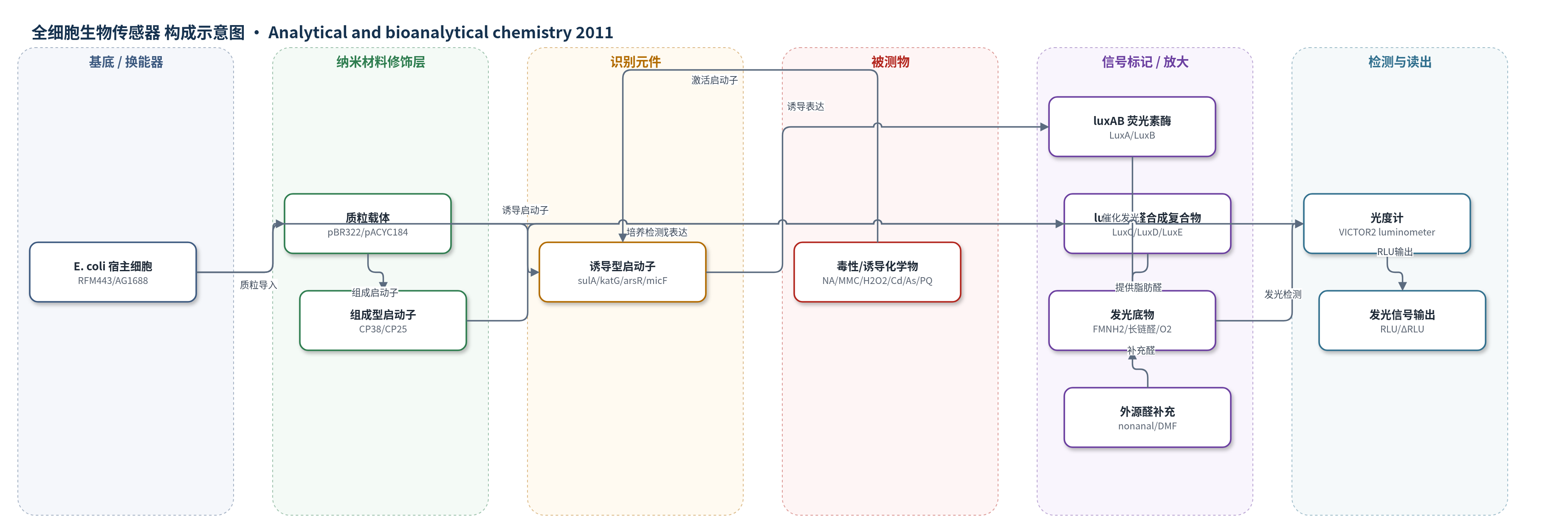
点击图片查看大图 · 依据论文自动绘制
传感器类型
全细胞生物传感器
检测对象
萘啶酸(nalidixic acid, NA)、丝裂霉素C(mitomycin C, MMC)、过氧化氢(H2O2)、氯化镉(cadmium chloride, CdCl2)、亚砷酸钠(sodium arsenite, NaAsO2)、甲基紫精/百草枯(methyl viologen/paraquat);样品基质为 LB 培养基(模拟水样/毒性样品)
检测原理
被测毒性/应激化学物进入 E. coli 后激活相应诱导型启动子(sulA、katG、arsR 或 micF),启动 luxAB 转录;同时组成型启动子 CP38/CP25 持续表达 luxCDE,使 LuxC/LuxD/LuxE 合成长链脂肪醛。LuxA/LuxB 荧光素酶催化还原型黄素单核苷酸 FMNH2、长链脂肪醛和 O2 发生氧化反应,发射蓝绿光。诱导物浓度越高,luxAB 表达越多,发光强度与响应速度越大;拆分 lux 操纵子缩短转录/翻译单元,组成型 luxCDE 克服醛底物限制,外源 nonanal 可进一步补充醛并增强发光。最终由 VICTOR2 光度计读取 RLU/ΔRLU。
检测灵敏度
检出阈值(detection threshold): NA 0.55 mg/l(SY101)、0.56 mg/l(SY103);MMC 28.0 µg/l(SY101);H2O2 2.0 mg/l(SY102);CdCl2 3.16 mg/l(SY203);NaAsO2 0.04 mg/l(SY302);paraquat 0.84 mg/l(SY403);EC200: NA 1.42 mg/l(SY103)、MMC 140.0 µg/l(SY101)、H2O2 5.6 mg/l(SY103)、CdCl2 8.1 mg/l(SY203)、NaAsO2 0.18 mg/l(SY302)、paraquat 28.5 mg/l(SY403);相关系数: 线性区回归系数均 >0.95
效应效果
拆分 lux 组合在多数情况下优于完整 luxCDABE,尤其诱导型 luxAB 加组成型 luxCDE 的信号更强、更快。arsR 完整传感器对亚砷酸钠无响应,而拆分 SY302 检出阈值达 0.04 mg/l;katG/CdCl2 中 SY203 阈值 3.16 mg/l;micF/paraquat 中 SY403 阈值 0.84 mg/l;sulA/NA 中 SY101/SY103 阈值分别为 0.55 和 0.56 mg/l。SY102 背景 RLU 较高(NA 下 9652),但 ΔRLU 最大;CP25 驱动 luxCDE 较 CP38 略增信号,外源 nonanal 可再增强约六倍。实验重复三次,作者认为该类传感器适合检测全局毒性、致突变性和氧化应激,而非单一化学物的高灵敏度定量。
传感器的构成
- 宿主细胞:E. coli K12 RFM443(或构建用 AG1688),作为活细胞传感平台与基因表达宿主
- 质粒载体:pBR322 衍生质粒(携带 luxAB)与 pACYC184 衍生质粒(携带 luxCDE),用于共表达拆分 lux 基因
- 识别/感应元件:诱导型启动子 sulA、katG、arsR、micF,分别响应 DNA 损伤、过氧化/金属、重金属、阳离子抗菌肽/超氧应激
- 组成型调控元件:合成组成型启动子 CP38 或 CP25,驱动 luxCDE(或 luxAB)持续表达
- 报告酶单元:luxAB 编码荧光素酶 LuxA/LuxB,催化 FMNH2 与长链脂肪醛氧化发光
- 底物合成单元:luxCDE 编码脂肪醛合成复合物 LuxC/LuxD/LuxE,持续提供长链脂肪醛
- 发光底物/辅因子:FMNH2、长链脂肪醛(可外源补充 nonanal)和 O2,参与蓝绿光发射
- 信号读出:VICTOR2 luminometer 与不透光白色 96 孔板,测量相对发光单位 RLU
中文摘要
发光细菌生物报告器通常将细菌生物发光基因 luxCDABE 作为报告元件,与应激响应启动子融合作为感应元件;当环境胁迫或诱导化学物激活启动子时,产生剂量依赖性生物发光信号。为提高发光生物报告器性能,本研究将发光杆菌 Photorhabdus luminescens 的 luxCDABE 拆分为两个较小功能单元:编码荧光素酶、催化发光反应的 luxAB,以及编码负责合成反应底物长链脂肪醛的酶复合物的 luxCDE。两个单元分别置于诱导型应激响应启动子或合成组成型启动子控制下,并在大肠杆菌中测试不同组合对多种化学物的响应。所有测试组合均优于天然 luxCDABE 构型,表明两个小基因单元相比同一基因的较长单元具有更高的转录和/或翻译效率。最佳组合为诱导型 luxAB 与组成型 luxCDE,说明在 E. coli 中五个基因共同表达时长链醛供应受限,并证明通过重排 lux 操纵子基因可提高生物传感器性能。
英文摘要
Bioluminescent bacterial bioreporters harbor a fusion of bacterial bioluminescence genes (luxCDABE), acting as the reporting element, to a stress-response promoter, serving as the sensing element. Upon exposure to conditions that activate the promoter, such as an environmental stress or the presence of an inducing chemical, the promoter::reporter fusion generates a dose-dependent bioluminescent signal. In order to improve bioluminescent bioreporter performance we have split the luxCDABE genes of Photorhabdus luminescens into two smaller functional units: luxAB, that encode for the luciferase enzyme, which catalyzes the luminescence reaction, and luxCDE that encode for the enzymatic complex responsible for synthesis of the reaction's substrate, a long-chain aldehyde. The expression of each subunit was put under the control of either an inducible stress-responsive promoter or a synthetic constitutive promoter, and different combinations of the two units were tested for their response to selected chemicals in Escherichia coli. In all cases tested, the split combinations proved to be superior to the native luxCDABE configuration, suggesting an improved efficiency in the transcription and/or translation of two small gene units instead of a larger one with the same genes. The best combination was that of an inducible luxAB and a constitutive luxCDE, indicating that aldehyde availability is limited when the five genes are expressed together in E. coli, and demonstrating that improved biosensor performance may be achieved by rearrangement of the lux operon genes.