组成图示
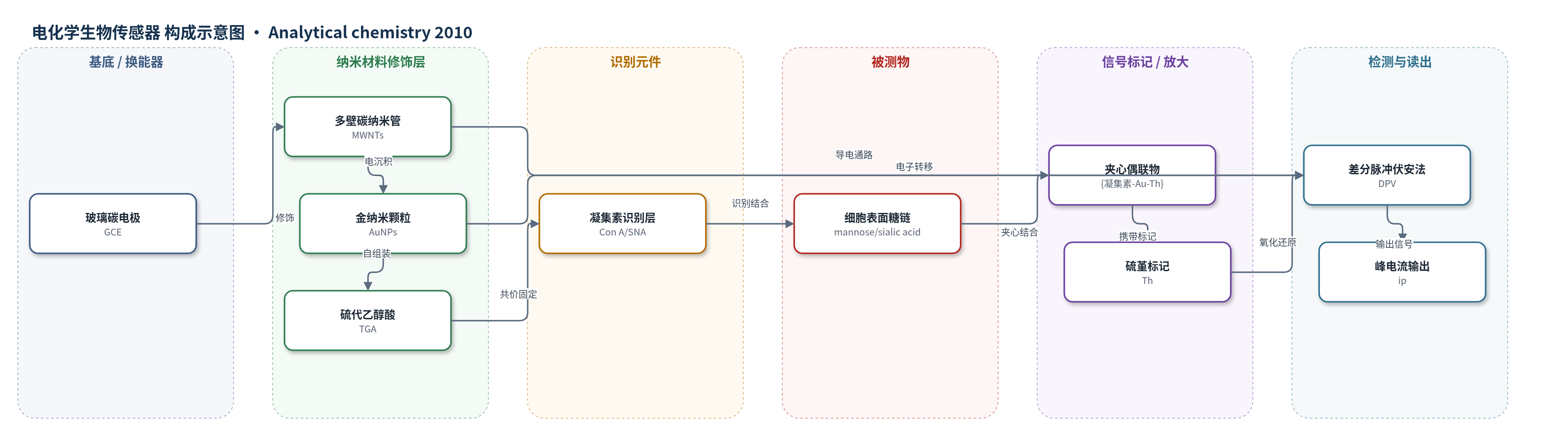
点击图片查看大图 · 依据论文自动绘制
传感器类型
电化学生物传感器
检测对象
甘露糖(mannose)、唾液酸(sialic acid);样品基质:活细胞悬液(人肺、肝、前列腺来源正常细胞与癌细胞)
检测原理
传感器表面固定Con A或SNA,分别特异性结合细胞表面甘露糖或唾液酸,将活细胞捕获于电极表面形成第一识别层。随后加入{凝集素-Au-Th}生物偶联物,其凝集素再与细胞表面糖链结合,形成夹心结构。AuNPs负载大量电活性硫堇(Th),通过纳米颗粒质量负载实现信号放大。DPV在0至-0.70 V(vs SCE)检测结合态Th的氧化还原峰电流。细胞浓度或表面糖链表达量越高,捕获细胞及结合偶联物越多,Th量越大,峰电流越大。AuNP/MWNT复合膜提供导电网络与电催化,降低电子转移阻力,提高灵敏度。
检测灵敏度
LOD: A549 7.0 × 10^3 cells/mL;H1299 8.0 × 10^4 cells/mL;95-D 7.0 × 10^4 cells/mL;QGY-7701 1.1 × 10^5 cells/mL;QGY-7703 5.0 cells/mL;LNCaP 5.0 × 10^4 cells/mL;线性范围: A549 3.0 × 10^4–3.0 × 10^7 cells/mL;H1299 3.0 × 10^5–3.0 × 10^8 cells/mL;95-D 2.5 × 10^5–2.5 × 10^8 cells/mL;QGY-7701 3.6 × 10^5–3.6 × 10^8 cells/mL;QGY-7703 10–1.0 × 10^6 cells/mL;LNCaP 2.0 × 10^5–5.0 × 10^8 cells/mL;R: A549 0.993;H1299 0.991;95-D 0.994;QGY-7701 0.993;QGY-7703 0.992;LNCaP 0.995;斜率: A549 1.43;H1299 1.38;95-D 1.42;QGY-7701 1.45;QGY-7703 0.86;LNCaP 1.24;唾液酸标准 0.19 µA/µM;A549细胞 1.30 × 10^-6 µA/(cells/mL);回归方程: A549 ip (µA) = 1.43 lg cA549 - 2.40;H1299 ip (µA) = 1.38 lg cH1299 - 3.36;95-D ip (µA) = 1.42 lg c95-D - 3.57;QGY-7701 ip (µA) = 1.45 lg cQGY-7701 - 3.91;QGY-7703 ip (µA) = 0.86 lg cQGY-7703 + 3.42;LNCaP ip (µA) = 1.24 lg cLNCaP - 2.35;唾液酸标准 ip (µA) = 0.19csialic acid (µM) + 4.99;A549细胞 ip′ (µA) = 1.30 × 10^-6cA549 + 5.04
效应效果
该传感器利用Con A和SNA特异性识别甘露糖和唾液酸,阻断实验验证{凝集素-Au-Th}偶联物对细胞表面糖链的特异性。AuNP/MWNT复合膜相比AuNP/GCE和MWNT/GCE给出更高DPV峰电流,增强灵敏度。结果表明甘露糖在正常与癌细胞中均高表达,唾液酸在癌细胞中显著高于正常细胞,与荧光显微镜一致。SNA基传感器可定量癌细胞,QGY-7703的LOD低至5.0 cells/mL,线性范围10–1.0×10^6 cells/mL;单细胞唾液酸量如A549 4.5×10^9、LNCaP 6.4×10^8 molecules。原文未报告RSD、回收率与长期稳定性数据。作者认为可用于活细胞糖链分析、癌症早期诊断和治疗监测。
传感器的构成
- 基底/换能器电极:玻璃碳电极(GCE,Φ=3 mm),经抛光和清洗,作为电化学换能器。
- 纳米材料修饰层:多壁碳纳米管(MWNTs,直径约10–30 nm)滴涂于GCE,提供导电网络与高比表面。
- 纳米材料修饰层:金纳米颗粒(AuNPs,平均直径约18 nm)通过多电位阶跃电沉积于MWNT/GCE,增强电催化与电子转移。
- 界面连接层:硫代乙醇酸(TGA,25 mM)通过Au–S键自组装于AuNP/MWNT/GCE,提供羧基用于共价固定。
- 活化层:EDC/NHS(400 mM EDC/100 mM NHS)活化TGA羧基,形成活性酯以偶联凝集素。
- 识别元件:刀豆蛋白A(Con A,1.0 mg/mL)或黑接骨木凝集素(SNA,1.0 mg/mL)共价固定于电极,分别特异性识别甘露糖和唾液酸。
- 封闭剂:1.0% BSA/PBS封闭非特异性结合位点。
- 信号标记/放大元件:{凝集素-Au-Th}生物偶联物,由Th包覆AuNPs再结合Con A或SNA构成,Th为电活性标记,AuNPs负载Th实现信号放大。
中文摘要
本文报道一种新型凝集素基电化学生物传感器,用于通过比较人肺、肝、前列腺来源正常细胞与癌细胞表面甘露糖和唾液酸表达,检测癌症相关糖基化。采用夹心格式,将凝集素生物传感器与{凝集素-Au-Th}生物偶联物结合,其中凝集素和硫堇(Th)标记连接至金纳米颗粒(AuNPs)用于信号放大,实现高灵敏度和选择性。结果表明甘露糖在正常和癌细胞中均高表达,而唾液酸在癌细胞中较正常细胞更丰富;结果与荧光显微镜研究一致。两种糖表达差异表明唾液酸可作为早期癌症检测潜在生物标志物。该凝集素生物传感器还可定量癌细胞并评估单细胞表面平均唾液酸量,为糖链在癌症进展中的功能提供重要信息。总体而言,该凝集素基电化学生物传感器为分析活细胞表面糖链表达提供有效途径,有望促进癌症早期诊断和治疗。
英文摘要
In this article, we report a novel lectin-based biosensor for electrochemical assay of cancer-associated glycosylation by comparative study of mannose and sialic acid expression on normal and cancer cells derived from human lung, liver, and prostate. Using a sandwich format, high sensitivity and selectivity were achieved by combining the lectin-based biosensor with the {lectin-Au-Th} bioconjugates featuring lectin and thionine (Th) labels linked to gold nanoparticles (AuNPs) for signal amplification. The proposed strategy demonstrated that mannose exhibited high expression levels in both normal and cancer cells, while sialic acid was more abundant in cancer cells as compared to normal ones. The results were in good agreement with those from fluorescent microscopy studies. The differences in the two glycan expression indicated that sialic acid could serve as a potential biomarker for early cancer detection. The lectin-based biosensor was also successfully used to quantify cancer cells and evaluate the average amount of sialic acid on single cell surface, which could supply significant information on glycan functions in cancer progression. Overall, the lectin-based electrochemical biosensor provides an effective pathway to analyze glycan expression on living cells and may greatly facilitate the medical diagnosis and treatment in early process of cancer.