组成图示
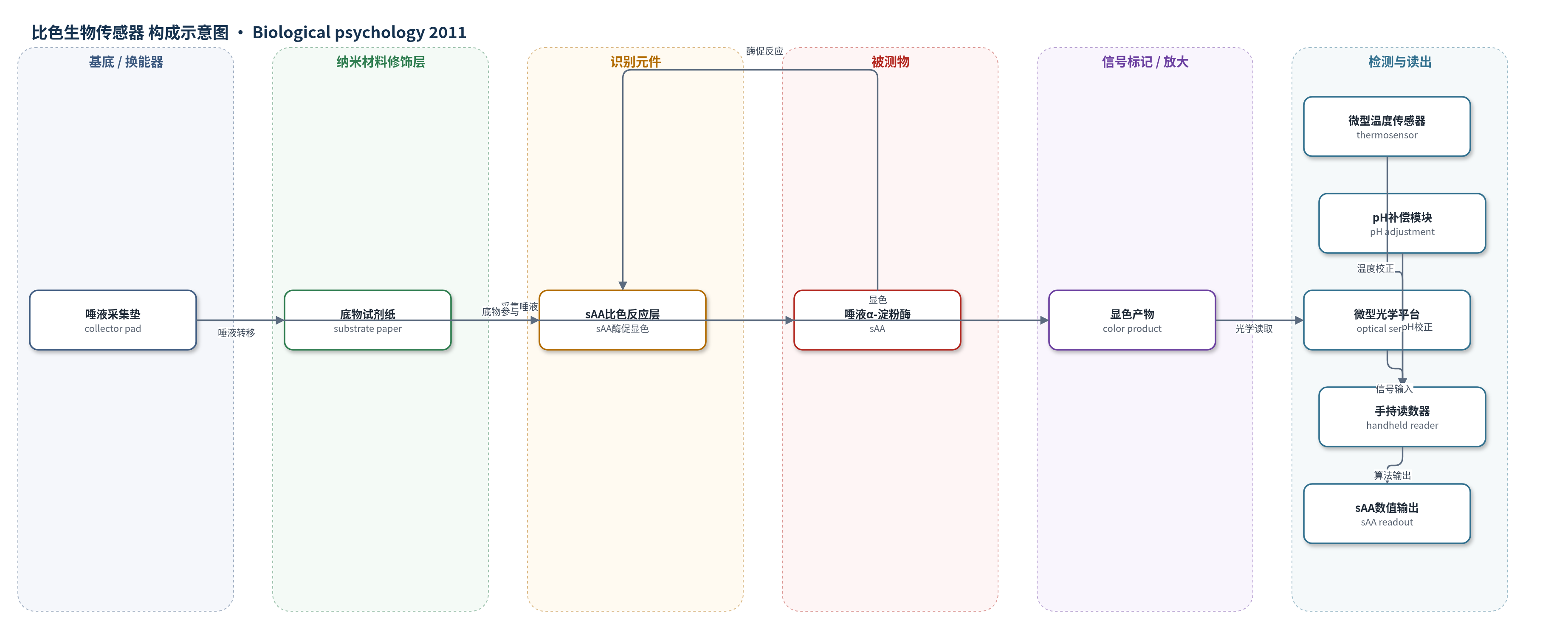
点击图片查看大图 · 依据论文自动绘制
传感器类型
比色生物传感器
检测对象
唾液α-淀粉酶(salivary alpha amylase, sAA);样品基质:未刺激全唾液(whole saliva)
检测原理
便携式sAA生物传感器由一次性比色试纸条和手持光学读数器组成。使用时,试纸采集垫置于舌下约15 s,收集约23 μl未刺激唾液;唾液中的α-淀粉酶(sAA)与底物浸渍试剂纸接触后发生酶促反应,生成显色产物。sAA活性越高,显色程度越强,颜色变化随sAA浓度/活性单调变化。微型光学平台检测试纸颜色,内置标准曲线和算法将光信号转换为sAA水平;微型温度传感器和pH补偿算法分别校正环境温度与唾液pH波动,从而提高读数稳定性。整个过程约15 s完成,无需离心或送检。
检测灵敏度
—
效应效果
本研究在54名健康男性牙科学生中完成292次sAA生物传感器测量,依从率91.3%,未因唾液量不足丢失读数。试纸仅需20–30 μl唾液,采集约10 s,读数约15 s,短于传统方法1–2 min;先前验证显示与传统实验室蛋白定量方法可比。考试期主观痛苦显著高于基线期(p<.0001),但sAA无显著会话差异(p=.99);考试日sAA随时间升高(p=.03),5 PM高于10 AM(p=.007)。sAA与同步主观痛苦相关,个体均值r=.36(p=.009);基线期r=.40(p=.0052),考试期r=.22(p=.12)。作者认为其适合现场压力暴露即时检测。
传感器的构成
- 采集垫:升级collector pad,饱和时收集约23 μl唾液,减少唾液流速影响
- 底物试剂纸:substrate-impregnated reagent paper,含底物/试剂,扩展动态范围并改善线性
- sAA比色反应层:唾液α-淀粉酶催化底物显色的反应层,实现sAA识别与信号生成
- 温度补偿元件:微型thermosensor,归一化环境温度变化
- pH补偿模块:pH adjustment,归一化唾液pH变化
- 光学换能器:miniaturized optical platform/new optical sensor,读取试纸颜色变化
- 手持读数器:handheld reader,内置标准曲线算法、日期时间戳和USB接口,输出sAA水平
中文摘要
近期生物传感器技术的发展使唾液α-淀粉酶(sAA)的即时检测成为可能,其精度和准确度已接近传统实验室检测。本研究在54名健康男性牙科学生中部署便携式原型sAA生物传感器,分别在低压力基线期和期末考试期进行测量。基线期参与者完成简明症状量表(BSI);基线期和考试周均在上午10点、下午1点和下午5点采集唾液,并同步评价主观痛苦程度。结果显示,考试期主观痛苦显著高于基线期,但sAA水平在基线期与考试期之间无显著差异。较高的sAA水平与较高的同步主观痛苦相关;BSI中抑郁和社会孤立症状评分较高者,在考试期表现出较低的sAA水平。结合先前验证数据,sAA生物传感器有望成为评估压力暴露的即时检测工具。
英文摘要
Recent developments in biosensor technology allow point-of-use reporting of salivary alpha amylase (sAA) levels while approaching the precision and accuracy of conventional laboratory-based testing. We deployed a portable prototype sAA biosensor in 54 healthy, male dental students during a low stress baseline and during final exams. At baseline, participants completed the Brief Symptom Inventory (BSI). At baseline and the exam week, participants provided saliva samples at 10 AM, 1 PM, and 5 PM, and rated concurrent subjective distress. Although subjective distress was higher during exams compared to baseline, sAA levels did not differ between baseline and exams. Higher sAA levels were related to higher concurrent subjective distress, and higher depressive and social isolation symptoms on the BSI were related to lower sAA during exams. Results from this study, in combination with previous validation data, suggest that the sAA biosensor is a promising tool for point-of-use measures of exposure to stress.