组成图示
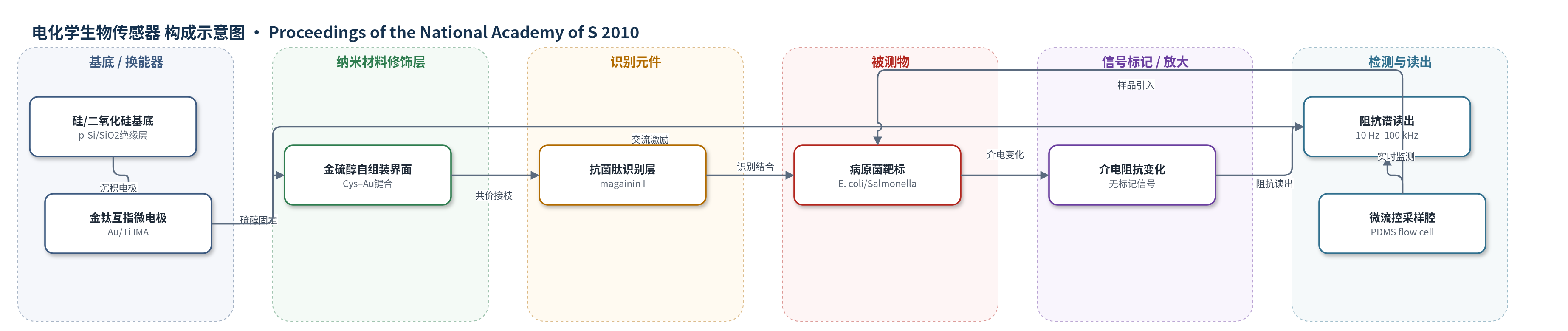
点击图片查看大图 · 依据论文自动绘制
传感器类型
电化学生物传感器
检测对象
致病大肠杆菌 O157:H7(Escherichia coli O157:H7)、鼠伤寒沙门氏菌(Salmonella typhimurium)、单核细胞增生李斯特菌(Listeria monocytogenes)、非致病大肠杆菌 ATCC 35218(Escherichia coli ATCC 35218);样品基质为 PBS 缓冲液中的热灭活菌悬液,微流控模拟水采样(未测真实水样)。
检测原理
传感器以 C 端半胱氨酸修饰的 magainin I 作为识别元件,通过 Au–S 键定向固定于金互指微电极表面,使肽的 N 端正电荷与疏水面向外。当病原菌流经或孵育于电极时,阳离子 AMP 与细菌膜负电荷磷脂、脂多糖(LPS)发生静电吸引,并伴随疏水相互作用;革兰氏阴性菌外膜 LPS 及致病大肠杆菌 O 抗原可增强结合。细菌结合后,菌体膜与界面水分子改变电极表面介电性质,使微电容阻抗升高,尤其在 10 Hz 低频下阻抗变化与结合菌数近似成正比,并随菌浓度呈对数增加。系统以 10 Hz–100 kHz 阻抗谱读出,无需荧光标记或酶放大。
检测灵敏度
LOD: 10^3 cfu/mL(1 bacterium/μL);原文报告检测浓度范围为 10^3–10^7 cfu/mL,阻抗变化随菌浓度呈对数增加。
效应效果
选择性方面,magainin I 对革兰氏阴性致病大肠杆菌和沙门氏菌的响应显著高于革兰氏阳性李斯特菌,10 Hz 阻抗差异约 2 个数量级;致病与非致病大肠杆菌间也有近 2 个数量级差异。10^7 cfu/mL 大肠杆菌与李斯特菌混合样中主要响应大肠杆菌,空白芯片响应可忽略。实时流动检测中,各浓度 5 min 内出现可测响应,最高浓度 30 s 内响应,约 20 min 饱和;流动响应低于静态孵育。实验重复 3 次,文献报道金表面 magainin 活性可保持至少 6 个月。作者认为该平台可替代传统抗体免疫分析,用于水质监测和便携病原体检测。
传感器的构成
- 基底/绝缘层:4英寸 p型 Si 晶圆(10–16 Ω·cm,550 μm)及 PECVD 沉积 1 μm SiO2,提供机械支撑与电绝缘。
- 换能电极层:电子束蒸发 10 nm Ti/300 nm Au 互指微电容电极阵列(IMA,50对,宽/间距 5 μm),用于阻抗/电容信号换能。
- 识别元件层:C端半胱氨酸修饰抗菌肽 magainin I(AMP)通过 Au–S 键共价固定于 Au 表面,识别并结合细菌。
- 样品接触/微流控层:PDMS 微流控流道与检测微腔,键合于 IMA 芯片,实现样品注入、孵育与实时流动检测。
- 清洗/再生介质:PBS 缓冲液用于孵育与洗涤;1 M NaCl/100 mM HCl/200 mM CHAPS 清洗液用于传感器再生。
中文摘要
本文报道了一种基于抗菌肽功能化微电容电极阵列的无标记电学生物传感器,用于病原菌检测。作者将天然存在于非洲爪蟾皮肤中的半选择性抗菌肽 magainin I 通过 C 端半胱氨酸残基共价固定于金微电极表面,利用阻抗谱监测细菌结合引起的介电性质变化。对致病大肠杆菌 O157:H7 的检测限约为 1 菌/μL(10^3 cfu/mL),达到临床相关水平。该器件还表现出革兰氏阴性菌选择性、致病与非致病大肠杆菌菌株区分能力,并保留对沙门氏菌的识别。进一步将 PDMS 微流控流道集成到传感器芯片上,实现模拟水采样条件下的实时片上监测。该平台有望用于水质监测、药品污染检测和便携病原体预警。
英文摘要
The development of a robust and portable biosensor for the detection of pathogenic bacteria could impact areas ranging from water-quality monitoring to testing of pharmaceutical products for bacterial contamination. Of particular interest are detectors that combine the natural specificity of biological recognition with sensitive, label-free sensors providing electronic readout. Evolution has tailored antimicrobial peptides to exhibit broad-spectrum activity against pathogenic bacteria, while retaining a high degree of robustness. Here, we report selective and sensitive detection of infectious agents via electronic detection based on antimicrobial peptide-functionalized microcapacitive electrode arrays. The semiselective antimicrobial peptide magainin I--which occurs naturally on the skin of African clawed frogs--was immobilized on gold microelectrodes via a C-terminal cysteine residue. Significantly, exposing the sensor to various concentrations of pathogenic Escherichia coli revealed detection limits of approximately 1 bacterium/μL, a clinically useful detection range. The peptide-microcapacitive hybrid device was further able to demonstrate both Gram-selective detection as well as interbacterial strain differentiation, while maintaining recognition capabilities toward pathogenic strains of E. coli and Salmonella. Finally, we report a simulated "water-sampling" chip, consisting of a microfluidic flow cell integrated onto the hybrid sensor, which demonstrates real-time on-chip monitoring of the interaction of E. coli cells with the antimicrobial peptides. The combination of robust, evolutionarily tailored peptides with electronic read-out monitoring electrodes may open exciting avenues in both fundamental studies of the interactions of bacteria with antimicrobial peptides, as well as the practical use of these devices as portable pathogen detectors.