组成图示
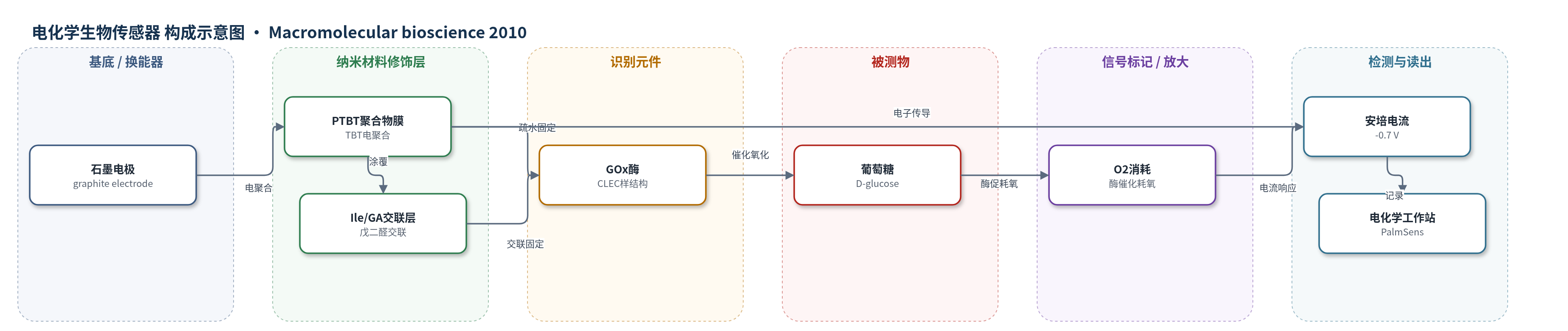
点击图片查看大图 · 依据论文自动绘制
传感器类型
电化学生物传感器
检测对象
葡萄糖(glucose, D-glucose);样品基质:缓冲液、酵母发酵液(Schatzman medium/fermentation broth)
检测原理
该传感器以GOx为识别催化元件,PTBT导电聚合物膜为固定基质。葡萄糖进入酶层后,GOx催化β-D-葡萄糖与O2反应生成葡萄糖酸内酯和H2O2,同时消耗溶解氧。电极在-0.7 V下对氧的消耗/还原产生安培电流,电流响应随葡萄糖浓度升高而线性变化。高离子强度磷酸盐缓冲液与Ile使GOx在疏水PTBT表面形成CLEC样聚集体,戊二醛交联进一步稳定酶构象,透析膜提供选择性屏障。系统遵循Michaelis-Menten动力学,无需额外化学放大,主要依靠酶催化与导电聚合物界面实现信号转换。
检测灵敏度
LOD: 0.029 × 10^-3 M;线性范围: 0.05–2.5 × 10^-3 M;灵敏度: 0.011 mA × 10^-3 M^-1;R^2 = 0.9972(0.1–2.5 × 10^-3 M);Km: 4.6 × 10^-3 M;Imax: 2.49 mA;响应时间: 52 s
效应效果
传感器在-0.7 V下对葡萄糖具有良好选择性,抗坏血酸、胆固醇、尿素(0.01–10 ×10^-3 M)及Schatzman培养基(10–1000 μL)均无明显干扰。对1 mM葡萄糖连续测量10次,RSD为4.2%;运行稳定性8 h内无活性损失,4 ℃储存15 d无活性下降。无PTBT膜时响应更低且RSD达27%,说明聚合物基质提高性能。实际酵母发酵液中葡萄糖监测结果与HPLC参考方法高度一致,作者认为该传感器可用于酵母培养发酵过程的葡萄糖生物监测。
传感器的构成
- 基底/换能器电极:石墨电极(graphite electrode, RW001),作为工作电极承载聚合物膜并传导电子。
- 导电聚合物修饰层:PTBT(poly(2-dodecyl-4,7-di(thiophen-2-yl)-2H-benzo[d][1,2,3]triazole)),由TBT单体在0.1 M ACN/TBAPF6中电聚合形成,提供疏水烷基链与导电固定基质。
- 疏水辅助固定层:异亮氨酸(Ile,1 mg)与250 mM磷酸盐缓冲液(pH 7.0),增强GOx在疏水PTBT表面的分散与疏水相互作用。
- 识别/催化元件:葡萄糖氧化酶(GOx,Aspergillus niger,EC 1.1.3.4),催化葡萄糖氧化并消耗O2。
- 交联固定剂:戊二醛(GA,0.1%),交联GOx氨基形成CLEC样结构并固定酶。
- 选择性膜:透析膜(cellulose membrane, 25 mm × 16 mm),覆盖酶层,起perm-selective膜作用。
- 测量电极:Ag/AgCl参比电极与Pt对电极,用于三电极安培检测。
中文摘要
本文报道了一种新型导电聚合物聚(2-十二烷基-4,7-双(噻吩-2-基)-2H-苯并[d][1,2,3]三唑)(PTBT)作为生物分子固定化基质。在石墨电极上通过电位动态法将单体TBT电聚合为PTBT膜,随后将黑曲霉葡萄糖氧化酶(GOx)与异亮氨酸(Ile)在250 mM磷酸盐缓冲液(pH 7.0)中混合并涂覆于膜表面,再用0.1%戊二醛(GA)交联固定,最后覆盖透析膜。高离子强度与疏水氨基酸促进GOx在疏水聚合物表面形成交联酶晶体(CLEC)样结构。采用扫描电镜和荧光显微镜表征表面形貌。酶电极在-0.7 V下通过监测葡萄糖存在时的氧消耗产生安培响应。优化后的葡萄糖生物传感器在0.05–2.5 mM范围内线性良好,响应时间52 s,检出限0.029 mM。动力学参数Km和Imax分别为4.6 mM和2.49 mA,运行与储存稳定性良好,并用于酵母发酵液中葡萄糖监测,结果与HPLC一致。
英文摘要
A recently synthesized conducting polymer [poly(2-dodecyl-4,7-di(thiophen-2-yl)-2H-benzo[d][1,2,3]triazole (PTBT)] was tested as a platform for biomolecule immobilization. After electrochemical polymerization of the monomer (TBT) on graphite electrodes, immobilization of glucose oxidase (GOx,β-D-glucose: oxygen-1-oxidoreductase, EC 1.1.3.4) was carried out. To improve the interactions between the enzyme and hydrophobic alkyl chain on the polymeric structure, GOx and isoleucine (Ile) amino acid were mixed in sodium phosphate buffer (pH 7.0) with a high ionic strength (250 × 10(-3) M). The solution is then casted on the polymer film, and the amino groups in the protein structure were crosslinked using glutaraldehyde (GA) as the bifunctional agent. Finally, the surface was covered with a perm-selective membrane. Consequently, cross-linked enzyme crystal (CLEC) like assembles with regular shapes were observed after immobilization. Microscopic techniques such as scanning electron microscopy (SEM) and fluorescence microscopy were used to monitor the surface morphologies of both the polymer and the bioactive layer. Electrochemical responses of the enzyme electrodes were measured by monitoring O(2) consumption in the presence of glucose at -0.7 V. The optimized biosensor showed a very good linearity between 0.05 and 2.5 × 10(-3) M with a 52 s response time and a detection limit (LOD) of 0.029 × 10(-3) M to glucose. Also, kinetic parameters, operational and storage stabilities were determined. K(m) and I(max) values were found as 4.6 × 10(-3) M and 2.49 µA, respectively. It was also shown that no activity was lost during operational and storage conditions. Finally, proposed system was applied for glucose biomonitoring during fermentation in yeast culture where HPLC was used as the reference method to verify the data obtained by the proposed biosensor.