组成图示
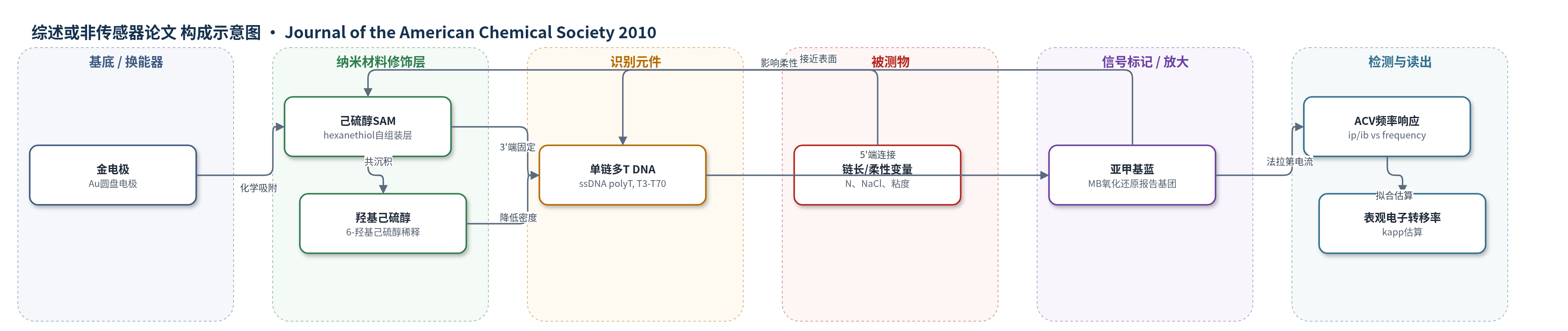
点击图片查看大图 · 依据论文自动绘制
传感器类型
综述或非传感器论文
检测对象
无明确分析物(机理研究);样品基质:10 mM磷酸盐缓冲液(pH 7,1 M NaCl),粘度实验含46% w/w葡萄糖
检测原理
体系由3'端固定于己硫醇自组装单分子层(SAM)的金电极上的单链多胸腺嘧啶DNA(ssDNA polyT)和5'端连接的亚甲基蓝(MB)组成。MB与电极间电子转移并非通过DNA链内跳跃,而需MB末端在链柔性驱动下接近SAM/电极表面形成“接近态”。若异相电子转移步骤k2限速,表观速率kapp≈K·k2,其中K为接近态平衡概率。K随链长近似按1/N下降,因此kapp随链长呈约-1次方标度;离子强度改变持续长度lp,使kapp∝(Nlp)^-1;溶剂粘度主要影响链动力学,对kapp影响弱。交流伏安法测量MB法拉第电流的ip/ib频率依赖,拟合电荷转移电阻和吸附伪电容,得到kapp。
检测灵敏度
无LOD/线性范围;相关系数: R^2 = 0.91;R = 0.95;链长幂律指数: -1.16 ± 0.09
效应效果
本文未报道实际样品检测或选择性/回收率。表观电子转移速率比单链DNA溶液重排和端端碰撞慢多个数量级;15T构象为(1.5±0.5)×10^2 s^-1,比同长度溶液端端碰撞慢约4个数量级。链长依赖指数为-1.16±0.09,接近高斯链理论-1和排除体积链估算-1.2。固定链长下速率与持续长度成反比,R^2=0.91;斜率与链长反比相关R=0.95。粘度提高8倍时速率仅降低约2倍,弱于扩散控制。30T探针在5倍密度范围内表观速率无显著变化。MB直接连接己硫醇SAM速率约1000 s^-1,与3T构象1670±110 s^-1相近,支持单分子层异相电子转移限速。
传感器的构成
- 基底/换能器电极:多晶金圆盘电极(Au),作为电子换能器与固定表面
- 自组装单分子层:己硫醇(hexanethiol)经3'端磷酸二酯连接化学吸附,形成间隔层并固定DNA
- 稀释/封闭层:6-羟基己硫醇(6-hydroxyhexanethiol)共沉积,降低寡核苷酸表面密度;6-巯基己醇(6-mercaptohexanol, MCH)浸泡封闭非特异性位点
- 识别/探针链:单链多胸腺嘧啶寡核苷酸(ssDNA polythymine, T3–T70),3'端固定、5'端连接氧化还原报告基团
- 信号标记物:亚甲基蓝(methylene blue, MB),共价连接于5'端,作为氧化还原报告基团
- 电解液:10 mM磷酸盐缓冲液(pH 7,1 M NaCl),粘度实验使用46% w/w葡萄糖
- 读出系统:CHI 630B电位计交流伏安法(ACV),通过ip/ib频率依赖估算表观电子转移速率kapp
中文摘要
电极固定、氧化还原报告基团修饰的寡核苷酸在多种电化学生物传感器中发挥作用,因此通过或来自此类分子的电子转移备受关注。本文实验表征了短单链多胸腺嘧啶DNA远端亚甲基蓝基团与单分子层修饰金电极之间电子转移速率,DNA另一端通过位点特异性方式固定于电极。结果显示,该速率随寡核苷酸链长呈 -1.16 ± 0.09 次方标度。这种弱近似反比链长依赖与单链DNA端端碰撞速率及寡核苷酸内电子跳跃所观察到的强依赖显著不同,而与反应受限过程预期一致:总速率正比于寡核苷酸链末端接近电极表面的平衡概率。离子强度和粘度依赖性研究进一步支持该“链柔性”机制;将亚甲基蓝直接连接至己硫醇单分子层的电子转移速率研究则提示,穿过单分子层的异相电子转移为限速步骤。因此,在本文条件下,寡核苷酸链的柔性(即平衡统计性质)决定了所连接氧化还原报告基团向底层电极转移电子的速率,这一发现可能有助于设计新型生物传感器架构。
英文摘要
Electrode-bound, redox-reporter-modified oligonucleotides play roles in the functioning of a number of electrochemical biosensors, and thus the question of electron transfer through or from such molecules has proven of significant interest. In response, we have experimentally characterized the rate with which electrons are transferred between a methylene blue moiety on the distal end of a short, single-stranded polythymine DNA to a monolayer-coated gold electrode to which the other end of the DNA is site-specifically attached. We find that this rate scales with oligonucleotide length to the -1.16 ± 0.09 power. This weak, approximately inverse length dependence differs dramatically from the much stronger dependencies observed for the rates of end-to-end collisions in single-stranded DNA and through-oligonucleotide electron hopping. It instead coincides with the expected length dependence of a reaction-limited process in which the overall rate is proportional to the equilibrium probability that the end of the oligonucleotide chain approaches the surface. Studies of the ionic strength and viscosity dependencies of electron transfer further support this "chain-flexibility" mechanism, and studies of the electron transfer rate of methylene blue attached to the hexanethiol monolayer suggest that heterogeneous electron transfer through the monolayer is rate limiting. Thus, under the circumstances we have employed, the flexibility (i.e., the equilibrium statistical properties) of the oligonucleotide chain defines the rate with which an attached redox reporter transfers electrons to an underlying electrode, an observation that may be of utility in the design of new biosensor architectures.