组成图示
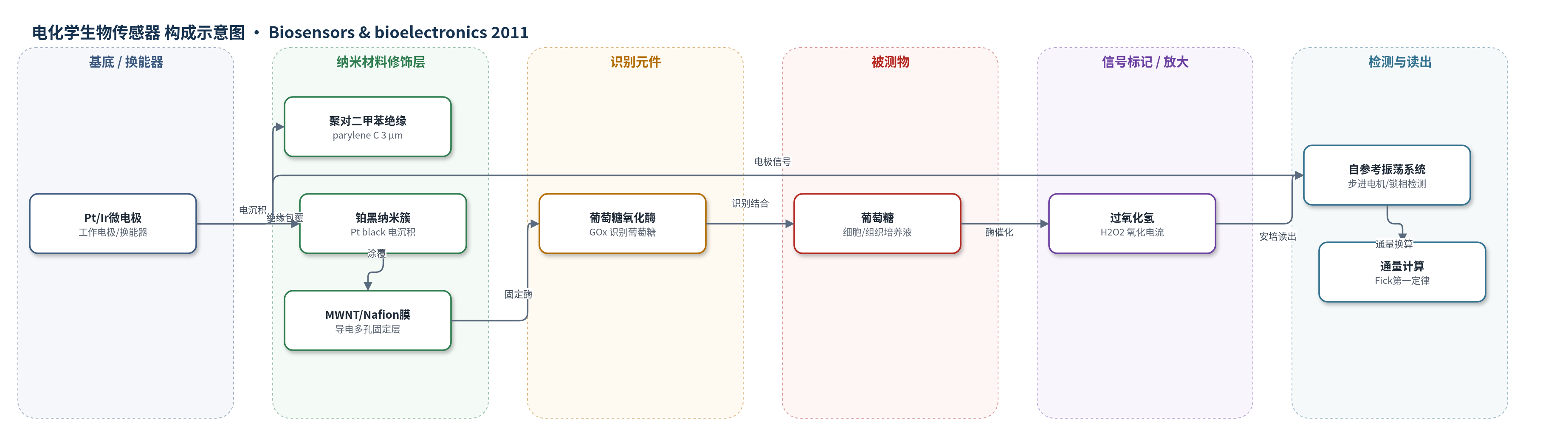
点击图片查看大图 · 依据论文自动绘制
传感器类型
电化学生物传感器
检测对象
葡萄糖(glucose, Glc);样品基质:细胞/组织培养液、PBS、培养基(DMEM/RPMI)、生物膜表面等。
检测原理
葡萄糖氧化酶(GOx)特异性催化葡萄糖氧化生成葡萄糖酸和过氧化氢(H2O2)。H2O2在+500 mV工作电位下于铂黑/多壁碳纳米管/Nafion修饰的Pt/Ir微电极表面发生氧化,产生与葡萄糖浓度成正比的安培电流。自参考模式下,计算机控制微传感器在细胞/组织表面附近的浓度边界层内以已知距离振荡,分别记录近极浓度C1和远极浓度C2。通过相位敏感检测、锁相/DC耦合和差分漂移算法滤除背景漂移与电磁噪声,再按Fick第一定律J=D(C1-C2)/ΔX计算跨膜/跨组织葡萄糖通量。当细胞摄取葡萄糖时,边界层浓度梯度改变,通量信号随摄取速率实时变化。
检测灵敏度
LOD: 10 μM;线性范围: 0.01–17.5 mM;R^2 = 0.99;灵敏度: 531 ± 149 pA mM−1;单位面积灵敏度: 15.0 ± 2.4 mA mM−1 cm−2;t95: 0.88 s
效应效果
GOx/Nafion提供选择性并降低干扰;4°C保存7天灵敏度变化11%,1天<1%。线性范围覆盖哺乳动物细胞培养基葡萄糖浓度(0.5–11.1 mM),单位面积灵敏度显著高于已报道微传感器。自参考相位敏感检测滤除nA–μA背景漂移/噪声,在pA–nA细胞表面信号下实现2–5 s时间分辨率。肿瘤性乳腺内皮细胞葡萄糖摄取229.0±3.8 pmol cm−2 s−1,高于非肿瘤细胞126.0±2.1 pmol cm−2 s−1(p<0.01);INS-1 β细胞K=3.1±1.3 mM,phloretin EC50=28±1.6 μM;铜绿假单胞菌生物膜通量525±81 pmol cm−2 s−1,AgNO3后185±24 min下降96±5%。
传感器的构成
- 基底/换能器电极:Pt/Ir 微电极(PI20033.0A10,尖端直径 1–2 μm,轴径 0.256 mm),作为电化学工作电极与安培信号换能器。
- 绝缘层:parylene C 涂层(约 3 μm)包覆金属轴,仅暴露尖端,降低背景电流并保护电极。
- 催化修饰层:电沉积 Pt black(铂黑纳米簇,0.72% H2PtCl6 与 0.001% Pb(OAc)2 中 10 V 沉积 1 min),增大有效表面积并催化 H2O2 氧化。
- 纳米复合固定层:MWNT/Nafion 膜(羧基化多壁碳纳米管 MWNT 与 Nafion 混合,2 mg MWNT/1 mL Nafion,超声后涂覆 2 μL),提供导电/多孔基质并固定酶、降低干扰。
- 识别元件:葡萄糖氧化酶 GOx(50 mg/mL PBS 浸渍 30 min),特异性催化葡萄糖氧化生成 H2O2。
- 信号标记物:H2O2(GOx 反应产物),在 +500 mV 下于 Pt black 表面氧化产生安培电流。
中文摘要
葡萄糖是多种生化途径的核心分子,已有多种微传感器用于测量细胞和/或组织内/附近葡萄糖浓度。生理研究中微传感器普遍面临信噪比低的问题,且细胞代谢活动会引起浓度漂移。自参考技术通过计算机控制步进电机使单个微传感器在细胞/组织附近稳定浓度边界层内振荡,可滤除杂散电噪声并直接定量主动膜转运,是一种非侵入性测量跨膜或跨组织分析物通量的方法。本文在铂/铱微电极上沉积铂黑、多壁碳纳米管和Nafion,并固定葡萄糖氧化酶,制备了高灵敏/选择性葡萄糖微生物传感器。该传感器用于自参考模式开展细胞/组织生理转运研究,并详细给出了通过相位敏感检测(含测量后分析技术)滤除信号漂移/噪声的分析方法。利用该技术,在癌症细胞生理、生物能量学、糖尿病和微生物生物膜生理等代谢与药理学研究中实现了生理葡萄糖摄取的实时测量。该稳健、通用的生物传感器技术可为生物医学、环境和农业研究中的生物转运提供重要见解。
英文摘要
Glucose is the central molecule in many biochemical pathways, and numerous approaches have been developed for fabricating micro biosensors designed to measure glucose concentration in/near cells and/or tissues. An inherent problem for microsensors used in physiological studies is a low signal-to-noise ratio, which is further complicated by concentration drift due to the metabolic activity of cells. A microsensor technique designed to filter extraneous electrical noise and provide direct quantification of active membrane transport is known as self-referencing. Self-referencing involves oscillation of a single microsensor via computer-controlled stepper motors within a stable gradient formed near cells/tissues (i.e., within the concentration boundary layer). The non-invasive technique provides direct measurement of trans-membrane (or trans-tissue) analyte flux. A glucose micro biosensor was fabricated using deposition of nanomaterials (platinum black, multiwalled carbon nanotubes, Nafion) and glucose oxidase on a platinum/iridium microelectrode. The highly sensitive/selective biosensor was used in the self-referencing modality for cell/tissue physiological transport studies. Detailed analysis of signal drift/noise filtering via phase sensitive detection (including a post-measurement analytical technique) are provided. Using this highly sensitive technique, physiological glucose uptake is demonstrated in a wide range of metabolic and pharmacological studies. Use of this technique is demonstrated for cancer cell physiology, bioenergetics, diabetes, and microbial biofilm physiology. This robust and versatile biosensor technique will provide much insight into biological transport in biomedical, environmental, and agricultural research applications.