组成图示
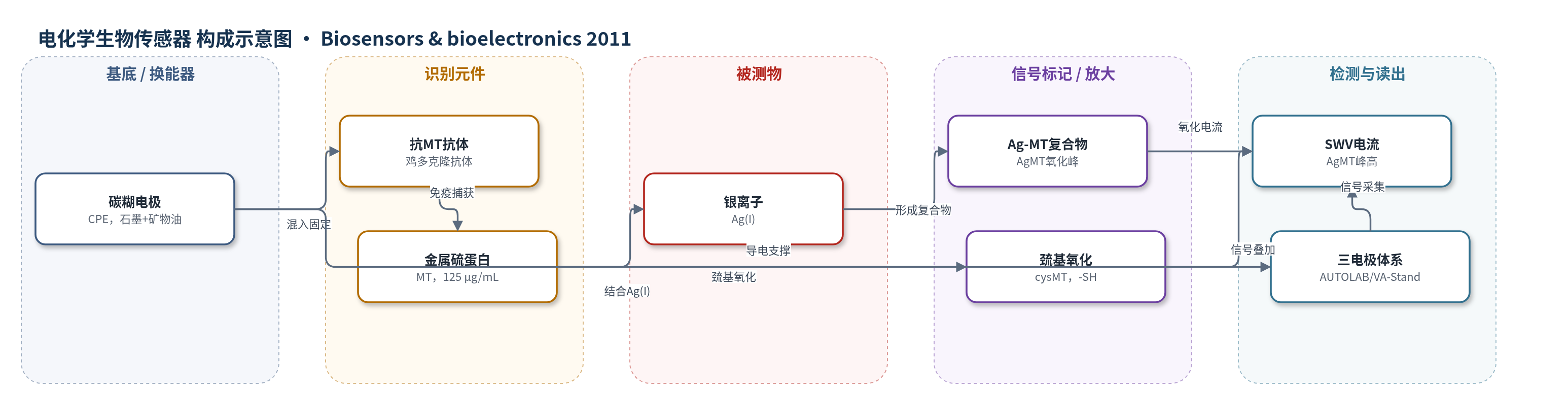
点击图片查看大图 · 依据论文自动绘制
传感器类型
电化学生物传感器
检测对象
银(I)离子(Ag(I) ions / Ag+);样品基质:水样(Milli Q水、蒸馏水、自来水、雨水、Ponávka河水)
检测原理
鸡抗MT抗体混入碳糊电极,特异性捕获MT。MT富含半胱氨酸,可与Ag(I)配位结合,形成Ag-MT复合物并改变电极界面氧化还原行为。方波伏安扫描时,Ag-MT复合物在约0.6 V产生氧化峰AgMT,Ag(I)与MT非共价结合信号MT(Ag)在约0.25 V出现;AgMT峰电流随Ag(I)浓度升高而增大,低浓度区线性,高浓度区因MT结合位点饱和而增长变缓。该体系无酶促放大,主要依靠抗体免疫捕获提高MT负载,使LOD降至0.5 nM。
检测灵敏度
LOD: 0.5 nM;定量限: 1.7 nM;线性范围: 10 nM–15 µM(I(pA)=0.7340(cAg)−6.336,R^2=0.9590);15.6 µM–500 µM(I(nA)=20.35 ln(cAg)−22.05,R^2=0.9720)
效应效果
抗体混入CPE后4 ℃保存2周峰高变化<5%,传感器保存期约10 d。重现性:同传感器日间RSD 2.5%(n=5),日内5.8%(n=5),一个月内<10%;不同批次MT RSD<10%;新制传感器日间RSD 7.5%(n=5)。水样加标回收率:Milli Q和蒸馏水101%–104%,自来水74%,Ponávka河水92%,雨水93%;复杂基质CV 7.1%–14%。10或100 µM Cu(II)、Pt(II)、Cd(II)、Zn(II)、Fe(II)、Ni(II)干扰较小,Hg(II)可致AgMT信号下降>15%。与HMDE法(LOD 500 nM)相比,LOD降低约1000倍,碳糊电极易微型化,适合环境水样痕量银监测。
传感器的构成
- 基底/换能器电极:碳糊电极(CPE,70%石墨粉+30%矿物油,Teflon管封装,2.5 mm),导电基底并输出伏安信号
- 识别/固定元件:鸡多克隆抗MT抗体(anti-MT antibody,PBS 1:500稀释,100 µL混入500 mg碳糊),特异性捕获MT
- 生物结合元件:金属硫蛋白(MT,125 µg/mL,作用300 s),结合Ag(I)并提供半胱氨酸-SH及Ag-MT氧化信号
- 信号产生层:Ag-MT复合物(Ag(I)与MT结合后形成),产生AgMT氧化信号
- 支持电解质:硼酸盐缓冲液(0.2 M,pH 9.6),维持电化学环境
- 信号读出:方波伏安(SWV,AUTOLAB/VA-Stand 663,三电极体系),读取AgMT峰电流
中文摘要
本文报道一种基于金属硫蛋白(MT)经抗MT抗体固定于碳糊电极(CPE)表面的重金属生物传感器,用于银(I)离子检测。首先评估MT在CPE上的电化学活性,发现其半胱氨酸-SH基团在约0.6 V产生氧化峰(cysMT)。将鸡多克隆抗MT抗体混入碳糊电极后,抗体稳定,两周信号变化<5%。通过方波伏安法研究MT与抗体结合,观察到cysMT峰和抗体色氨酸残基氧化峰Wa(约1.4 V)。优化MT浓度125 µg/mL、作用时间300 s后,构建Ag(I)生物传感器。Ag(I)与MT结合后在约0.6 V产生AgMT氧化信号,随Ag(I)浓度增加而增强。检出限(3 S/N)为0.5 nM。在蒸馏水、自来水、雨水等水样加标检测中,回收率为74%–104%。该传感器结构简单、可微型化,适用于环境水样中痕量银的检测。
英文摘要
In this paper, heavy metal biosensor based on immobilization of metallothionein (MT) to the surface of carbon paste electrode (CPE) via anti-MT-antibodies is reported. First, the evaluation of MT electroactivity was done. The attention was focused on the capturing of MT to the CPE surface. Antibodies incorporated and mixed into carbon paste were stable; even after two weeks the observed changes in signal height were lower than 5%. Further, the interaction of MT with polyclonal chicken antibodies incorporated in carbon paste electrode was determined by square-wave voltammetry. In the voltammogram, two signals--labelled as cys(MT) and W(a)--were observed. The cys(MT) corresponded to -SH moieties of MT and W(a) corresponded to tryptophan residues of chicken antibodies. Time of interaction (300 s) and MT concentration (125 μg/ml) were optimized to suggest a silver(I) ions biosensor. Biosensor (CPE modified with anti-MT antibody) prepared under the optimized conditions was then used for silver(I) ions detection. The detection limit (3 S/N) for silver(I) ions was estimated as 0.5 nM. The proposed biosensor was tested by detection spiking of silver(I) ions in various water samples (from very pure distilled water to rainwater). Recoveries varied from 74 to 104%.