组成图示
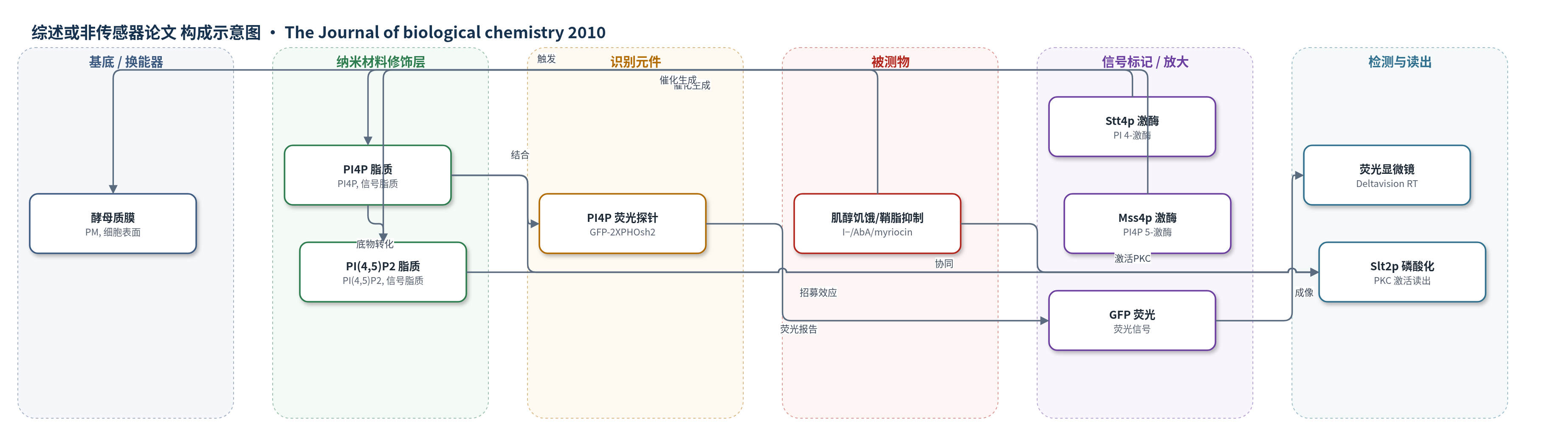
点击图片查看大图 · 依据论文自动绘制
传感器类型
综述或非传感器论文
检测对象
磷脂酰肌醇-4-磷酸(PI4P)、磷脂酰肌醇-4,5-二磷酸(PI(4,5)P2);样品基质:酿酒酵母细胞质膜/细胞内
检测原理
该研究使用荧光脂质相关报告蛋白(FLARE)监测酵母细胞内 PI4P 的亚细胞分布。GFP-2XPHOsh2 中的串联 Osh2p PH 结构域识别并结合 PI4P;当肌醇饥饿或 AbA/myriocin 抑制含肌醇鞘脂合成时,质膜上 Stt4p 依赖的 PI4P 池可及性增加,探针由主要位于高尔基体转向质膜富集,GFP 荧光在质膜增强。PI(4,5)P2 探针 GFP-2XPHPLCγ1 作为对照,其质膜分布基本不变。Stt4p 将 PI 磷酸化为 PI4P,Mss4p 进一步生成 PI(4,5)P2;这些脂质招募/激活 Rom2p 等效应蛋白,最终引起 Slt2p 磷酸化。荧光显微镜读出 PI4P 探针的质膜富集,作为 PKC 激活的标记。
检测灵敏度
原文未报告 LOD、线性范围、灵敏度斜率或相关系数。
效应效果
探针在四个不同遗传背景的野生型酵母中均能在肌醇饥饿后约 60 min 出现质膜 PI4P 富集,120 min 增强;加回肌醇后 10–15 min 减弱。stt4ts 在限制温度下完全缺失质膜 PI4P,而 pik1ts 与野生型相似,说明信号依赖 Stt4p 而非 Pik1p。44 个突变体中,仅 stt4ts 和 mss4ts 完全缺失该信号,且二者呈肌醇营养缺陷型但 INO1 正常去抑制。AbA 或 myriocin 处理使 >90% 细胞出现质膜 PI4P 并诱导 Slt2p 磷酸化;外源 DHS/PHS 不能诱导 PKC 激活。作者主张该 PI4P 荧光探针可作为 PKC 激活和含肌醇鞘脂代谢扰动的细胞内标记。
传感器的构成
- 荧光报告蛋白:GFP 或 mCherry,提供可成像荧光信号
- 识别元件:酵母 Osh2p 串联 PH 结构域(2XPHOsh2),特异性结合 PI4P
- 识别元件:哺乳动物 PLCγ1 串联 PH 结构域(2XPHPLCγ1),结合 PI(4,5)P2
- 质膜靶向/磷酸酶对照:GFP-Sac1ΔC-2XPHPLCγ1,含 Sac1p 磷酸酶域与 PLCγ1 PH 域,用于靶向质膜并降低 PI4P/PI(4,5)P2
- 表达载体:2μ 质粒 pRS426、pRS416、pRS425,由 PRC1 启动子驱动探针表达
- 样品基质:酿酒酵母细胞,主要监测质膜与高尔基体区室
中文摘要
蛋白激酶C(PKC)-MAPK 信号级联在酿酒酵母缺乏磷脂前体肌醇时被激活,并对细胞存活至关重要。本研究报道,通过肌醇饥饿或使用阻断鞘脂合成的试剂抑制含肌醇鞘脂代谢,可在不依赖鞘碱(DHS 和 PHS)积累的情况下触发 PKC 信号。在相同生长条件下,用于检测 PKC 信号必需中间产物磷脂酰肌醇-4-磷酸(PI4P)的荧光生物传感器在质膜上富集。PI4P 探针出现在质膜上与 PKC 激活相关,并依赖 PI 4-激酶 Stt4p。与 PKC-MAPK 通路其他突变体类似,Stt4p 和 PI4P 5-激酶 Mss4p 缺陷突变体表现出肌醇营养缺陷型,但 INO1 仍完全去抑制。这些结果提示,含肌醇鞘脂代谢通过调控信号脂质 PI4P 和磷脂酰肌醇-4,5-二磷酸(PI(4,5)P2)与质膜效应蛋白的可及性,从而控制 PKC 信号。
英文摘要
The protein kinase C (PKC)-MAPK signaling cascade is activated and is essential for viability when cells are starved for the phospholipid precursor inositol. In this study, we report that inhibiting inositol-containing sphingolipid metabolism, either by inositol starvation or treatment with agents that block sphingolipid synthesis, triggers PKC signaling independent of sphingoid base accumulation. Under these same growth conditions, a fluorescent biosensor that detects the necessary PKC signaling intermediate, phosphatidylinositol (PI)-4-phosphate (PI4P), is enriched on the plasma membrane. The appearance of the PI4P biosensor on the plasma membrane correlates with PKC activation and requires the PI 4-kinase Stt4p. Like other mutations in the PKC-MAPK pathway, mutants defective in Stt4p and the PI4P 5-kinase Mss4p, which generates phosphatidylinositol 4,5-bisphosphate, exhibit inositol auxotrophy, yet fully derepress INO1, encoding inositol-3-phosphate synthase. These observations suggest that inositol-containing sphingolipid metabolism controls PKC signaling by regulating access of the signaling lipids PI4P and phosphatidylinositol 4,5-bisphosphate to effector proteins on the plasma membrane.