组成图示
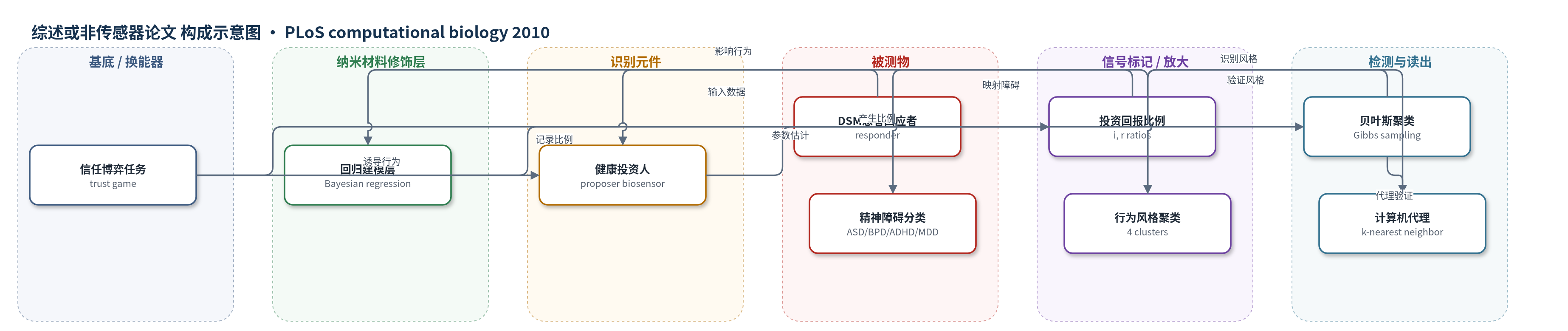
点击图片查看大图 · 依据论文自动绘制
传感器类型
综述或非传感器论文
检测对象
自闭症谱系障碍(ASD)、边缘型人格障碍(BPD)、注意缺陷多动障碍(ADHD)、重性抑郁障碍(MDD);样品基质:多轮信任博弈中健康投资人的行为数据
检测原理
该‘生物传感器’并非实体器件,而是以健康投资人在多轮信任博弈中的行为动态作为传感信号。DSM-IV患者作为回应者/受托人,其异常社会交换行为会改变健康投资人的投资比例i与回报比例r;投资人的社会敏感性、工作记忆和对手建模能力构成识别元件。系统以历史i、r序列为输入,用贝叶斯回归估计当前投资对过去两轮投资与回报的线性依赖,并通过Gibbs采样得到行为类型聚类概率。不同精神障碍使投资人行为风格在相应聚类中过度代表,严重程度与聚类归属概率相关。计算机代理可替代人类投资人,实现行为传感的自动化读出。
检测灵敏度
相关系数: R=0.506874, R^2=0.2569(ASD);R=-0.571034, R^2=0.3261(BPD)
效应效果
在287个信任博弈数据中,方法识别4个行为聚类,并与DSM-IV组显著对应:ADHD在聚类1占89%(期望54%),ASD在聚类2占44%(期望23%),用药/非用药BPD在聚类3占36%/27%(期望15%),MDD在聚类4占20%(期望8%)。ASD评分与聚类2概率相关(R=0.506874,R^2=0.2569),BPD信任评分与聚类3相关(R=-0.571034,R^2=0.3261)。代理验证中,健康-BPD交互在聚类3过度代表7.19个标准差,健康-健康仅0.46个标准差。作者认为该行为探针可辅助精神病理学定量分类。
传感器的构成
- 基底/换能器:多轮信任博弈(multi-round trust game),提供双人交互行为数据与换能场景
- 修饰层:不适用,原文未报道实体纳米材料或电极修饰层
- 识别元件:健康投资人/提议者(healthy proposer/investor),以其社会敏感性感知对手行为异常
- 信号标记物:投资比例与回报比例(investment ratio i, repayment ratio r),作为行为信号输出
- 建模层:贝叶斯回归聚类(Bayesian regression clustering),估计行为类型与聚类概率
- 读出层:计算机代理(computer agent/k-nearest neighbor agent),用于自动化验证行为传感
中文摘要
本研究采用多轮双人信任博弈,让健康受试者作为提议者/投资人,与确诊DSM-IV精神障碍的回应者/受托人进行10轮货币交换,并将健康提议者在交互中表现出的行为动态视为一种‘生物传感器’,用于定量刻画其对手所属精神病理学组的认知特征。作者对大样本(n=574)数据应用贝叶斯聚类方法,根据投资比例与回报比例的历史依赖关系估计行为类型,发现健康提议者的行为聚类与自闭症谱系障碍、边缘型人格障碍、注意缺陷多动障碍和重性抑郁障碍等DSM-IV诊断组显著重叠。为验证结果,作者进一步用计算机代理替代人类提议者,显示该代理也能检测出上述四种DSM定义障碍。结果表明,人类在双人社会交换中高度发展的社会敏感性可被利用并自动化,从而通过不直接对应诊断标准的人际行为探针检测重要精神病理学。
英文摘要
We used a multi-round, two-party exchange game in which a healthy subject played a subject diagnosed with a DSM-IV (Diagnostic and Statistics Manual-IV) disorder, and applied a Bayesian clustering approach to the behavior exhibited by the healthy subject. The goal was to characterize quantitatively the style of play elicited in the healthy subject (the proposer) by their DSM-diagnosed partner (the responder). The approach exploits the dynamics of the behavior elicited in the healthy proposer as a biosensor for cognitive features that characterize the psychopathology group at the other side of the interaction. Using a large cohort of subjects (n = 574), we found statistically significant clustering of proposers' behavior overlapping with a range of DSM-IV disorders including autism spectrum disorder, borderline personality disorder, attention deficit hyperactivity disorder, and major depressive disorder. To further validate these results, we developed a computer agent to replace the human subject in the proposer role (the biosensor) and show that it can also detect these same four DSM-defined disorders. These results suggest that the highly developed social sensitivities that humans bring to a two-party social exchange can be exploited and automated to detect important psychopathologies, using an interpersonal behavioral probe not directly related to the defining diagnostic criteria.