组成图示
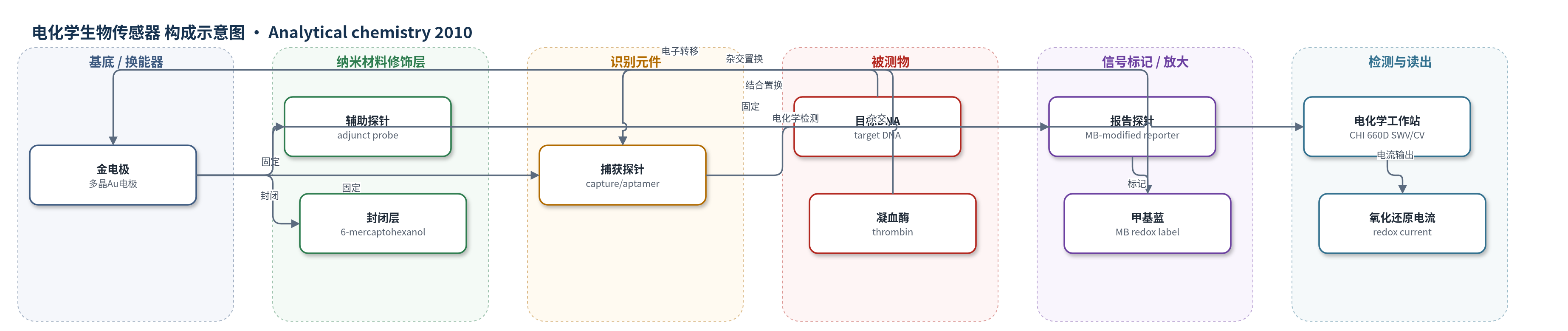
点击图片查看大图 · 依据论文自动绘制
传感器类型
电化学生物传感器
检测对象
目标DNA(target DNA)、凝血酶(thrombin);样品基质为杂交缓冲液(Tris-HCl/NaCl/Tween 20)及电化学测量缓冲液(PBS/NaCl)
检测原理
金电极上硫醇捕获探针与MB报告探针互补杂交,MB远离电极,氧化还原电流较低。加入目标DNA后,目标DNA与捕获探针杂交,置换报告探针部分序列,形成柔性MB标记单链;邻近辅助探针与该被置换片段杂交,将MB拉近电极表面,增加MB与电极碰撞概率并促进电子转移,使SWV/CV电流增强。目标浓度越高,置换和固定事件越多,电流越大。对凝血酶,适配体捕获探针结合凝血酶后置换报告探针,辅助探针同样固定MB片段,提高信号。辅助探针密度和序列影响灵敏度,最佳密度约0.08 µM。
检测灵敏度
LOD: 2.0 pM(target DNA,含辅助探针);40.0 pM(target DNA,无辅助探针);20.0 pM(thrombin,含辅助探针);200.0 pM(thrombin,无辅助探针)
效应效果
该传感器在0.2 nM目标DNA下,含辅助探针信号较对照提高84.0%,无辅助探针仅20.0%,灵敏度提高3.2倍;DNA检出限由40.0 pM降至2.0 pM,动态范围扩展约2个数量级。对1碱基错配目标DNA选择性良好:0.2 nM错配仅增10.0%,完全匹配增125.0%,约12倍;50.0 pM完全匹配增35.0%,高于0.2 nM错配。辅助探针密度0.01–0.08 µM信号上升,过高下降。凝血酶检测中,0.1 nM时含辅助探针信号增强提高2.0倍,LOD由200.0 pM降至20.0 pM;1.0 µM BSA和溶菌酶无明显干扰。传感器可4℃高盐磷酸盐缓冲液保存至少2周,作者认为可推广至RNA、蛋白和小分子如可卡因检测。
传感器的构成
- 基底电极:多晶金电极(polycrystalline Au electrode,2.0 mm),经氧化铝抛光和电化学清洗,提供硫醇探针固定与电化学换能表面
- 识别元件:5′-硫醇功能化寡核苷酸捕获探针(thiol-functionalized capture probe)或凝血酶适配体(thrombin aptamer),通过金-硫键固定于金电极,特异性识别目标DNA或凝血酶
- 辅助探针:硫醇端寡核苷酸辅助探针(adjunct probe,如5′-AAT GAA GTG GGT CG-(CH2)3-SH-3′),邻近捕获探针固定,作为固定器杂交报告探针被置换片段
- 封闭剂:6-巯基己醇(6-mercaptohexanol, 6-MH),封闭金电极表面并促进DNA单分子层排列
- 报告探针:甲基蓝标记寡核苷酸报告探针(MB-modified reporter probe),与捕获探针互补杂交,携带电化学活性信号
- 信号标记物:甲基蓝(methyl blue, MB),作为氧化还原活性标记,其靠近电极时产生增强电流
中文摘要
本文提出一种通过引入辅助探针提高电化学生物传感器灵敏度的新方法。该信号增强型传感器由固定在金电极表面的硫醇功能化捕获探针、与捕获探针互补的甲基蓝(MB)标记报告探针,以及邻近捕获探针固定的辅助探针组成。无目标物时,捕获探针与报告探针杂交形成双链,MB远离电极,电化学信号较低;加入目标DNA或蛋白后,目标物与捕获探针/适配体结合,置换报告探针的一部分,形成柔性MB标记单链。辅助探针作为固定器与该被置换片段杂交,将MB拉近电极表面,增加其碰撞电极的概率并促进电子转移,从而增强氧化还原电流。该传感器对DNA和凝血酶检测具有更高灵敏度和更宽动态范围,并能区分1碱基错配目标DNA。作者指出该方法还可用于RNA、蛋白及可卡因等小分子的灵敏检测。
英文摘要
Despite their promising applications in the biomedical research, the development of electrochemical biosensors with improved sensitivity and low detection limit has remained a great challenge. Here, we demonstrate a new approach to improve the sensitivity of the electrochemical biosensor by simply introducing an adjunct probe into its construction. This signal-on biosensor consists of a thiol-functionalized capture probe attached on the gold electrode surface, an electrochemical sign (methyl blue, MB)-modified reporter probe which is complementary to the capture probe, and an adjunct probe attached nearby the capture probe. The adjunct probe functions as a fixer to immobilize the element of reporter probe which is displaced by the target DNA and protein, increasing the chance of the dissociative reporter probe to collide with the electrode surface and facilitating the electron transfer. The biosensor with an adjunct probe exhibits improved sensitivity and a large dynamic range for DNA and the thrombin assay and can even distinguish 1-base mismatched target DNA. Importantly, the use of this biosensor is not limited to such and is viable for sensitive detection of numerous biomolecules, including RNA, proteins, and small molecules such as cocaine.