组成图示
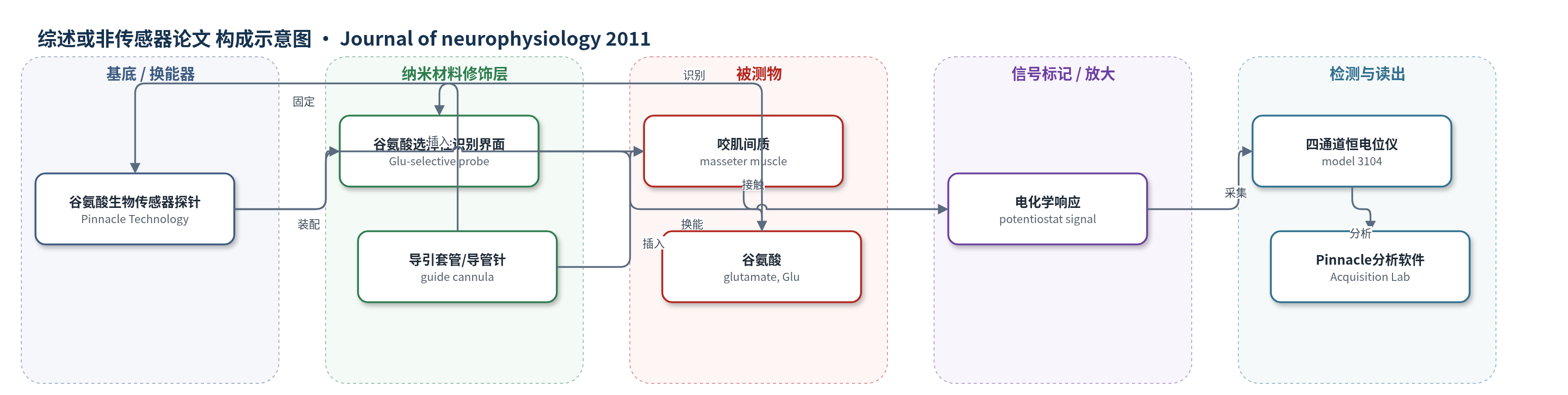
点击图片查看大图 · 依据论文自动绘制
传感器类型
综述或非传感器论文
检测对象
谷氨酸(glutamate, Glu);样品基质:大鼠咬肌间质(masseter muscle interstitium)
检测原理
该研究使用商品化谷氨酸选择性生物传感器探针原位检测大鼠咬肌间质谷氨酸。探针在体外按厂家说明校准后,经导引套管插入咬肌,导管针位于探针附近用于注射TNFα或PBS。注射前记录10 min基线谷氨酸浓度,注射后每小时记录3 h。谷氨酸与探针的选择性识别/换能界面作用后,引起探针电化学响应变化;四通道恒电位仪采集该响应,Pinnacle Acquisition Laboratory软件将其转换为谷氨酸浓度。浓度变化以注射后浓度减去基线浓度表示。原文未报告探针的具体电极材料、识别分子、封闭剂或信号放大策略,因此不涉及HCR、RCA、CRISPR-Cas或酶催化沉积等放大机制。
检测灵敏度
原文未报告谷氨酸生物传感器的LOD、线性范围、灵敏度斜率或相关系数。
效应效果
谷氨酸探针体外校准后用于活体咬肌,基线谷氨酸浓度为44 ± 16 μM(n=8)。TNFα注射后谷氨酸平均升高约6 μM(约15%),与PBS组差异显著,但差异主要来自PBS注射后谷氨酸下降,可能受局部稀释影响。探针连续3 h每小时测量,可追踪TNFα诱导的谷氨酸变化;原文未报告选择性、抗干扰、稳定性或RSD。结合电生理,双氯芬酸部分逆转TNFα引起的机械阈值下降,APV和TrkA抗体无显著作用;PGE2升高且可被双氯芬酸抑制,NGF未显著升高。作者据此主张TNFα诱导的咬肌伤害感受器机械敏化部分由PGE2介导。
传感器的构成
- 传感探针:谷氨酸选择性生物传感器探针(glutamate-selective biosensor probe, Pinnacle Technology),用于原位测量咬肌间质谷氨酸浓度。
- 定位/注射组件:导引套管(guide cannula)与导管针(catheter needle),固定探针并用于在探针附近注射TNFα或PBS。
- 电化学读出装置:四通道恒电位仪(four-channel potentiostat, model 3104),连接探针并采集电化学信号。
- 软件分析模块:Pinnacle Acquisition Laboratory软件,处理探针输入信号并计算谷氨酸浓度变化。
- 检测基质:大鼠咬肌间质(masseter muscle interstitium),作为谷氨酸生物传感器探针的原位检测环境。
中文摘要
本研究旨在探讨肿瘤坏死因子α(TNFα)是否通过释放谷氨酸、前列腺素E2(PGE2)和/或神经生长因子(NGF)等致痛物质,间接诱导大鼠咬肌伤害感受器的机械敏化。作者在大鼠咬肌内注射1 μg TNFα或溶剂对照,3 h后采用商品化酶免疫/ELISA试剂盒测定肌肉匀浆中PGE2和NGF水平,并使用谷氨酸选择性生物传感器探针原位测量咬肌间质谷氨酸浓度。随后分别注射环氧合酶抑制剂双氯芬酸、竞争性NMDA受体拮抗剂APV以及TrkA受体抗体,以评估PGE2、谷氨酸和NGF对TNFα诱导敏化的贡献。结果显示,TNFα注射3 h后咬肌PGE2和谷氨酸浓度均显著升高;双氯芬酸可部分逆转TNFα引起的机械阈值下降,而溶剂对照、APV和TrkA抗体均无显著作用。结果表明,TNFα诱导的咬肌伤害感受器机械敏化至少部分由PGE2水平升高介导,支持TNFα通过间接释放PGE2产生延迟机械敏化的假说。
英文摘要
TNFα induces mechanical sensitization of rat masseter muscle nociceptors, which takes 2-3 h to manifest and is mediated through activation of P55 and P75 receptors. This study was undertaken to determine whether TNFα induces nociceptor mechanical sensitization through the release of other algogenic substances such as glutamate, prostaglandin E(2) (PGE(2)), and/or nerve growth factor (NGF), which have been shown to induce mechanical sensitization of muscle nociceptors. Masseter muscle homogenate levels of PGE(2) and NGF were measured 3 h after injection of TNFα (1 μg) or vehicle control using commercially available kits. Interstitial glutamate concentration was measured after injection of TNFα or vehicle control using a glutamate-selective biosensor probe. Diclofenac, a cyclooxygenase inhibitor that blocks the synthesis of PGE(2), D-2-amino-5-phosphonovaleric acid (APV), a competitive N-methyl-D-aspartate (NMDA) receptor antagonist, and a tyrosine kinase A (TrkA) receptor antibody, which blocks NGF-induced masseter muscle nociceptor sensitization, were used to assess the contribution of PGE(2), glutamate, and NGF to TNFα-induced nociceptor sensitization. PGE(2) and glutamate concentrations were significantly elevated 3 h after TNFα injection into the masseter muscle. Injection of diclofenac partially reversed the TNFα-induced decreases in the mechanical threshold (MT) of masseter muscle nociceptors, whereas vehicle control, APV, and TrkA antibody did not significantly alter nociceptor MT. These results suggest that TNFα-induced mechanical sensitization of masseter muscle nociceptors is mediated in part by increased PGE(2) levels. The findings of this study support the hypothesis that TNFα induces a delayed mechanical sensitization of masseter muscle nociceptors indirectly by the release of PGE(2).