组成图示
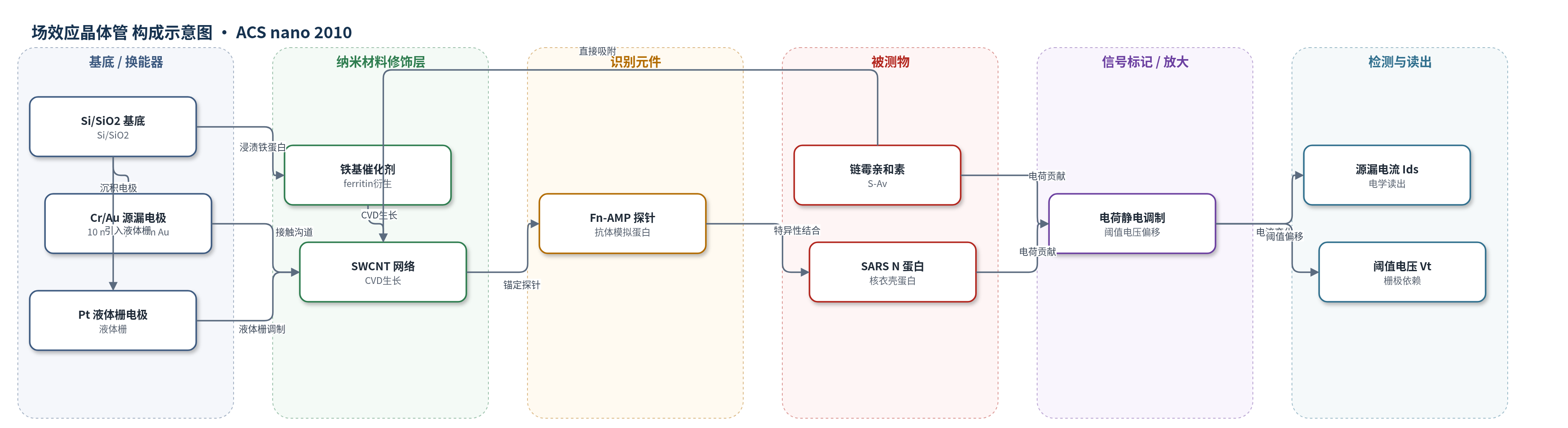
点击图片查看大图 · 依据论文自动绘制
传感器类型
场效应晶体管(FET)生物传感器
检测对象
链霉亲和素(streptavidin, S-Av)、严重急性呼吸综合征冠状病毒核衣壳蛋白(SARS coronavirus nucleocapsid protein, N protein);样品基质为 1×PBS 缓冲液(离子强度约140 mM,模拟血清/血浆生理条件)。
检测原理
该传感器为碳纳米管场效应晶体管(CNT-FET),以 Pt 液体栅电极调制 SWCNT 沟道。当链霉亲和素或 SARS N 蛋白接近沟道时,前者通过氨基直接吸附,后者经 Fn 支架抗体模拟蛋白(AMP)特异性捕获;结合物携带电荷在界面形成静电场。低密度 SWCNT 网络呈半导体特性,金属性导电通路少、量子电容较低,且管间屏蔽较弱,因此相同结合电荷引起更大的阈值电压偏移和源漏电流变化。信号按 ΔV=ΔQ/Ctotal 的电容耦合机制放大,Ctotal 包含双电层电容与 CNT 量子电容。最终通过 Ids 下降和 Vt 偏移读出,浓度越高响应越大。
检测灵敏度
LOD: 1 pM(低密度器件,1×PBS,离子浓度约140 mM);LOD: 1 pM–10 pM(低密度器件,链霉亲和素);LOD: 10–100 pM(中密度器件);LOD: 100 pM–1 nM(高密度器件);LOD: 5 nM(SARS N 蛋白,1×PBS)
效应效果
低密度器件在链霉亲和素检测中响应最大,1 pM 时电导下降约2%,并可随浓度升至100 nM 连续下降;中密度器件在1、10 pM 响应≤0.5%,100 pM 才>1%;高密度器件仅1 nM 有响应。器件开/关比分别约为10^4、10^1–10^2和10,且同密度器件分布一致,说明工艺可重复。对 SARS N 蛋白,4 μM BSA 无稳定干扰,5 nM N 蛋白使电导下降约2%,Langmuir 拟合 Kd 为33 nM(SPR 为3 nM)。Pt 栅电位在 PBS 中稳定,作者认为密度优化 CNT-FET 可在高电解质生理条件下用于 SARS 快速诊断。
传感器的构成
- 基底/换能器电极:Si/SiO2 基底,10 nm Cr/40 nm Au 源漏电极,Pt 液体栅电极,构成 CNT-FET 并用于电学读出。
- 催化剂密度控制层:铁蛋白(ferritin)衍生铁基催化剂纳米颗粒,通过浸渍时间控制 CVD 生长 SWCNT 密度。
- 纳米材料修饰层:CVD 生长的单壁碳纳米管(SWCNT)网络,平均直径 1–2 nm、长度 5–30 μm,作为 FET 沟道。
- 识别元件:基于人纤连蛋白(Fn)支架的工程抗体模拟蛋白(AMP)捕获探针,锚定于 SWCNT 表面,特异性识别 SARS N 蛋白。
- 封闭剂:牛血清白蛋白(BSA),覆盖源漏电极与纳米管空区,减少非特异性结合。
- 信号标记物:无标记电学检测,未使用荧光、酶或纳米颗粒等信号标记物。
中文摘要
利用碳纳米管场效应晶体管(CNT-FET)的生物传感器有望成为下一代诊断系统的基础。尽管碳纳米管已被用于多种传感器,但此前很少关注纳米管密度如何影响生物传感器性能。作者系统研究了密度对纳米管生物传感器性能的影响,发现该参数对实现稳定高性能至关重要。低密度器件在检测限和响应幅度方面均具有更高灵敏度;在含高浓度电解质(离子浓度约140 mM,与血清和血浆离子强度匹配)的缓冲液中,低密度纳米管器件的检出限达到1 pM。进一步研究表明,灵敏度提升源于低密度纳米管网络呈现半导体特性,即更强的栅极依赖性和更低的电容。最后,作者利用密度优化的纳米管生物传感器在生理条件下检测严重急性呼吸综合征(SARS)病毒核衣壳(N)蛋白,展示了改进的检出限。结果表明,仔细调控纳米管密度对制备灵敏可靠的器件至关重要。
英文摘要
Biosensors utilizing carbon nanotube field-effect transistors have a tremendous potential to serve as the basis for the next generation of diagnostic systems. While nanotubes have been employed in the fabrication of multiple sensors, little attention has previously been paid to how the nanotube density affects the biosensor performance. We conducted a systematic study of the effect of density on the performance of nanotube biosensors and discovered that this parameter is crucial to achieving consistently high performance. We found that devices with lower density offer higher sensitivity in terms of both detection limit and magnitude of response. The low density nanotube devices resulted in a detection limit of 1 pM in an electrolyte buffer containing high levels of electrolytes (ionic concentration ∼140 mM, matching the ionic strength of serum and plasma). Further investigation suggested that the enhanced sensitivity arises from the semiconductor-like behavior-strong gate dependence and lower capacitance-of the nanotube network at low density. Finally, we used the density-optimized nanotube biosensors to detect the nucleocapsid (N) protein of the SARS virus and demonstrated improved detection limits under physiological conditions. Our results show that it is critical to carefully tune the nanotube density in order to fabricate sensitive and reliable devices.