组成图示
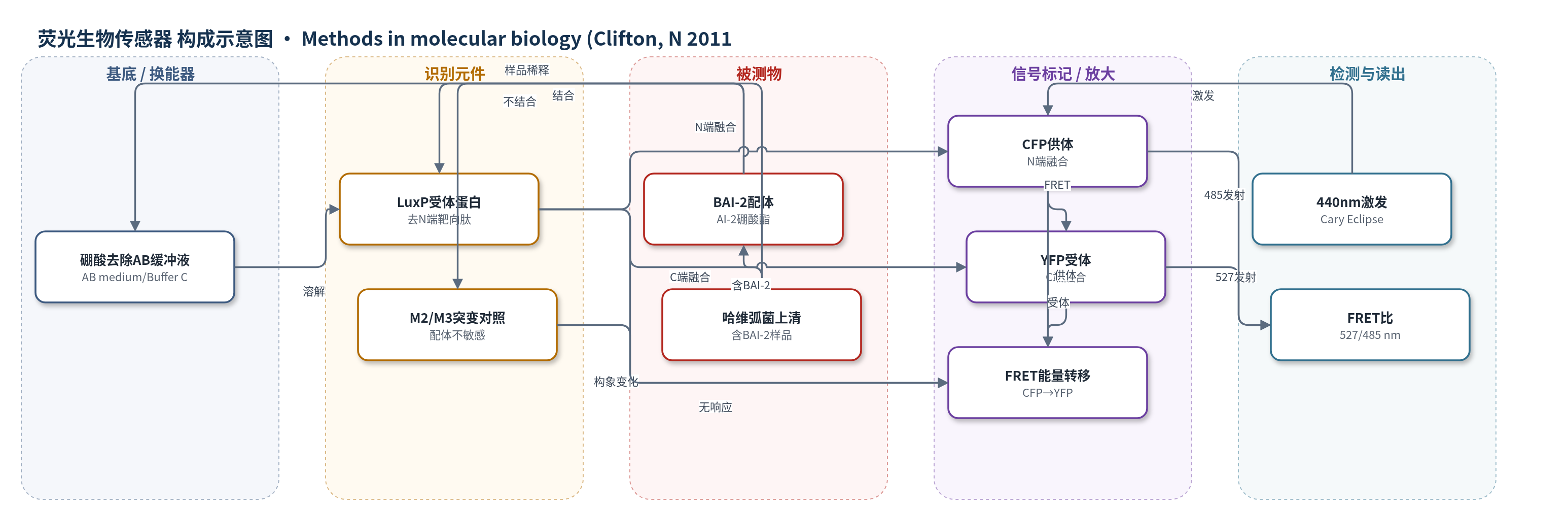
点击图片查看大图 · 依据论文自动绘制
传感器类型
荧光生物传感器
检测对象
BAI-2(呋喃硼酸二酯,autoinducer-2 borate ester,AI-2 的硼酸酯形式);样品基质:Vibrio harveyi 无细胞培养上清/AB 培养基滤液及合成 BAI-2 标准品
检测原理
该传感器为溶液相蛋白 FRET 传感器。BAI-2 与 LuxP 受体结合后,诱导 LuxP 两个球状结构域经柔性铰链发生构象变化,改变 N 端 CFP 与 C 端 YFP 之间的相对距离和取向(初始约 40 Å)。440 nm 激发 CFP 后,CFP 发射(约 485 nm)与 YFP 发射(约 527 nm)之间的 FRET 效率随配体结合而改变;BAI-2 浓度升高使 FRET 比(527/485 nm)下降,变化幅度与配体浓度相关。检测时以无配体和饱和配体 FRET 比拟合饱和曲线,得到半饱和体积 h,再结合 BAI-2–LuxP 解离常数 Kd = 270 nM 计算样品中 BAI-2 浓度。
检测灵敏度
原文未报告 LOD、线性范围、灵敏度斜率或相关系数;报告 Kd = 270 nM。
效应效果
该 FRET 传感器对合成和生物来源的 BAI-2 均选择性响应,并用配体不敏感的 M2CLPY(Q77A/S79A)和 M3CLPY(Q77A/S79A/W82F)突变体确认响应来自 LuxP–BAI-2 结合。纯化后的 CLPY 需室温成熟 5 h 或 4°C 成熟 48 h,之后无配体时 FRET 比不再随时间漂移,表明信号稳定。氯离子会抑制 YFP 荧光,因此需保持样品与缓冲液氯离子浓度一致。实际样品为 V. harveyi BB120 无细胞培养上清,经 3 kDa 滤膜去除蛋白和碎片后,可随培养龄和细胞密度监测 BAI-2;luxS− 突变株 MM30/MM32 上清作为阴性对照。相比传统 V. harveyi 生物发光报告系统,该方法更快、配体特异性更高,并减少培养 pH、代谢物和生长抑制剂等干扰。
传感器的构成
- 识别元件:Vibrio harveyi 群体感应受体蛋白 LuxP(去除 N 端 23 aa 周质靶向肽),特异性结合 BAI-2 并发生构象变化
- 供体荧光标记:CFP(cyan fluorescent protein),融合于 LuxP N 端,作为 FRET 供体
- 受体荧光标记:YFP(yellow fluorescent protein),融合于 LuxP C 端,作为 FRET 受体
- 对照识别元件:LuxP 突变体 M2CLPY(Q77A/S79A)和 M3CLPY(Q77A/S79A/W82F),配体不敏感,用于特异性对照
- 纯化标签:N 端 6×His 标签,用于 His-Select/Ni-NTA 亲和层析纯化
- 检测介质:硼酸去除 AB 培养基/Buffer C(25 mM NaH2PO4–Na2HPO4 pH 8.0、35 mM NaCl、50 mM imidazole),维持 DPD:borate 比例并避免硼干扰
- 信号读出:Cary Eclipse 荧光分光光度计,440 nm 激发,读取 527/485 nm FRET 比
中文摘要
细菌细胞间小分子信号分子可调控多种生物学功能,其中群体感应(QS)分子介导生物发光、III型分泌、铁载体产生、菌落形态、生物膜形成和金属蛋白酶产生等群体依赖响应。因此,QS 分子的检测与定量具有重要应用价值。以往革兰阴性菌 QS 分子的检测主要依赖细菌报告系统,但这些生物测定易受影响细菌生长和代谢的化合物干扰,且报告响应强烈依赖培养龄和细胞密度。为克服上述限制,作者开发了一种体外蛋白基检测系统,用于快速检测和定量自诱导物-2(AI-2)中呋喃硼酸二酯(BAI-2)亚类。该生物传感器基于 BAI-2 与 Vibrio harveyi QS 受体 LuxP 的相互作用;BAI-2 结合 LuxP 后引起受体构象变化,改变分别融合于 LuxP N 端和 C 端的青色荧光蛋白(CFP)与黄色荧光蛋白(YFP)的相对取向,从而引起 CFP 与 YFP 之间荧光共振能量转移(FRET)的变化,且变化幅度与配体浓度相关。作者还构建了配体不敏感的 LuxP 突变 FRET 蛋白传感器作为对照。该 FRET 基 BAI-2 生物传感器对合成和生物来源的 BAI-2 均具有选择性响应,可用于 BAI-2 的检测与定量。
英文摘要
Intercellular small molecular weight signaling molecules modulate a variety of biological functions in bacteria. One of the more complex behaviors mediated by intercellular signaling molecules is the suite of activities regulated by quorum sensing molecules. These molecules mediate a variety of population-dependent responses, including the expression of genes that regulate bioluminescence, type III secretion, siderophore production, colony morphology, biofilm formation, and metalloprotease production. Given their central role in regulating these responses, the detection and quantification of QS molecules has important practical implications. Until recently, the detection of QS molecules from Gram-negative bacteria has relied primarily on bacterial reporter systems. These bioassays though immensely useful are subject to interference by compounds that affect bacterial growth and metabolism. In addition, the reporter response is highly dependent on culture age and cell population density. To overcome such limitations, we developed an in vitro protein-based assay system for the rapid detection and quantification of the furanosyl borate diester (BAI-2) subclass of autoinducer-2 (AI-2) QS molecules. The biosensor is based on the interaction of BAI-2 with the Vibrio harveyi QS receptor LuxP. Conformation changes associated with BAI-2 binding to the LuxP receptor change the orientation of cyan and yellow variants of GFP (CFP and YFP) fused the N- and C-termini, respectively, of the LuxP receptor. LuxP-BAI2 binding induces changes in fluorescence resonance energy transfer (FRET) between CFP and YFP, whose magnitude of change is ligand concentration dependent. A set of ligand-insensitive LuxP-mutant FRET protein sensor was also developed for use as control biosensors. The FRET-based BAI-2 biosensor responds selectively to both synthetic and biologically derived BAI-2compounds. This report describes the use of the LuxP-FRET biosensor for the detection and quantification of BAI-2.