组成图示
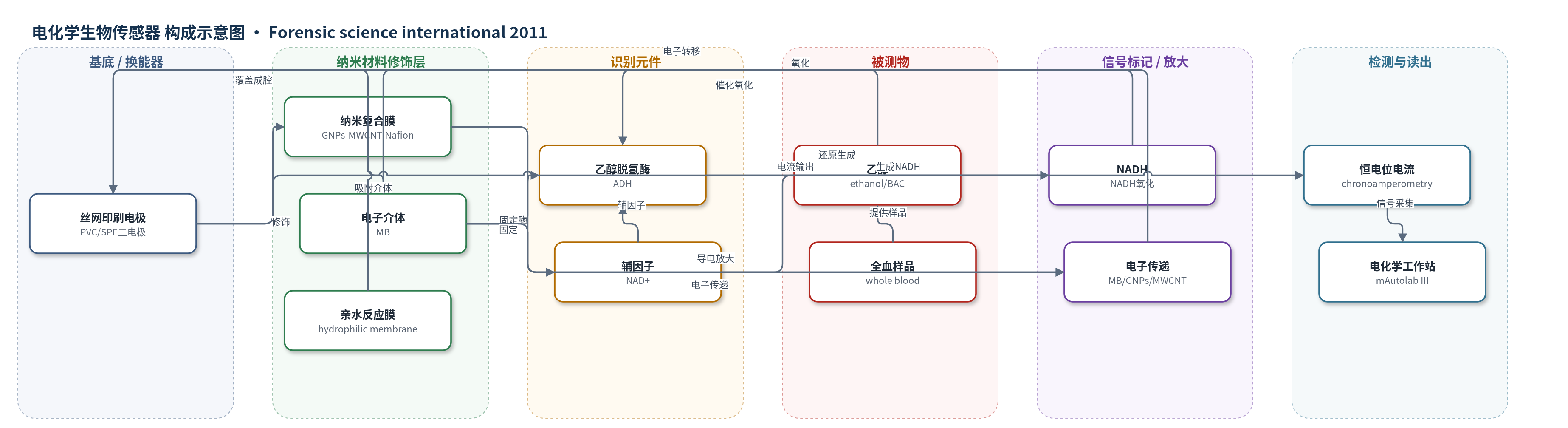
点击图片查看大图 · 依据论文自动绘制
传感器类型
电化学生物传感器
检测对象
乙醇(ethanol,酒精,BAC);样品基质:全血/血液样品(whole blood, blood samples)
检测原理
该传感器基于ADH催化乙醇氧化:乙醇在ADH和NAD+存在下被氧化为乙醛,同时NAD+被还原为NADH。NADH在MB介导下于工作电极发生低过电位氧化,释放电子;电子经MB、GNPs、MWCNT和Nafion复合膜传递至SPE碳工作电极,在-0.13 V(vs. Ag/AgCl)下以计时电流法读取安培电流。乙醇浓度越高,生成的NADH越多,稳态电流越大。GNPs和MWCNT通过高导电性、大电活性面积和协同电子传递放大电流,MB降低NADH氧化过电位并减少干扰,亲水膜限制样品体积,实现小体积全血BAC检测。
检测灵敏度
LOD: 5.0 × 10^-5 mol/L (S/N = 3);线性范围: 2.0 × 10^-4 to 25 × 10^-3 mol/L;标准曲线: Δi (mA) = 0.09347 + 0.12141C (mmol/L);r = 0.99498
效应效果
在20 mmol/L干扰物测试中,葡萄糖、甲醇、乳酸、丙酮、抗坏血酸、正丙醇、异丁醇、正丁醇和异丙醇的干扰率分别为3.31%、6.41%、4.52%、-4.92%、-4.35%、5.82%、4.97%、5.16%和5.63%,抗干扰性良好。4 ℃保存20天和30天后响应电流分别下降3.6%和5.8%;批内CV为4.1%,批间CV为4.7%。响应时间小于15 s,表观Km为5.3 mmol/L。对60例酒驾血液样品(50例活体、10例死亡)检测,与气相色谱法线性相关方程为Y=1.03986X-0.2644,r=0.99621,表明可用于法医BAC快速筛查。
传感器的构成
- 基底/换能器电极:PVC基底上的丝网印刷电极(SPE),含碳工作电极、碳对电极和Ag/AgCl参比电极,提供三电极电化学换能。
- 纳米复合修饰层:GNPs–MWCNT–Nafion-117纳米复合膜,滴涂于工作电极,GNPs与MWCNT协同导电并增大电活性面积,Nafion成膜并吸附介体。
- 电子介体层:Meldola's blue(MB),通过循环伏安吸附于GNPs–MWCNT–Nafion膜,介导NADH在低过电位氧化并传递电子。
- 识别/催化元件层:乙醇脱氢酶(ADH)与烟酰胺腺嘌呤二核苷酸(NAD+)混合酶液,滴涂于MB修饰膜,ADH催化乙醇氧化并生成NADH。
- 封闭/稳定剂:牛血清白蛋白(BSA),与ADH和NAD+共固定,稳定酶并减少非特异吸附。
- 样品反应腔:中心带孔的亲水膜覆盖工作区,形成5 mL反应池,限制样品体积并允许血液接触电极。
- 信号读出:mAutolab III电化学工作站,在-0.13 V(vs. Ag/AgCl)下采用计时电流法读取安培电流。
中文摘要
本研究构建了一种用于小体积样品检测血醇浓度(BAC)的新型可抛弃安培生物传感器试纸条。该传感器以丝网印刷电极(SPE)为基底,先在工作电极上修饰由Nafion-117、多壁碳纳米管(MWCNT)和金纳米粒子(GNPs)组成的GNPs–MWCNT–Nafion纳米复合膜;随后以Meldola's blue(MB)作为电子传递介体,并将乙醇脱氢酶(ADH)与烟酰胺腺嘌呤二核苷酸(NAD+)依次固定于复合膜上;最后在工作区外覆盖中心带孔的亲水膜,形成5 mL反应池,得到亲水膜/ADH–NAD+/GNPs–MWCNT–MB–Nafion/SPE试纸条。通过吸液方式精确取5 mL血液样品即可完成BAC检测。实验优化了工作电位、pH、温度及干扰物等条件。结果表明,该传感器准确度和稳定性良好,线性范围为2.0×10^-4至25×10^-3 mol/L,检出限为5.0×10^-5 mol/L(S/N=3)。在真实血液样品检测中,其结果与气相色谱法具有良好相关性,可用于BAC分析。
英文摘要
A novel disposable amperometric biosensor strip for determination of blood alcohol concentration (BAC) with small volume of sample has been constructed using screen-printed electrodes (SPE), nanocomposite film and alcohol dehydrogenase (ADH). Firstly, the GNPs-MWCNT-Nafion nanocomposite film modified on a working electrode was made of Nafion-117, multi-wall carbon nanotubes (MWCNT) and gold nanoparticles (GNPs). After that Meldola's blue (MB) acted as an electron transfer mediator and the mixed solution of ADH, nicotinamide adenine dinucleotide (NAD(+)) were modified in order on the nanocomposite film. At last, a hydrophilic membrane which had an eyehole in center was placed at the outermost of the working area to make a reaction tank of 5 μL, then the hydrophilic membrane/ADH-NAD(+)/GNPs-MWCNT-MB-Nafion/SPE was prepared. The detection of BAC can be accomplished with 5 μL of blood sample obtained precisely by siphonage. Optimum conditions of the biosensor were experimentally determined by varying several important parameters: working potential, solution pH value, environmental temperature and interferences. Experimental results indicated that the biosensor possessed a good accuracy and stability, the linear response range was 2.0 × 10(-4) to 25 × 10(-3)mol/L and the detection limit of the biosensor was 5.0 × 10(-5)mol/L (S/N=3). In the measurement of blood samples, the proposed biosensor had excellent detection performance for measuring BAC and showed a good correlation with gas chromatography. The prepared biosensor strip can be valid for the analysis of BAC.