组成图示
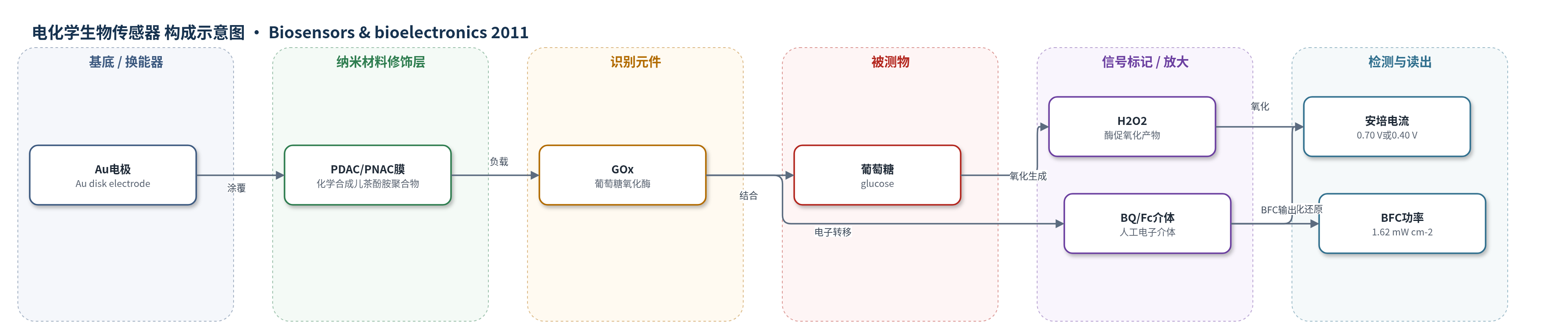
点击图片查看大图 · 依据论文自动绘制
传感器类型
电化学生物传感器
检测对象
葡萄糖(glucose);样品基质:PBS缓冲液、血清(验证)
检测原理
GOx固定于化学合成的PDAC/PNAC多孔儿茶酚胺聚合物膜中,CS增强膜完整性。葡萄糖进入膜内被GOx催化氧化为葡萄糖酸内酯并生成H2O2,同时FAD被还原为FADH2。第一代模式下,H2O2透过膜在Au电极0.70 V处氧化,产生与葡萄糖浓度成正比的安培电流;第二代模式下,BQ或Fc作为人工介体在FADH2与电极间穿梭电子,在0.40 V处发生氧化还原,形成催化电流。多孔膜高负载GOx并允许介体/H2O2透过,同时排斥抗坏血酸、尿酸等干扰物,使电流随葡萄糖浓度升高而增大,直至介体或酶反应饱和。
检测灵敏度
LOD: 0.07 μM (S/N = 3);线性范围: 2.0 μM–3.0 mM;灵敏度: 135 ± 8.5 μA mM−1 cm−2;Km: 2.1 mM;第二代BQ: 线性范围 2 μM–48 mM,灵敏度 135 ± 4.4 μA mM−1 cm−2,jmax ca. 8.0 mA cm−2;第二代Fc: 线性范围 2 μM–16.0 mM,jmax 3.5 mA cm−2
效应效果
传感器抗干扰良好,PDAC/CS膜允许H2O2透过并排斥抗坏血酸、尿酸;血清样品结果与医院葡萄糖自动分析仪一致。热稳定性突出:60 °C下12 d仅失活5%、20 d失活20%,寿命约3周;30 °C下60 d失活20%,寿命超2个月;20.0 M尿素处理30 h后酶活几乎不损失。响应时间<3 s。化学聚合膜灵敏度高于电聚合膜,DA≈NA>oAP>oPD>indole>aniline。固定化GOx表面浓度8.63×10⁻¹¹ mol cm−2,约为单分子层51倍,相对酶活98.6%。BFC开路电压1.09 V、短路电流3.38 mA cm−2、最大功率密度1.62 mW cm−2,优于多数已报道BFC。
传感器的构成
- 基底/换能器:Au disk electrode,提供电子传导与安培检测界面
- 聚合物修饰层:化学合成PDAC或PNAC多孔儿茶酚胺聚合物膜,负载GOx并允许H2O2/介体透过
- 识别/催化元件:GOx,催化葡萄糖氧化并发生FAD/FADH2氧化还原
- 增强层:CS壳聚糖凝胶层,涂覆于酶膜表面增强机械与热稳定性
- 信号产物:H2O2,第一代模式下在Au电极0.70 V被氧化产生电流
- 信号介体:BQ对苯醌或Fc环戊二烯基羧酸,第二代模式下在FADH2与电极间穿梭电子
中文摘要
多巴胺(DA)或左去甲肾上腺素(NA)经K3Fe(CN)6化学氧化,生成负载葡萄糖氧化酶(GOx)的PDAC或PNAC聚合物;将其涂覆于Au电极并用壳聚糖(CS)增强,用于葡萄糖生物传感和生物燃料电池(BFC)。优化的CS/PDAC–GOx/Au传感器灵敏度达135 μA mM−1 cm−2,检出限0.07 μM,响应时间<3 s,抗干扰良好,60 °C下寿命3周、30 °C下超2个月,且耐尿素变性。在第二代模式下,以对苯醌(BQ)或环戊二烯基羧酸(Fc)为人工介体,线性范围分别拓宽至2.0 μM–48.0 mM和2.0 μM–16.0 mM,饱和电流达mA cm−2量级。介体透过酶膜使可定量固定化GOx表面浓度,UV–Vis测定显示酶活/负载较高。以该酶膜为生物阳极、含100 mM葡萄糖和4.0 mM BQ的PBS为阳极液、Nafion膜隔离酸性KMnO4碳阴极为阴极,构建的BFC最大功率密度1.62 mW cm−2,优于多数已报道BFC。
英文摘要
Rapid oxidation of dopamine (DA) or L-noradrenaline (NA) by K(3)Fe(CN)(6) yields poly(DA) (PDA(C)) or poly(NA) (PNA(C)) with glucose oxidase (GOx) effectively entrapped, and such an enzyme-entrapped catecholamine polymer is cast on an Au electrode followed by chitosan (CS) strengthening for biosensing and fabrication of a biofuel cell (BFC). The optimized glucose biosensor of CS/PDA(C)-GOx/Au displays an extremely high sensitivity up to 135 μA mM(-1) cm(-2), a very low limit of detection of 0.07 μM, a response time of <3 s, good suppression of interferents, striking thermostability (lifetime of 3 weeks at 60°C and over 2 months at 30°C), and high resistance to urea denaturation. The biosensor also works well in the second generation biosensing mode with p-benzoquinone (BQ) or ferrocene monocarboxylic acid (Fc) as an artificial mediator, with greatly broadened linear detection ranges (2.0 μM-48.0 mM for BQ and 2.0 μM-16.0 mM for Fc) and up to mA cm(-2)-scale glucose-saturated current density. The good permeability of artificial mediators across the enzyme film enables the quantification of the surface concentration of immobilized GOx on the basis of a reported kinetic model, and UV-Vis spectrophotometry is used to measure the enzymatic activity, revealing high enzymatic activity/load at CS/PDA(C)-GOx/Au. A BFC is also successfully fabricated with a bioanode of CS/PDA(C)-GOx/Au in phosphate buffer solution containing 100 mM glucose and 4.0 mM BQ and a carbon cathode in Nafion-membrane-isolated acidic KMnO(4), and its maximum power density of 1.62 mW cm(-2) is superior to those of most BFC hitherto reported.