组成图示
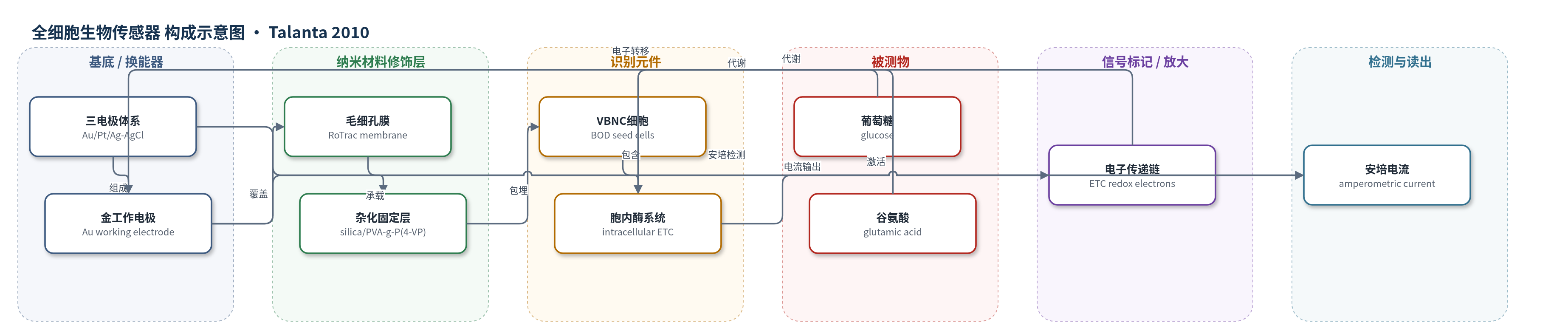
点击图片查看大图 · 依据论文自动绘制
传感器类型
全细胞生物传感器
检测对象
葡萄糖(glucose)、谷氨酸(glutamic acid);样品基质为水溶液/缓冲液(0.1 M KCl 支持电解质溶液)
检测原理
VBNC 全细胞被二氧化硅/PVA-g-P(4-VP) 杂化膜固定,干燥使细胞壁受损但胞内酶与电子传递链保留,形成核壳/支架结构。检测时,葡萄糖和谷氨酸扩散穿过可渗透细胞壁进入胞内酶系统,被代谢并驱动电子传递链产生可电活性电子。在 0.1 M KCl 中,Au 工作电极施加 -700 mV,安培法记录电流。底物浓度升高时,胞内代谢通量和电子转移速率增加,电流响应增大。该传感器无外源标记,依靠全细胞代谢电子传递链实现信号转导,VBNC 状态避免细胞生长,提高储存稳定性。
检测灵敏度
原文未报告 LOD、线性范围、灵敏度斜率或相关系数。
效应效果
论文未报告选择性、抗干扰、RSD、实际样品回收率或与 ELISA/HPLC/qPCR 的对比。主要性能为长期储存稳定性:对 10.91 mg/L 葡萄糖-谷氨酸溶液,第 1 天最大电流 85.4 nA;约 4℃ 储存 18、30、58、100 天后分别保持 94%(80.0 nA)、82.4%(70.4 nA)、86.4%(73.8 nA)、53.9%(46.0 nA)。VBNC 细胞净电流 64.2 nA,高于新鲜细胞 48.8 nA 和 PBS 保存细胞 19.9 nA。单次测量约 10 min,恢复约 60 min。作者认为 VBNC 细胞无需营养和生长控制,制备条件温和、操作简便、成本低,适合长期储存生物传感器。
传感器的构成
- 换能器电极:Au 工作电极、Pt 辅助电极与 Ag/AgCl 参比电极组成三电极体系,施加 -700 mV 进行安培检测
- 基底载体膜:RoTrac 毛细孔膜承载 VBNC 细胞膜并覆盖于电极表面
- 有机-无机杂化固定层:silica sol-gel(由 TEOS 制备)与 PVA-g-P(4-VP) 接枝共聚物形成生物基质,固定细胞并保护胞内酶
- 识别/催化元件:VBNC 微生物细胞(BOD seed,含 Pseudomonas aeruginosa 等),以胞内酶和电子传递链代谢葡萄糖与谷氨酸
- 信号转导介质:0.1 M KCl 支持电解质,提供离子导电环境
- 信号读出:安培电流响应(nA),随葡萄糖-谷氨酸浓度变化
中文摘要
传统活细胞和纯化酶生物传感器常受细胞生长控制、酶纯化复杂及稳定性差等限制。本文首次报道将 viable but nonculturable(VBNC)细胞用于生物传感器制备。作者采用二氧化硅溶胶-凝胶与聚乙烯醇-4-乙烯基吡啶接枝共聚物 PVA-g-P(4-VP) 构成的有机-无机杂化材料固定微生物细胞;干燥后细胞壁受损,形成 VBNC 状态。以胞内酶为核心、受损细胞壁为壳,VBNC 细胞呈现核壳结构,胞外材料则形成支架结构。共聚焦激光扫描显微镜(CLSM)单细胞成像证实了该核壳与支架结构。电化学方法进一步检测 VBNC 细胞的酶活性,表明其无需营养处理和其他理化生长条件。基于 VBNC 细胞构建的葡萄糖-谷氨酸生物传感器在约 4℃ 储存 100 天后仍保持较高响应,表现出良好的长期储存稳定性。
英文摘要
In this paper, we first reported the viable but nonculturable (VBNC) cells used for fabricating biosensor. The organic-inorganic hybrid material composed of silica and the grafting copolymer of poly(vinyl alcohol) and 4-vinylpyridine (PVA-g-P(4-VP)) was used to immobilize microbial cells for biosensor fabrication. The VBNC cells were formed after the hybrid material dried, showing the cell walls were sacrificed. With the intracellular enzymes as core and the "sacrificed" cell walls as shell, the present VBNC cells maybe considered as a core/shell structure. The extracellular material worked as the scaffold for core/shell structure. The core/shell structure and the scaffold structure were demonstrated by single-cell level image analysis using confocal laser scanning microscopy (CLSM). The electrochemical method was adopted for further examining the enzyme activity of VBNC cells. The VBNC cells did not need nutrient treatment and other physicochemical factors for cell growth, which is a significant contribution for storing biosensor. A glucose-glutamic acid biosensor fabricated by the VBNC cells exhibited long-term storage stability for 100 days.