组成图示
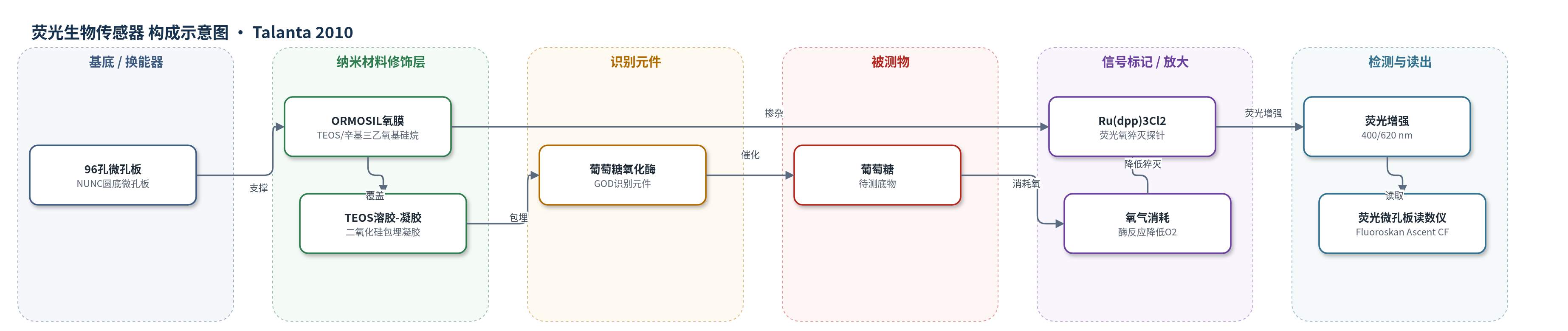
点击图片查看大图 · 依据论文自动绘制
传感器类型
荧光生物传感器
检测对象
葡萄糖(glucose);样品基质:0.1 M KPB缓冲标准液、5%和20%葡萄糖注射液稀释液,文中亦提及饮料与血液样品
检测原理
葡萄糖氧化酶(GOD)催化葡萄糖氧化,同时消耗溶解氧并生成过氧化氢。底部ORMOSIL膜中Ru(dpp)3Cl2的荧光受溶解氧猝灭;葡萄糖浓度越高,酶促反应消耗氧的速率越快,膜内氧浓度下降越明显,猝灭减弱,荧光强度随时间增强。采用动态瞬态法(DTM)对荧光-时间曲线作Sigmoid拟合,取最大荧光变化率作为定量参数。该最大变化率与葡萄糖浓度在0.1–5.0 mM内线性相关,实现无标记、并行、抗干扰的葡萄糖检测。
检测灵敏度
LOD: 0.06 mM;线性范围: 0.1–5.0 mM;Y = 13.28X − 0.128;R = 0.9968
效应效果
该阵列在pH 3–10范围内均可工作,pH 7–10响应率保持在90%以上,pH 3–6约60%。0.1 M Na+、K+、Cl−、PO4^3−及抗坏血酸无明显干扰,选择性优于非酶电化学葡萄糖传感器。同一5孔连续4次检测2 mM葡萄糖无明显变化,重复性良好;4℃保存30天活性下降4.6%,60天下降10.4%,长期稳定性较好。实际5%和20%葡萄糖注射液分别稀释100和500倍后测定,加标回收率102%–110%,RSD 5.5%–9.4%。单次可并行检测25孔,96孔板可进一步提高通量,适用于饮料厂或临床实验室大批量样品检测。
传感器的构成
- 基底/微孔板:96孔圆底微孔板(NUNC),提供96通道并行检测载体
- 氧传感膜:有机改性硅胶(ORMOSIL,由TEOS与辛基三乙氧基硅烷octyl-triEOS溶胶-凝胶形成),作为底部荧光氧传感层
- 荧光探针:三(4,7-二苯基-1,10-菲啰啉)氯化钌(II)(Ru(dpp)3Cl2),掺杂于ORMOSIL中,受溶解氧猝灭
- 酶包埋层:四乙氧基硅烷(TEOS)溶胶-凝胶,经盐酸催化、真空除乙醇并稀释后形成二氧化硅凝胶,固定酶并维持活性
- 识别元件:葡萄糖氧化酶(GOD),催化葡萄糖氧化并消耗O2
- 密封层:透明PET微孔板盖,防止空气氧扩散进入微孔
- 读出装置:荧光微孔板读数仪(Fluoroskan Ascent CF),激发400 nm、发射620 nm记录荧光
中文摘要
为快速测定大量饮料和血液样品中的葡萄糖浓度,开发了基于将葡萄糖氧化酶(GOD)固定于氧传感层的光学生物传感器阵列。葡萄糖氧化酶先通过溶胶-凝胶法包埋于二氧化硅凝胶中,再固定于底部集成氧传感膜的96孔微阵列上。氧传感膜由掺杂三(4,7-二苯基-1,10-菲啰啉)氯化钌(II)(Ru(dpp)3Cl2)的有机改性硅胶(ORMOSIL)制成。葡萄糖被葡萄糖氧化酶氧化时,因反应消耗氧气,可通过荧光强度增强进行监测。动态瞬态法(DTM)评价的荧光变化率与葡萄糖浓度呈宽线性关系,线性范围0.1–5.0 mM(Y=13.28X−0.128,R=0.9968),检出限0.06 mM。系统研究了pH和共存离子影响,结果表明该光学生物传感器阵列在宽pH范围内工作,Na+、K+、Cl−、PO4^3−和抗坏血酸等常见干扰物无明显干扰。葡萄糖氧化酶活性在2个月储存后大部分保留,表明长期稳定性好。
英文摘要
Optical biosensor arrays for rapidly determining the glucose concentrations in a large number of beverage and blood samples were developed by immobilizing glucose oxidase (GOD) on oxygen sensor layer. Glucose oxidase was first encapsulated in silica based gels through sol-gel approach and then immobilized on 96-well microarrays integrated with oxygen sensing film at the bottom. The oxygen sensing film was made of an organically modified silica film (ORMOSIL) doped with tris(4,7-diphenyl-1,10-phenanthroline) ruthenium dichloride (Ru(dpp)(3)Cl(2)). The oxidation reaction of glucose by glucose oxidase could be monitored through fluorescence intensity enhancement due to the oxygen consumption in the reaction. The luminescence changing rate evaluated by the dynamic transient method (DTM) was correlated with the glucose concentration with the wide linear range from 0.1 to 5.0mM (Y=13.28X-0.128, R=0.9968) and low detection limit (0.06 mM). The effects of pH and coexisting ions were systemically studied. The results showed that the optical biosensor arrays worked under a wide range of pH value, and normal interfering species such as Na(+), K(+), Cl(-), PO(4)(3-), and ascorbic acid did not cause apparent interference on the measurement. The activity of glucose oxidase was mostly retained even after 2-month storage, indicating their long-term stability.