组成图示
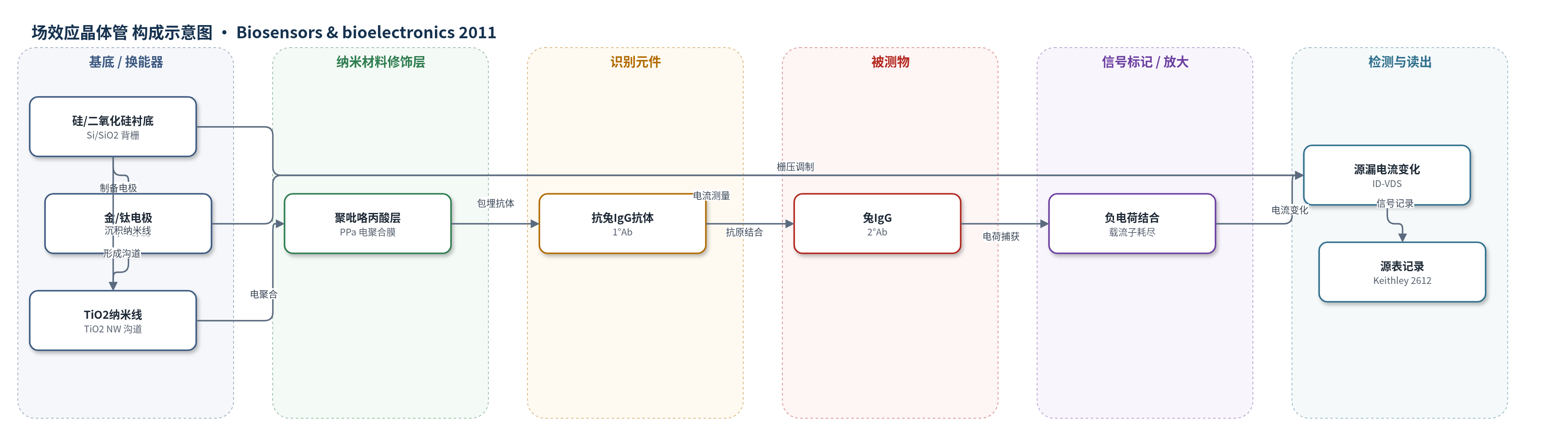
点击图片查看大图 · 依据论文自动绘制
传感器类型
场效应晶体管(FET)生物传感器
检测对象
兔 IgG(rabbit IgG,2°Ab);样品基质:10 mM PBS 缓冲液
检测原理
传感器以 TiO2 纳米线作为 n 型半导体沟道,先在其表面通过循环伏安电聚合吡咯丙酸(Pa),形成低电导聚吡咯丙酸(PPa)薄膜,并将抗兔 IgG(1°Ab)包埋于 PPa 网络中。该过程使识别元件主要固定在纳米线传感区,减少非传感区污染。当兔 IgG(2°Ab)加入后,2°Ab 与 1°Ab 发生特异性抗原抗体结合。由于 2°Ab 通常带负电荷,结合后负电荷/电子载流子可沿 PPa 路径影响 TiO2 NW 沟道,使沟道附近形成耗尽区,移动载流子密度下降,沟道电阻增加。在固定栅源电压和漏源电压下,源漏电流 ID 随 2°Ab 浓度变化,从而实现电学读出。浓度越高,结合蛋白越多,电流响应变化越大。
检测灵敏度
LOD: 原文将 −3.96 A/(ng/mL) 标为 LOD;灵敏度斜率: −3.96 A/(ng/mL);线性范围: 119 pg/mL–5.95 ng/mL;R^2 = 0.903
效应效果
EDS 显示 PPa/1°Ab 涂层后碳信号与 Ti 信号位置一致,非纳米线区未检出碳,说明固定主要发生在 TiO2 NW 表面,减少非传感区污染。电学测试中,PPa/1°Ab 传感器加入 11.9 ng/mL 兔 IgG 后,在 VDS=5 V、VGS=5 V 下源漏电流变化约 75 nA;仅 PPa 对照变化可忽略,特异性良好。选择性测试中,先加入 12.3 ng/mL 抗人 IgA 几乎无响应,再加入 11.9 ng/mL 兔 IgG 出现明显变化,抗干扰较好。灵敏度方面,119 pg/mL–5.95 ng/mL 线性良好,R^2=0.903。论文未报告稳定性、重现性、实际样品回收率或与 ELISA/HPLC/qPCR 对比,但作者认为 PPa 电聚合可替代硅烷法,实现纳米线特定区域固定并提升灵敏度。
传感器的构成
- 基底/换能器电极:Si/SiO2 衬底(100 nm 热氧化层)与图案化 Au/Ti 电极(150/50 nm,15 μm 间隙),作为 FET 源漏电极和背栅
- 纳米线通道:TiO2 纳米线(TiO2 NW,锐钛矿结构,直径 40–50 nm,长 10–20 μm),作为 n 型半导体沟道
- 电聚合修饰层:聚吡咯丙酸(PPa,由吡咯丙酸 Pa 电聚合形成),在 NW 表面形成低电导薄膜并限制生物分子固定区域
- 识别元件:抗兔 IgG 抗体(anti-rabbit IgG,1°Ab),包埋于 PPa 网络中,特异性识别兔 IgG
- 包埋液:10 mM PBS、15 mM Pa、100 μg/mL 1°Ab,用于原位电聚合形成 PPa/1°Ab 膜
- 信号读出:源漏电流 ID 随 VDS/VGS 变化,由 Keithley 2612 源表和 LabTracer 记录
中文摘要
硅烷偶联法已成为生物分子固定,尤其一维纳米材料生物传感器制备的标准方法,但目标分子的特异性结合可能污染传感区与非传感区,降低灵敏度。本文探索在一维纳米材料场效应晶体管(FET)生物传感器中,利用聚吡咯丙酸(PPa)包埋生物分子。研究在二氧化钛(TiO2)纳米线(NW)基 FET 上,通过电聚合自制低电导聚合物吡咯丙酸(Pa)实现生物分子包埋,并以能量色散谱(EDS)和电学分析考察 PPa 捕获抗兔免疫球蛋白 G(PPa/1°Ab)复合膜。进一步分析传感器的特异性、选择性和灵敏度,以评估 PPa/1°Ab 固定 NW 生物传感器的免疫反应。结果表明,PPa/1°Ab 在 EDS 分析下实现高特异性固定于纳米线表面;所开发的 TiO2-NW FET 免疫传感器可成功实现对目标蛋白兔 IgG 的纳克级特异性、选择性和灵敏度检测。PPa 材料与电聚合方法可为在纳米线等特定表面固定生物分子提供替代方案。
英文摘要
Silane-based methods have become the standards for the conjugation of biomolecules, especially for the preparation of one-dimensional nanomaterial biosensors. However, the specific binding of those target molecules might raise problems with regard to the sensing and non-sensing regions, which may contaminate the sensing devices and decrease their sensitivity. This paper attempts to explore the encapsulation of biomolecules on a one-dimensional nanomaterial field effect transistor (FET) biosensor using polypyrrole propylic acid (PPa). Specifically, the encapsulation of biomolecules via the electropolymerization of pyrrole propylic acid (Pa), a self-made low-conductivity polymer, on TiO(2)-nanowire (NW)-based FETs is presented. The energy dispersive spectrum (EDS) was obtained and electrical analysis was conducted to investigate PPa entrapping anti-rabbit IgG (PPa/1°Ab) on a composite film. The specificity, selectivity and sensitivity of the sensor were analyzed in order to determine the immunoreaction of PPa/1°Ab immobilized NW biosensors. Our results show that PPa/1°Ab achieved high specificity immobilization on NWs under the EDS analysis. Furthermore, the TiO(2)-NW FET immunosensor developed in this work successfully achieved specificity, selectivity and sensitivity detection for the target protein rabbit IgG at the nano-gram level. The combination of PPa material and the electropolymerization method may provide an alternative method to immobilize biomolecules on a specific surface, such as NWs.