组成图示
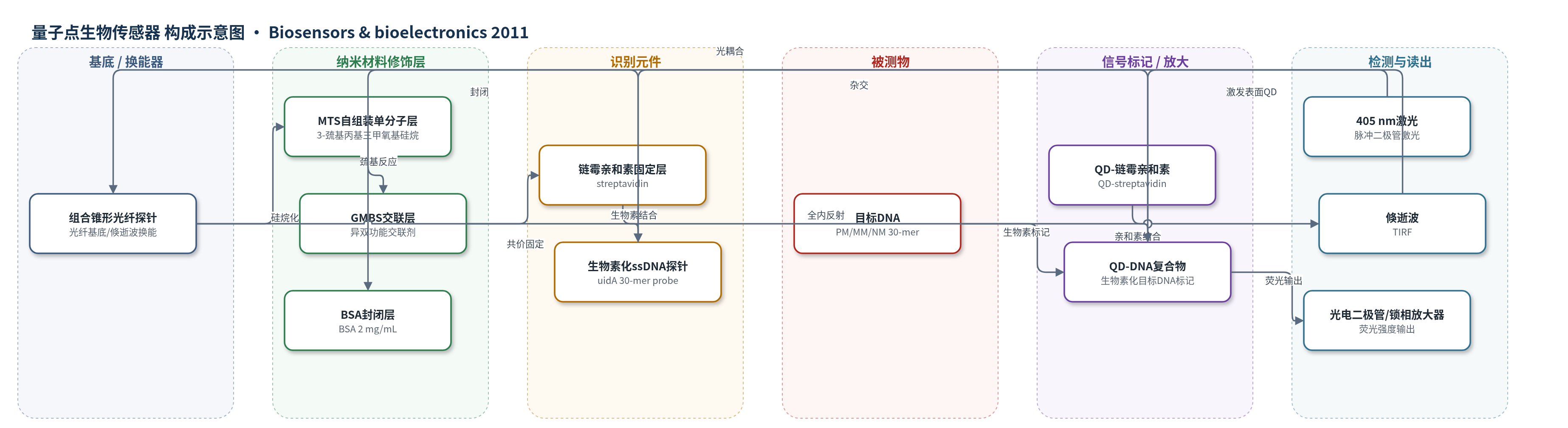
点击图片查看大图 · 依据论文自动绘制
传感器类型
量子点生物传感器
检测对象
单链DNA(ssDNA,大肠杆菌uidA基因30-mer片段,PM/MM/NM);样品基质:缓冲液/溶液(TE、PBS、杂交缓冲液)
检测原理
405 nm脉冲激光经单多模光纤耦合器进入组合锥形光纤,在光纤表面发生全内反射并产生倏逝波。倏逝波穿透距离短,主要激发靠近光纤表面的荧光分子,从而降低溶液背景。光纤表面经MTS、GMBS和链霉亲和素修饰后固定生物素化ssDNA探针;生物素化目标DNA与QD-链霉亲和素偶联物结合形成QD-DNA。当QD-DNA与探针杂交后,QD被限制在倏逝波场内,405 nm激发产生荧光,荧光强度随表面结合目标DNA量增加。QD高量子产率和抗光漂白特性增强信号。通过Langmuir模型分析荧光时间曲线,可得到结合与解离动力学参数。
检测灵敏度
LOD: 3.2 amol of bound target DNA;溶液浓度检出限: below 1 × 10⁻¹² M;线性范围: 0.1–2.5 nM;线性方程: y = 1,379,780x + 0.00467;R^2 = 0.9868;kon: 1.38 × 10^6 M−1 s−1;koff: 4.67 × 10⁻³ s−1;Ka: 2.96 × 10^8 M−1
效应效果
该传感器对完美匹配PM、单碱基错配MM和非互补NM DNA表现出明显选择性:PM信号最高,MM信号较低,NM无明显信号;QD-链霉亲和素无DNA及无盐QD-DNA均无信号,加入0.1×PBS后出现杂交信号,表明非特异性吸附可忽略。QD标记相比Dylight 680荧光信号提高20倍以上。传感表面经pH 1.9 SDS再生,可连续30次以上检测,性能下降小于8%。表面结合目标DNA检出限3.2 amol,优于SPR(>20 amol)和QCM(>2000 amol)。作者认为该平台可用于临床诊断、病理、遗传、早期癌症检测、现场分析和蛋白-DNA相互作用研究。
传感器的构成
- 基底/换能器:组合锥形光纤探针(combination-tapered fiber optic probe),传输405 nm激发光并产生倏逝波,同时收集表面荧光
- 表面修饰层:3-巯基丙基三甲氧基硅烷(MTS)自组装单分子层,在光纤表面引入巯基
- 交联层:N-(4-马来酰亚胺丁氧基)琥珀酰亚胺(GMBS)异双功能交联剂,连接巯基与链霉亲和素氨基
- 固定元件:链霉亲和素(streptavidin),共价固定于GMBS,作为生物素结合元件
- 识别元件:生物素化单链DNA探针(biotinylated ssDNA probe, uidA 30-mer),通过生物素-链霉亲和素固定,与目标DNA杂交
- 封闭剂:牛血清白蛋白(BSA, 2 mg/mL),封闭非特异性吸附位点
- 信号标记物:Qdot链霉亲和素偶联物(QD-streptavidin conjugate)标记生物素化目标DNA,形成QD-DNA荧光报告分子
- 读出系统:405 nm脉冲二极管激光、单多模光纤耦合器、带通滤波器、光电二极管和数字锁相放大器,检测荧光强度
中文摘要
基于量子点(QDs)和全内反射荧光(TIRF)的新型生物传感平台实现了超灵敏DNA检测,对表面结合目标DNA的检出限达3.2 amol。可重复使用的传感表面通过异双功能试剂将链霉亲和素共价固定于光纤探针的自组装烷硫醇单分子层上制备;链霉亲和素作为通用结合元件用于固定生物素化单链DNA(ssDNA)。该ssDNA修饰光纤探针通过DNA-DNA杂交检测大肠杆菌uidA基因片段的30-mer ssDNA,目标DNA经亲和素-生物素作用用QDs标记。多个阴性对照表明无显著非特异性结合。结合目标DNA可用pH 1.9 SDS溶液从传感表面洗脱,30次以上检测循环后性能无显著损失。平台可高精度定量DNA结合动力学,结合速率1.38×10^6 M^-1 s^-1,解离速率4.67×10^-3 s^-1。所提平台为临床诊断、病理学和遗传学等应用提供简单、廉价、快速、稳健的方案。
英文摘要
Ultrasensitive DNA detection was achieved using a new biosensing platform based on quantum dots (QDs) and total internal reflection fluorescence, which featured an exceptional detection limit of 3.2 amol of bound target DNA. The reusable sensor surface was produced by covalently immobilizing streptavidin onto a self-assembled alkanethiol monolayer of fiber optic probe through a heterobifunctional reagent. Streptavidin served as a versatile binding element for biotinylated single-strand DNA (ssDNA). The ssDNA-coated fiber probe was evaluated as a nucleic acid biosensor through a DNA-DNA hybridization assay for a 30-mer ssDNA, which were the segments of the uidA gene of Escherichia coli and labeled by QDs using avidin-biotin interaction. Several negative control tests revealed the absence of significant non-specific binding. It also showed that bound target DNA could easily be eluted from the sensor surface using SDS solution (pH 1.9) without any significant loss of performance after more than 30 assay cycles. A quantitative measurement of DNA binding kinetics was achieved with high accuracy, indicating an association rate of 1.38×10(6) M(-1) s(-1) and a dissociation rate of 4.67×10(-3) s(-1). The proposed biosensing platform provides a simple, cheap, fast, and robust solution for many potential applications including clinical diagnosis, pathology, and genetics.