组成图示
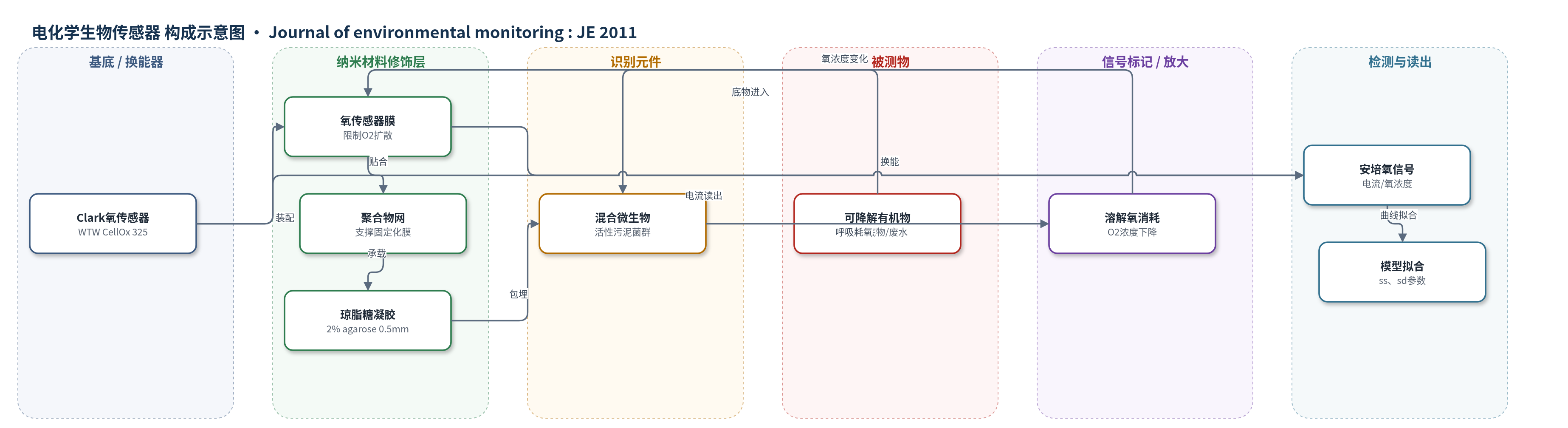
点击图片查看大图 · 依据论文自动绘制
传感器类型
电化学生物传感器
检测对象
生化需氧量(BOD/BOD7);样品基质:OECD合成废水、市政污水
检测原理
将含可生物降解有机物的样品加入空气饱和磷酸盐缓冲液中,固定于琼脂糖膜内的混合微生物摄取底物并进行有氧呼吸,消耗溶解氧。底物浓度越高,微生物耗氧速率越大,导致氧传感器外膜附近氧浓度下降。Clark型安培氧传感器通过阴极还原溶解氧产生与氧浓度相关的电流/氧浓度读数,因此输出信号随BOD增加而下降。由于微生物膜和琼脂糖基质引入扩散阻力,响应存在滞后和瞬态衰减;论文建立指数和模型拟合非稳态曲线,得到参数ss和sd。ss与底物浓度/BOD7呈线性关系,用于定量;sd主要取决于氧传感器膜厚与氧扩散系数,用于评估传感器稳定性。该方法无需外源标记或酶促放大,直接以微生物呼吸耗氧作为识别与信号事件。
检测灵敏度
线性范围: 15–110 mg O2 L−1;R^2 = 0.96;非线性拟合相关系数: above 0.98
效应效果
该传感器在35天内完成160次BOD测量,结果可重复。重复性测试中,表征安培氧传感器瞬态输出稳定性的参数sd的RSD为2.8%,表征瞬态响应与底物浓度依赖的参数ss的RSD为5.8%。在OECD合成废水中校准范围为15–110 mg O2 L−1,ss与BOD7的线性校准R^2 = 0.96,非线性拟合相关系数above 0.98。实际市政污水中,BOD生物传感器结果较传统BOD7平均高估13.4%和13.6%,RSD分别为7.5%和5.0%;对难降解混合废水则低估4–10%。作者认为模型可在每次测量中评估传感器稳定性,并比稳态法更快、更有效地估算废水中可生物降解有机物含量。
传感器的构成
- 换能器电极:Clark型安培氧传感器(WTW CellOx 325),通过阴极还原溶解氧产生电流/氧浓度读数
- 传感器膜:氧传感器外膜,限制氧扩散并决定瞬态响应时间常数sd
- 支撑层:特定厚度聚合物网,承载琼脂糖凝胶并影响机械稳定性
- 固定化基质:2%琼脂糖凝胶(厚度0.15–0.8 mm,优选0.5 mm),包埋微生物并控制氧/底物扩散
- 识别元件:市政污水活性污泥来源的混合微生物菌群,经OECD合成废水驯化,通过呼吸消耗氧识别可生物降解有机物
- 信号标记物:无外源标记物,以溶解氧浓度下降作为内源信号
- 测量介质:空气饱和磷酸盐缓冲液,持续通气与搅拌,维持氧供应
中文摘要
构建了一种用于快速有效估算BOD7的生物化学需氧量(BOD)生物传感器,并系统研究了输出信号的非稳态阶段。所提出的建模方法可实现响应曲线重构和高质量曲线拟合,得到反映响应与有机底物浓度关系以及BOD生物传感器稳定性特性的参数。同时,对不同厚度的固定化基质进行了表征,以评估其在非稳态条件下生物传感测量的适用性,并考察BOD生物传感器随时间的机械耐久性。根据所建立模型对实验输出非稳态响应进行拟合,可确定传感器输出稳定性及其对可生物降解有机底物浓度的依赖关系。在OECD合成废水中,该BOD生物传感器的校准范围为15–110 mg O2 L−1。重复性测试显示,表征安培氧传感器瞬态输出随时间变化的参数sd的相对标准偏差(RSD)为2.8%,表征BOD生物传感器瞬态响应与有机底物浓度依赖关系的参数ss的RSD为5.8%。利用该BOD生物传感器评估易降解和难降解市政废水生化需氧量的实验结果与传统BOD7分析具有良好一致性。
英文摘要
A biochemical oxygen demand (BOD) biosensor for effective and expeditious BOD(7) estimations was constructed and the non-steady phase of the output signal was extensively studied. The modelling approach introduced allows response curve reconstruction and a curve fitting procedure of good quality, resulting in parameters indicating the relationship between response and organic substrate concentration and stability properties of the BOD biosensor. Also, the immobilization matrixes of different thicknesses were characterized to determine their suitability for bio-sensing measurements in non-stationary conditions, as well as for the determination of the mechanical durability of the BOD biosensor in time. The non-steady response of the experimental output of the BOD biosensor was fitted according to the developed model that enables to determine the stability of the biosensor output and dependency on biodegradable organic substrate concentration. The calibration range of the studied BOD biosensor in OECD synthetic wastewater was 15-110 mg O(2) L(-1). Repeatability tests showed relative standard deviation (RSD) values of 2.8% and 5.8% for the parameter τ(d), characterizing the transient output of the amperometric oxygen sensor in time, and τ(s), describing the dependency of the transient response of the BOD biosensor on organic substrate concentration, respectively. BOD biosensor experiments for the evaluation of the biochemical oxygen demand of easily degradable and refractory municipal wastewater showed good concurrence with traditional BOD(7) analysis.