组成图示
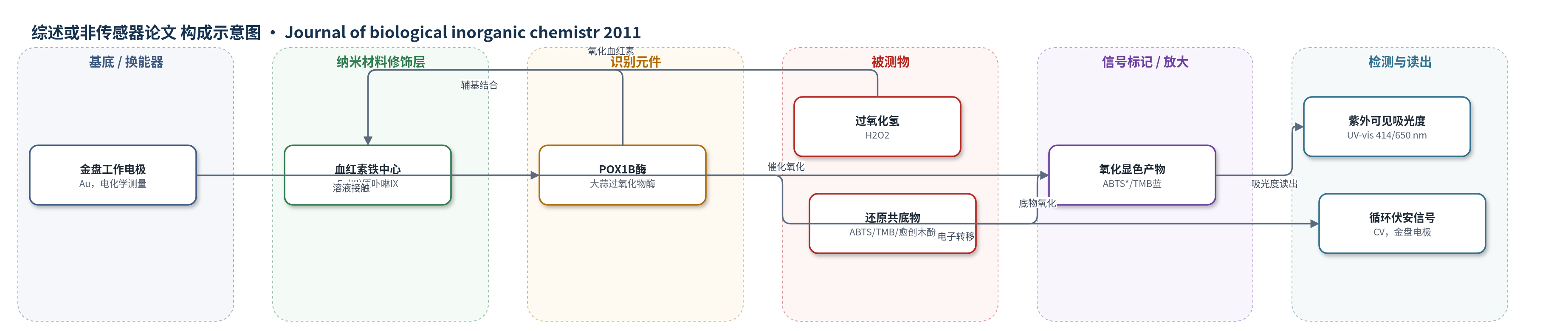
点击图片查看大图 · 依据论文自动绘制
传感器类型
综述或非传感器论文
检测对象
过氧化氢(H2O2)、酚类/芳香还原共底物(愈创木酚、邻联苯胺、ABTS、TMB);样品基质:Tris-HCl、PBS、醋酸钠缓冲液
检测原理
POX1B 的血红素 Fe(III) 在近端组氨酸(His170)配位下形成五配位活性中心。H2O2 与 Fe(III) 反应生成高价铁氧中间体(Compound I/II),随后氧化 ABTS、TMB、邻联苯胺或愈创木酚等还原共底物,产生有色氧化产物。产物在 414、650、460、470 nm 处吸光度随 H2O2 或底物浓度增加而升高,可用于比色/电化学读出。POX1B 的 Fe(III)/Fe(II) 氧化还原电位较高(约 +0.46 至 +0.54 V vs NHE),有利于氧化较高氧化还原电位底物。硝基化合物在连二亚硫酸钠存在下可被还原并与 Fe(II) 形成亚硝基烷烃复合物,Soret 带移至 411 nm,提供另一类光谱响应。
检测灵敏度
—
效应效果
POX1B 在酸性 pH 下活性较高,对温度和储存较稳定,溶液态或生物聚合物固定化均保持活性。酶活性测定重复六次,重现性良好。与 HRP C 和 SBP 相比,POX1B 对 ABTS 和 TMB 的 kcat 较低,但 kcat/KM 较高,分别为 400±30 和 411±44 mM−1 s−1,显示高底物亲和力带来的催化效率。血红素–蛋白解离常数约 1 nM 和 0.5 nM,吡啶和咪唑结合 Kd 分别约 0.90±0.05 mM 和 0.03±0.002 mM。其 Fe(III)/Fe(II) 电位高于 HRP、SBP 等,表明强氧化能力。硝基化合物可形成 Fe(II)–亚硝基烷烃复合物,提示药物代谢应用潜力。
传感器的构成
- 催化酶层:POX1B(大蒜过氧化物酶,催化 H2O2 氧化还原共底物)
- 辅基层:铁(III)原卟啉IX(hemin,血红素铁中心,参与氧化还原)
- 近端配体:组氨酸(His170,血红素铁第五配位)
- 氧化剂:过氧化氢(H2O2,提供氧化当量)
- 还原共底物:ABTS、TMB、邻联苯胺、愈创木酚(被氧化产生显色产物)
- 还原剂:连二亚硫酸钠(Na2S2O4,用于还原血红素铁并研究硝基化合物)
中文摘要
本文对大蒜来源的新型过氧化物酶 POX1B 的结构与活性进行了表征,并与其它血红素过氧化物酶比较。POX1B 具有较高过氧化物酶活性,可用于过氧化氢和酚类化合物的生物传感器检测。通过光谱性质分析并结合新一代高性能混合质谱确定的结构,研究了其结构–功能关系。通过多种配体的氧化还原活性和多种底物反应性分析酶的反应性。结果表明,大蒜过氧化物酶的血红素基团为五配位,近端配体为组氨酸。POX1B 对过氧化氢及多种还原共底物具有较高亲和力,并表现出较高酶特异性。对 3,3′,5,5′-四甲基联苯胺(TMB)和 2,2′-偶氮双(3-乙基苯并噻唑-6-磺酸)(ABTS)的 kcat/KM 值分别为 411 和 400 mM−1 s−1。此外,通过铁(II)亚硝基烷烃复合物实验证明 POX1B 可还原硝基化合物;在连二亚硫酸钠存在下与 1-硝基己烷反应出现 411 nm 特征 Soret 带,显示其在药物代谢中的应用潜力。该酶的高催化效率适用于多种分析物监测和生物催化。
英文摘要
Structural characterization and study of the activity of new POX(1B) protein from garlic which has a high peroxidase activity and can be used as a biosensor for the detection of hydrogen peroxide and phenolic compounds were performed and compared with the findings for other heme peroxidases. The structure-function relationship was investigated by analysis of the spectroscopic properties and correlated to the structure determined by a new generation of high-performance hybrid mass spectrometers. The reactivity of the enzyme was analyzed by studies of the redox activity toward various ligands and the reactivity with various substrates. We demonstrated that, in the case of garlic peroxidase, the heme group is pentacoordinated, and has an histidine as a proximal ligand. POX(1B) exhibited a high affinity for hydrogen peroxide as well as various reducing cosubstrates. In addition, high enzyme specificity was demonstrated. The k(cat) and K(M) values were 411 and 400 mM(-1) s(-1) for 3,3',5,5'-tetramethylbenzidine and 2'-azinobis(3-ethylbenzothiazoline-6-sulfonic acid), respectively. Furthermore, the reduction of nitro compounds in the presence of POX(1B) was demonstrated by iron(II) nitrosoalkane complex assay. In addition, POX(1B) showed a great potential for application for drug metabolism since its ability to react with 1-nitrohexane in the presence of sodium dithionite was demonstrated by the appearance of a characteristic Soret band at 411 nm. The high catalytic efficiency obtained in the case of the new garlic peroxidase (POX(1B)) is suitable for the monitoring of different analytes and biocatalysis.