组成图示
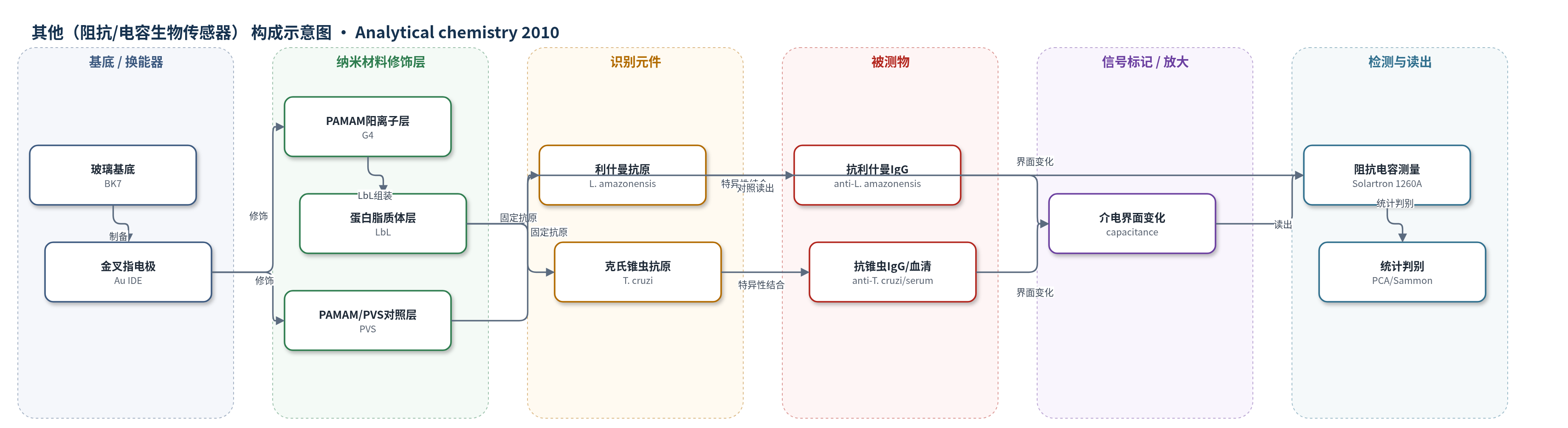
点击图片查看大图 · 依据论文自动绘制
传感器类型
其他(阻抗/电容生物传感器)
检测对象
抗 L. amazonensis IgG(anti-L. amazonensis IgG)、抗 T. cruzi IgG(anti-T. cruzi IgG);样品基质:小鼠总血清、纯化 IgG 溶液、缓冲液
检测原理
金叉指电极间隙通过 layer-by-layer 组装 PAMAM G4 与蛋白脂质体薄膜,蛋白脂质体中固定 L. amazonensis 膜抗原。样品中的抗 L. amazonensis IgG 与固定抗原特异性结合,在电极间隙介电区域形成额外界面并改变介电常数,使平面电容随抗体浓度增加而增大,约在 1 × 10^-5 mg/mL 达到平台。系统以 10 Hz–1 MHz 阻抗/电容谱读出,1–10 kHz 区域选择性最高。同时利用裸电极、PAMAM/PVS 对照电极和 T. cruzi 抗原电极的多电极电容数据,通过 PCA/Sammon 投影进行统计关联,从而区分抗 L. amazonensis、抗 T. cruzi 与阴性血清,减少交叉反应。检测不依赖酶或外源标记放大,主要依靠抗原-抗体识别、介电界面变化和统计判别。
检测灵敏度
可检测浓度: 10^-5 mg/mL;测试浓度范围: 10^-2–10^-10 mg/mL;平台: ca. 1 × 10^-5 mg/mL
效应效果
系统对抗 L. amazonensis IgG 选择性高,在 1–10 kHz 选择性最佳;混合抗体中仅抗 L. amazonensis 结合,阴性 IgG 与缓冲液响应一致,未观察到与 T. cruzi 交叉反应。PCA 可在 10^-5 mg/mL 区分缓冲液、阴性、抗 T. cruzi 和抗 L. amazonensis 样品。总血清稀释至 10^-2–10^-10 mg/mL 时仍能区分 L. amazonensis 阳性与 T. cruzi 阴性血清,说明无需纯化 IgG 即可用于现场诊断。检测在数分钟内完成,成本低,作者认为可扩展至结核、疟疾、非洲昏睡病等被忽视传染病。未报告 RSD、稳定性或回收率。
传感器的构成
- 基底/换能器电极:BK7 玻璃基底上光刻金叉指电极(Au interdigitated electrodes,10 µm 宽 × 70 nm 厚,间距 10 µm),提供平面电容/阻抗换能
- 纳米材料修饰层:PAMAM G4 阳离子树状分子与蛋白脂质体(proteoliposomes)通过 layer-by-layer 组装 5 个双层层,形成多孔薄膜,固定抗原并允许抗体扩散
- 识别元件:L. amazonensis 膜抗原蛋白(membrane antigenic proteins)嵌入蛋白脂质体,固定于叉指电极间隙,特异性结合抗 L. amazonensis IgG
- 识别元件:T. cruzi 抗原蛋白脂质体,用于构建鉴别传感器,区分抗 T. cruzi IgG
- 脂质体膜材料:DPPC:DPPS:cholesterol(5:1:4 w/w)磷脂/胆固醇,形成蛋白脂质体并承载膜抗原
- 对照修饰层:PAMAM/PVS 5 双层,作为非特异有机膜对照,用于多电极统计判别
- 信号标记物:无外源标记物,抗体结合本身改变电极间隙介电界面并引起电容变化
- 检测液/样品:5 mM Tris-HCl(pH 7.5)缓冲液、纯化 IgG 或总血清,提供离子环境
- 读出仪器:Solartron 1260A 阻抗/增益相位分析仪,10 Hz–1 MHz 电容/阻抗测量
中文摘要
可靠、快速的诊断工具是安全有效治疗被忽视疾病的关键。利什曼病是由利什曼原虫(Leishmania spp.)经受感染白蛉传播的寄生虫病,在发展中国家仍构成公共卫生问题,约1200万人感染、3.5亿人面临感染风险。现有诊断方法仍不够有效,尤其因与克氏锥虫(Trypanosoma cruzi)引起的恰加斯病交叉反应导致假阳性,特异性不足。公认的金标准是通过显微镜或培养分离寄生虫,但均需侵入性取材。本文报道一种低成本生物传感器系统,采用含特定 L. amazonensis 和 T. cruzi 抗原的纳米结构薄膜,并以阻抗谱作为检测方法。固定抗原与抗体之间的分子识别过程,以及对电学阻抗数据进行统计关联,使系统能够区分真实样本中的恰加斯病阳性和利什曼病阳性。该系统可在数分钟内区分含 10^-5 mg/mL 抗体溶液的血清样本。所采用方法具有通用性,可扩展到其他类型生物传感器,有助于多种疾病的现场诊断。
英文摘要
The need for reliable, fast diagnostics is closely linked to the need for safe, effective treatment of the so-called "neglected" diseases. The list of diseases with no field-adapted diagnostic tools includes leishmaniasis, shigella, typhoid, and bacterial meningitis. Leishmaniasis, in particular, is a parasitic disease caused by Leishmania spp. transmitted by infected phlebotomine sandfly, which remains a public health concern in developing countries with ca. 12 million people infected and 350 million at risk of infection. Despite several attempts, methods for diagnosis are still noneffective, especially with regard to specificity due to false positives with Chagas' disease caused by Trypanosoma cruzi . Accepted golden standards for detecting leishmaniasis involve isolation of parasites either microscopically, or by culture, and in both methods specimens are obtained by invasive means. Here, we show that efficient distinction between cutaneous leishmaniasis and Chagas' disease can be obtained with a low-cost biosensor system made with nanostructured films containing specific Leishmania amazonensis and T. cruzi antigens and employing impedance spectroscopy as the detection method. This unprecedented selectivity was afforded by antigen-antibody molecular recognition processes inherent in the detection with the immobilized antigens, and by statistically correlating the electrical impedance data, which allowed distinction between real samples that tested positive for Chagas' disease and leishmaniasis. Distinction could be made of blood serum samples containing 10(-5) mg/mL of the antibody solution in a few minutes. The methods used here are generic and can be extended to any type of biosensor, which is important for an effective diagnosis of many other diseases.