组成图示
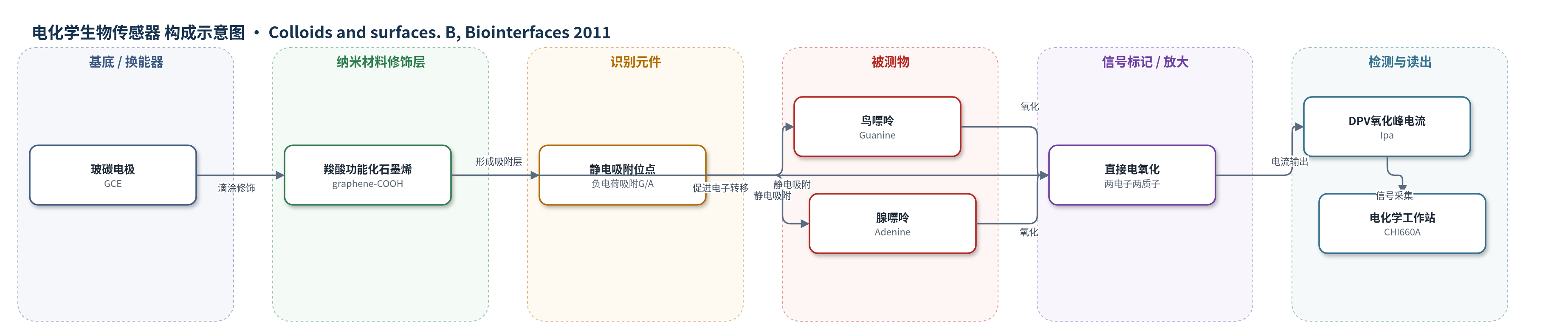
点击图片查看大图 · 依据论文自动绘制
传感器类型
电化学生物传感器
检测对象
鸟嘌呤(Guanine, G)、腺嘌呤(Adenine, A);样品基质:0.1 mol L−1醋酸缓冲液(ABS)标准溶液、热变性DNA溶液(鲱鱼精DNA热变性单链DNA)
检测原理
在pH 4.5的0.1 mol L−1醋酸缓冲液(ABS)中,graphene-COOH修饰玻碳电极(GCE)表面带有负电荷,可静电吸附带正电的鸟嘌呤(G)和腺嘌呤(A),并在开路预富集100 s后于电极界面富集。graphene-COOH具有良好导电性,能降低电子转移电阻,促进G和A的直接电氧化,使氧化峰电位较裸GCE负移(G约90 mV,A约105 mV)。G和A的氧化为不可逆两电子两质子过程,阳极峰电流随被测物浓度增加而增大,在0.5–200 μM范围内呈线性。由于G和A氧化峰电位分离约0.334 V,可用差分脉冲伏安法(DPV)同时检测。该方法未使用酶、适配体或核酸扩增放大,主要依靠静电吸附富集和石墨烯导电催化增强信号。
检测灵敏度
单独检测:Guanine LOD: 5.0 × 10⁻⁸ M;线性范围: 0.5–200 μM;Ipa (μA)=0.0103C (μM)+0.4774;R=0.9941。Adenine LOD: 2.5 × 10⁻⁸ M;线性范围: 0.5–200 μM;Ipa (μA)=0.0069C (μM)+0.4227;R=0.9951。同时检测:Guanine LOD: 5 × 10⁻⁸ M;线性范围: 0.5–200 μM;Ipa (μA)=0.0075C (μM)−0.3678;R=0.9985。Adenine LOD: 2.5 × 10⁻⁸ M;线性范围: 0.5–200 μM;Ipa (μA)=0.0065C (μM)+0.3370;R=0.9979。
效应效果
该传感器可同时检测G和A,氧化峰分离为0.334 V,有利于降低两者相互干扰。连续10次扫描测定1.0 μM G和1.0 μM A,RSD分别为2.62%和3.18%;15 d长期稳定性RSD≤5%;5个同批制备电极测定1.0 μM G和1.0 μM A的批间RSD为3.8%。在热变性DNA应用中,采用标准加入法测得A和G摩尔含量分别为22.2%和27.8%,(G+C)/(A+T)为0.80,与标准值0.77接近。作者指出,在血清和血浆中某些化合物会干扰测定,且血液基质易污染修饰电极,因此若用于复杂生物样品,应引入抗体或适配体等特异性识别元件。总体而言,该方法具有简单、快速、灵敏度高、重现性好和稳定性好等优点。
传感器的构成
- 基底/换能器电极:玻碳电极(GCE),直径3 mm,经氧化铝抛光和超声清洗后作为工作电极。
- 纳米材料修饰层:羧酸功能化石墨烯(graphene-COOH),由氧化石墨烯经HCl洗涤和快速加热裂解制得,滴涂6 μL水悬液干燥,提供导电通道与负电荷吸附位点。
- 识别元件:未使用抗体、适配体、酶或DNA探针等特异性识别元件,依赖graphene-COOH表面负电荷对带正电的鸟嘌呤(G)和腺嘌呤(A)进行静电吸附。
- 信号标记物:无外源标记物,鸟嘌呤和腺嘌呤在电极表面直接发生不可逆电氧化,其阳极峰电流作为检测信号。
- 检测介质:0.1 mol L−1醋酸缓冲液(ABS,pH 4.5),提供质子参与氧化反应并维持稳定电化学环境。
- 读出方式:差分脉冲伏安法(DPV)和循环伏安法(CV),在CHI660A电化学工作站三电极体系中记录氧化峰电流。
中文摘要
本文制备了羧酸功能化石墨烯(graphene-COOH)纳米材料,并将其修饰于玻碳电极(GCE)表面,构建了用于同时检测腺嘌呤(adenine, A)和鸟嘌呤(guanine, G)的新型电化学生物传感器。通过循环伏安法(CV)和差分脉冲伏安法(DPV)系统研究了A和G在graphene-COOH/GCE上的直接电氧化行为。结果表明,与裸GCE相比,A和G在修饰电极上的氧化峰电流明显增大,氧化峰电位发生负移。作者计算了A和G在graphene-COOH/GCE上的电化学参数,并建立了分别检测A和G的简单、可靠的电化学分析方法。该修饰电极在同时检测A和G时表现出良好的峰分离,峰间分离为0.334 V。单独检测时,G和A的检出限分别为5.0×10⁻⁸ M和2.5×10⁻⁸ M(S/N=3)。此外,作者利用该传感器测定了热变性单链DNA中A和G的含量,并计算出(G+C)/(A+T)值为0.80。该传感器具有操作简便、分析快速、灵敏度高、重现性好和长期稳定性好等优点。
英文摘要
A nano-material carboxylic acid functionalized graphene (graphene-COOH) was prepared and used to construct a novel biosensor for the simultaneous detection of adenine and guanine. The direct electrooxidation behaviors of adenine and guanine on the graphene-COOH modified glassy carbon electrode (graphene-COOH/GCE) were carefully investigated by cyclic voltammetry and differential pulse voltammetry. The results indicated that both adenine and guanine showed the increase of the oxidation peak currents with the negative shift of the oxidation peak potentials in contrast to that on the bare glassy carbon electrode. The electrochemical parameters of adenine and guanine on the graphene-COOH/GCE were calculated and a simple and reliable electroanalytical method was developed for the detection of adenine and guanine, respectively. The modified electrode exhibited good behaviors in the simultaneous detection of adenine and guanine with the peak separation as 0.334V. The detection limit for individual determination of guanine and adenine was 5.0×10(-8)M and 2.5×10(-8)M (S/N=3), respectively. Furthermore, the measurements of thermally denatured single-stranded DNA were carried out and the value of (G+C)/(A+T) of single-stranded DNA was calculated as 0.80. The biosensor exhibited some advantages, such as simplicity, rapidity, high sensitivity, good reproducibility and long-term stability.