组成图示
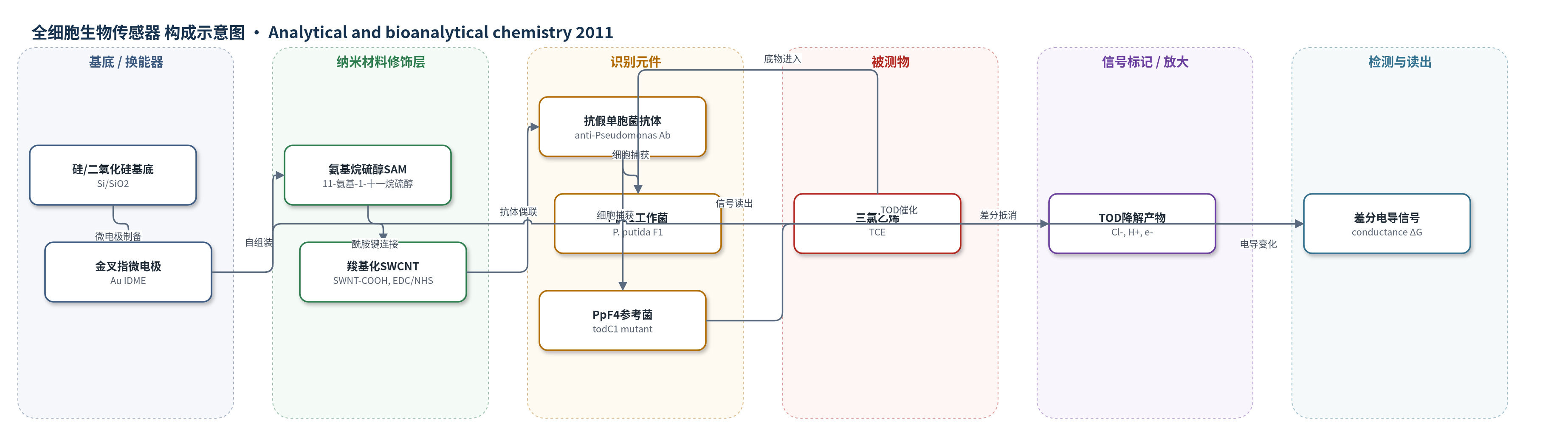
点击图片查看大图 · 依据论文自动绘制
传感器类型
全细胞生物传感器
检测对象
三氯乙烯(trichloroethylene, TCE);样品基质:地下水/水样(加标地下水及城市工业场地地下水)
检测原理
该传感器以甲苯诱导的PpF1为生物识别元件,其表达甲苯双加氧酶(TOD)。TCE进入细胞后被TOD共代谢氧化,生成乙醛酸和甲酸盐,并释放Cl-、H+和电子,使溶液离子强度增加,电导升高。工作电极固定PpF1,参考电极固定不能降解TCE的todC1缺陷突变株PpF4,采用10 mV、100 kHz小振幅交流差分电导测量,可抵消介质组成、温度等引起的背景电导变化。TCE浓度越高,TOD催化产生的离子越多,差分电导变化越大。SAM/SWCNT三维结构提高细菌负载、底物可及性和电子传递,从而增强响应。
检测灵敏度
LOD: 0.07 μM(若20 μL进样对应样品0.4 μM);线性范围: 0.07–100 μM;灵敏度: 0.4378±0.004 μS μM−1;R^2 = 0.9952
效应效果
该传感器响应时间约8 min,比无碳纳米管体系(22 min)更快,灵敏度提高80倍。短期重现性良好,10–100 μM范围内5次测量变异系数为2%–4%;4°C保存5周信号稳定,7周后仍保留92%初始信号。选择性方面,cis-1,2-DCE和氯乙烯在10 μM时相对响应仅6%和4%,酚为35%,甲苯为主要干扰,且与TCE竞争TOD位点。实际地下水加标回收率为102%、98%、99%;与HS-GC/MS测定六个场地水样结果一致(如P2:175.1±0.3对175.6 μM)。作者认为其适合现场快速监测TCE降解与水质。
传感器的构成
- 基底/换能器:硅基底上的二氧化硅层与金叉指薄膜微电极(Au interdigitated microelectrodes),Pt导线连接,氮化硅覆盖层,用于差分电导换能
- 自组装单层:11-氨基-1-十一烷硫醇(11-amino-1-undecanethiol, SAM-NH2)在金表面形成端氨基自组装单层,提供连接位点
- 碳纳米管修饰层:羧基化单壁碳纳米管(SWNT-COOH)经EDC/NHS活化后与SAM-NH2形成酰胺键,构建三维结构,提高细菌负载、可及性和电子传递
- 识别/固定元件:抗假单胞菌多克隆抗体(anti-Pseudomonas antibodies, Ab)偶联于SWNT-COOH,用于捕获细菌
- 封闭剂:0.1%酪蛋白(caseine)封闭未反应和非特异性位点
- 生物识别元件:甲苯诱导的Pseudomonas putida F1野生菌(PpF1)固定于工作电极;todC1缺陷突变株PpF4固定于参考电极,用于差分测量
- 信号产生元件:PpF1内甲苯双加氧酶(TOD)催化TCE降解,产生Cl-、H+和电子,改变溶液电导
中文摘要
三氯乙烯(TCE)是一种可疑人类致癌物,也是最常见的地下水挥发性污染物之一。现有测定方法多昂贵、耗时且需要专业操作人员。本文开发了一种快速、灵敏、微型化的全细胞电导生物传感器,用于检测TCE。该传感器通过将假单胞菌Pseudomonas putida F1(PpF1)固定于金叉指微电极表面构建,固定层为经抗假单胞菌抗体功能化的三维烷硫醇自组装单层/碳纳米管结构。TCE在0.07–100 μM范围内呈线性响应(9–13100 μg/L)。传感器在4°C、M457 pH 7培养基中保存5周未见明显酶活损失,7周后仍保留92%初始信号。其对顺式-1,2-二氯乙烯和氯乙烯无显著干扰,受酚的影响有限,甲苯为主要干扰物。该传感器成功用于加标地下水和六个受TCE污染的城市工业场地水样测定,结果经气相色谱-质谱法确认。
英文摘要
Trichloroethylene (TCE), a suspected human carcinogen, is one of the most common volatile groundwater contaminants. Many different methodologies have already been developed for the determination of TCE and its degradation products in water, but most of them are costly, time-consuming and require well-trained operators. In this work, a fast, sensitive and miniaturised whole cell conductometric biosensor was developed for the determination of trichloroethylene. The biosensor assembly was prepared by immobilising Pseudomonas putida F1 bacteria (PpF1) at the surface of gold interdigitated microelectrodes through a three-dimensional alkanethiol self-assembly monolayer/carbon nanotube architecture functionalised with Pseudomonas antibodies. The biosensor response was linear from 0.07 to 100 μM of TCE (9-13,100 μg L(-1)). No significant loss of the enzymatic activity was observed after 5 weeks of storage at 4 °C in the M457 pH 7 defined medium (two or three measurements per week). Ninety-two per cent of the initial signal still remained after 7 weeks. The biosensor response to TCE was not significantly affected by cis-1,2-dichloroethylene and vinyl chloride and, in a limited way, by phenol. Toluene was the major interference found. The bacterial biosensor was successfully applied to the determination of TCE in spiked groundwater samples and in six water samples collected in an urban industrial site contaminated with TCE. Gas chromatography-mass spectrometric analysis of these samples confirmed the biosensor measurements.