组成图示
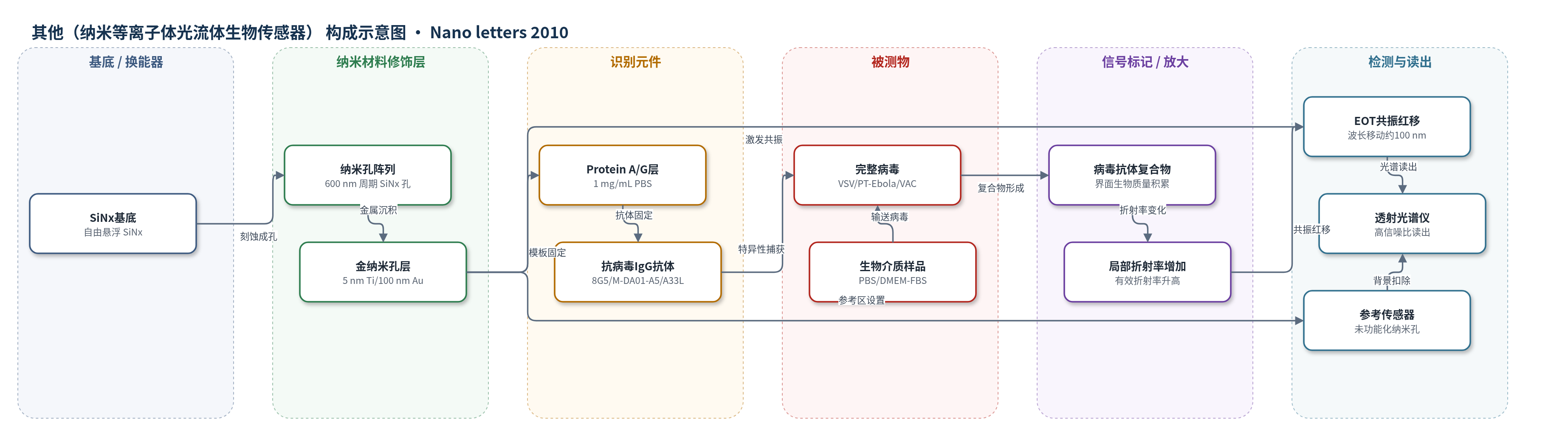
点击图片查看大图 · 依据论文自动绘制
传感器类型
其他(纳米等离子体光流体生物传感器)
检测对象
水泡性口炎病毒(vesicular stomatitis virus, VSV)、假型埃博拉病毒(pseudotyped Ebola, PT-Ebola)、痘苗病毒(vaccinia virus);样品基质为 PBS 或 DMEM/FBS 细胞培养基等生物介质
检测原理
传感器由金纳米孔阵列构成,垂直入射光通过光栅耦合在金属/介质界面激发表面等离子极化激元(SPP),形成异常光透射(EOT)共振。共振波长与邻近介质有效折射率相关。Protein A/G 将抗病毒 IgG 抗体定向固定于金表面,完整病毒经 PBS 或 DMEM/FBS 介质输送至传感面后,其糖蛋白与抗体特异性结合。病毒在界面累积使局部有效折射率升高,EOT 共振峰发生红移;病毒浓度越高,累积生物质量越大,红移越明显。由于 SPP 场在界面指数衰减,体相温度或折射率波动影响较小。系统通过透射光谱读取共振波长变化,并用未功能化参考孔扣除非特异结合,实现无标记、定量检测。
检测灵敏度
动态范围: 10^6–10^9 PFU/mL;分辨率: 0.05 nm;FOM: ~40;预测检测限: <10^5 PFU/mL
效应效果
该平台可在 PBS 和含 7% 胎牛血清的 DMEM/FBS 培养基中直接检测完整病毒。未功能化对照孔在 10^9 PFU/mL VSV 下仅约 1 nm 红移;生物介质中参考孔非特异结合约 1.3 nm,抗体孔在 10^6 PFU/mL 下约 4 nm 红移,可区分背景。PT-Ebola 和痘苗病毒在 10^8 PFU/mL 下均被 9/9 个传感器检出,红移约 14–21 nm,重复性好、信噪比高。器件 FOM 约 40,半高宽 15–20 nm,可在 BSL1/2 普通实验室无机械/光学隔离使用。与 ELISA/PCR 相比,它无标记、可定量、可多路复用,且捕获病毒保持完整,便于后续研究。
传感器的构成
- 基底/换能器:自由悬浮 SiNx 薄膜,经光刻与 KOH 湿法刻蚀形成,支撑纳米孔阵列并允许垂直光透射
- 纳米孔阵列:SiNx 膜上电子束光刻与 RIE 定义的纳米孔,周期 600 nm、孔径半径 220 nm、面积 90 µm×90 µm,构成光流体通道和等离子体共振结构
- 金属等离子体层:5 nm Ti 粘附层加 100 nm Au 直接沉积,形成悬浮金纳米孔阵列,激发 SPP 并产生 EOT 共振
- 识别固定模板:Protein A/G(蛋白 A/G,1 mg/mL PBS)固定于金表面,结合 IgG 的 Fc 区并定向固定抗体
- 识别元件:抗病毒 IgG 抗体(8G5 抗 VSV-GP、M-DA01-A5 抗 Ebola-GP、A33L 抗 Vaccinia-GP,0.5 mg/mL PBS)点样固定,特异性捕获病毒糖蛋白
- 参考/对照区:未功能化纳米孔传感器,用于扣除漂移、噪声和非特异结合
- 信号读出:透射光谱仪读取 EOT 共振波长红移,高浓度时透射光颜色变化可肉眼观察
中文摘要
快速、灵敏且可多点部署的病毒检测技术对防控未来疫情和生物恐怖威胁至关重要。本文报道了一种无标记光流体纳米等离子体生物传感器,可在几乎无需样品前处理的情况下,直接从生物介质中以临床相关浓度检测完整病毒。该平台基于等离子体纳米孔中的异常光透射效应,并利用群特异性抗体识别快速进化病毒的不同毒株。针对表面等离子极化激元穿透深度与病原体尺寸相当可能带来的局限,作者证明该平台能够检测并识别小型包膜 RNA 病毒(水泡性口炎病毒和假型埃博拉病毒)以及大型包膜 DNA 病毒(痘苗病毒),动态范围跨越 3 个数量级。该平台无需机械或光学隔离即可实现高信噪比测量,为在普通生物学实验室环境中检测多种病原体提供了可能。
英文摘要
Fast and sensitive virus detection techniques, which can be rapidly deployed at multiple sites, are essential to prevent and control future epidemics and bioterrorism threats. In this Letter, we demonstrate a label-free optofluidic nanoplasmonic sensor that can directly detect intact viruses from biological media at clinically relevant concentrations with little to no sample preparation. Our sensing platform is based on an extraordinary light transmission effect in plasmonic nanoholes and utilizes group-specific antibodies for highly divergent strains of rapidly evolving viruses. So far, the questions remain for the possible limitations of this technique for virus detection, as the penetration depths of the surface plasmon polaritons are comparable to the dimensions of the pathogens. Here, we demonstrate detection and recognition of small enveloped RNA viruses (vesicular stomatitis virus and pseudotyped Ebola) as well as large enveloped DNA viruses (vaccinia virus) within a dynamic range spanning 3 orders of magnitude. Our platform, by enabling high signal to noise measurements without any mechanical or optical isolation, opens up opportunities for detection of a broad range of pathogens in typical biology laboratory settings.