组成图示
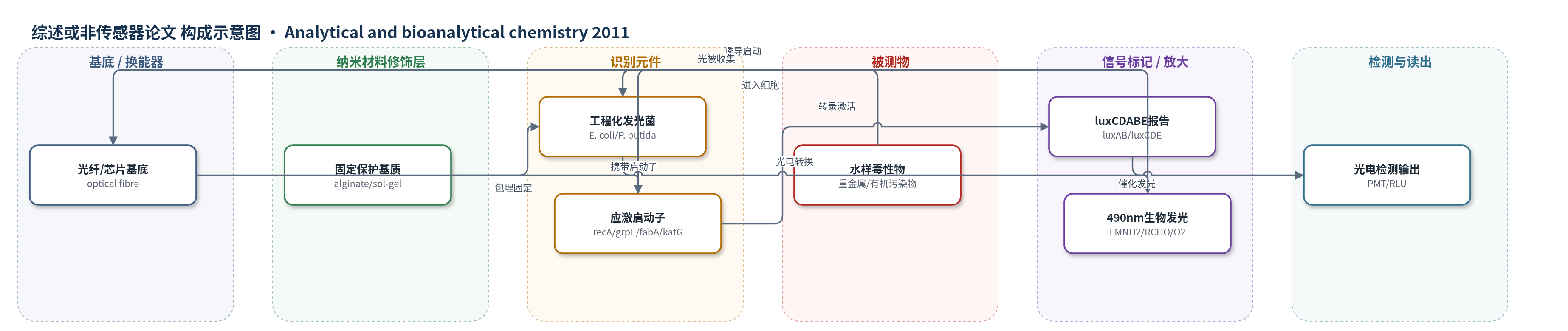
点击图片查看大图 · 依据论文自动绘制
传感器类型
综述或非传感器论文
检测对象
DNA损伤剂(mitomycin C/MMC、MNNG)、氧化应激物(H2O2、paraquat)、蛋白/膜损伤物(ethanol、phenol、4-bromophenol)、有机污染物(BTEX、toluene、naphthalene、salicylate、PCBs、phenols)、重金属(As、Cd、Hg、Cu、Ag、Zn、Pb);样品基质:地表水、饮用水、地下水、河水/土壤浸提物等。
检测原理
毒性物随水样穿过细菌细胞壁与细胞膜,进入胞内后激活特定启动子,如recA、grpE、fabA、katG、soxS、tod、nahG、merR等,使luxCDABE报告基因转录翻译。luxAB编码荧光素酶,催化FMNH2、长链醛RCHO和O2氧化,释放490 nm光子;luxCDE再生醛底物,使系统无需外源添加即可持续发光。毒性物浓度越高,启动子诱导越强,荧光素酶表达量增加,光强或响应比随之升高。灵敏度可通过染色体插入降低背景、tolC突变提高胞内毒物浓度、luxAB诱导而luxCDE组成表达等策略增强。
检测灵敏度
LOD: <0.01 mg/l MNNG;0.1 μg/l MMC;0.1 mg/l H2O2;0.01 mg/l paraquat;0.1 mg/l toluene;30 μg/l toluene;45 μg/l naphthalene;4 μg/l salicylic acid;0.15 mg/l 4-CB;0.03 mg/l 2-methylphenol;4 μg/l As;10 nM (1.1 μg/l) Cd;11 μg/l Cu;19-64 μg/l Ag;0.0136 μg/l HgCl2;0.002 μg/l CH3HgCl
效应效果
多数lux菌株检出限为mg/L至μg/L,化合物特异性菌株更灵敏,但除甲基汞(0.002 μg/l)等汞菌株外,多数阈值高于饮用水TTC目标值(基因毒性物0.01 μg/l、其他0.1 μg/l),难监测单个痕量污染物。响应时间平均约60 min,快速≤30 min,慢≥90 min,约1 h可满足地表水预警。选择性信息有限;效应特异性菌株可响应同效应混合物,具总效应监测价值。越南地下水砷检测194份样品与化学分析比较,假阴性8.0%、假阳性2.4%;20 mg/l Fe使砷检出限升至7.5 μg/l,仍低于WHO 10 μg/l。E. coli自然水稳健性较差,P. putida/P. fluorescens可能更适用。
传感器的构成
- 反应/样品接触腔:culture plate、portable sensor、bioreactor、optical fibre probe等,作为水样与菌体接触的反应单元。
- 固定/保护基质:alginate beads、sol-gel、latex等,用于包埋或固定工程菌,维持其活性。
- 生物识别层:工程化发光细菌(E. coli、P. putida、P. fluorescens、P. aeruginosa、B. subtilis、S. aureus)及其细胞壁/膜,作为毒性物进入与感应单元。
- 识别元件:应激或化合物特异性启动子(recA、grpE、fabA、katG、soxS、tod、nahG、nagR-nagAa、merR、zntA、copA、cadR、pbrR、arsR),响应DNA损伤、蛋白/膜损伤、氧化应激、有机污染物或重金属。
- 信号报告系统:luxCDABE基因簇,其中luxAB编码荧光素酶,luxCDE编码底物再生系统,实现无需外源底物的生物发光。
- 换能/读出基底:光学检测系统(photomultiplier、optical fibre、cell chip、microfluid chip),用于接收490 nm生物发光并转换为电信号。
中文摘要
基于发光细菌的生物传感器可能是监测地表水和饮用水化学质量与安全的重要工具。本综述概述了携带细菌荧光素酶基因luxCDABE的重组菌株,这些菌株可用于水质在线生物传感器。已有多种细菌菌株被报道用于检测DNA损伤、蛋白损伤、膜损伤、氧化应激、有机污染物和重金属等毒性参数。多数lux菌株的检出限在毫克/升至微克/升范围,化合物特异性菌株通常灵敏度更高。虽然可通过分子操作提高lux菌株灵敏度,但多数报道的检出阈值仍高于当前欧洲饮用水中单个污染物的实际水平。然而,能感应特定毒性效应的lux菌株可响应诱导相同效应的污染物混合物,因此可作为总效应传感器,包括化学分析尚未识别的化合物。本文据此评估了lux菌株用于地表水和饮用水监测的适用性。
英文摘要
Biosensors based on luminescent bacteria may be valuable tools to monitor the chemical quality and safety of surface and drinking water. In this review, an overview is presented of the recombinant strains available that harbour the bacterial luciferase genes luxCDABE, and which may be used in an online biosensor for water quality monitoring. Many bacterial strains have been described for the detection of a broad range of toxicity parameters, including DNA damage, protein damage, membrane damage, oxidative stress, organic pollutants, and heavy metals. Most lux strains have sensitivities with detection limits ranging from milligrams per litre to micrograms per litre, usually with higher sensitivities in compound-specific strains. Although the sensitivity of lux strains can be enhanced by various molecular manipulations, most reported detection thresholds are still too high to detect levels of individual contaminants as they occur nowadays in European drinking waters. However, lux strains sensing specific toxic effects have the advantage of being able to respond to mixtures of contaminants inducing the same effect, and thus could be used as a sensor for the sum effect, including the effect of compounds that are as yet not identified by chemical analysis. An evaluation of the suitability of lux strains for monitoring surface and drinking water is therefore provided.