组成图示
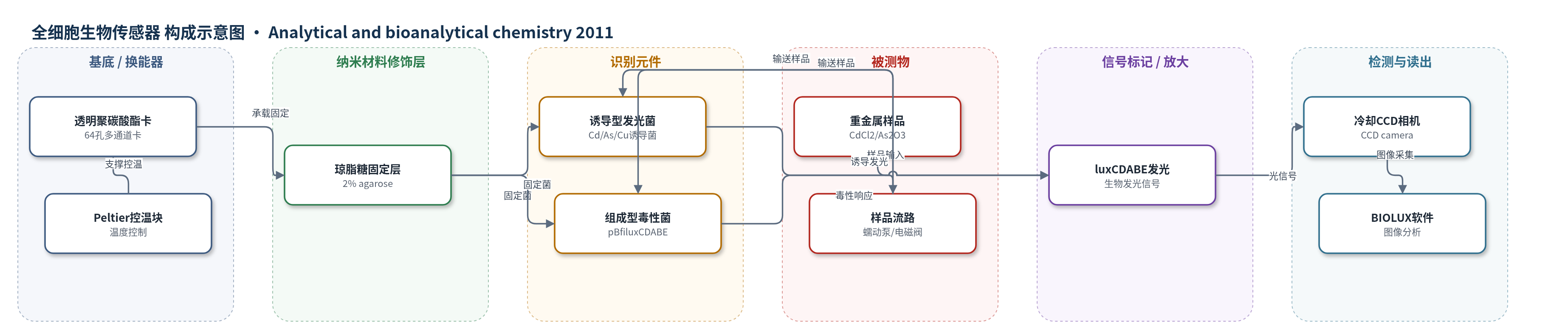
点击图片查看大图 · 依据论文自动绘制
传感器类型
全细胞生物传感器
检测对象
镉(CdCl2/Cd2+)、三价砷(As2O3/As(III));样品基质:环境水样/进水(以1/10乙酸盐培养基模拟)
检测原理
传感器以固定化重组大肠杆菌为识别元件。诱导型菌株分别携带金属响应启动子pzntA、parsR或pcopA驱动的luxCDABE发光操纵子;当样品中的Cd2+、As(III)等金属进入孔道并激活相应调控系统时,lux基因表达增加,荧光素酶催化底物氧化产生生物发光。组成型pBfiluxCDABE菌株持续发光,若样品具有毒性,其代谢或发光强度发生下降/变化。多菌株同时固定形成响应指纹。冷却CCD相机每10 min采集整卡图像,BIOLUX 1.0软件对每孔像素灰度求平均,得到0–1相对发光强度,并以诱导比IR=诱导后峰值/诱导前背景评价响应。信号随金属诱导强度或毒性抑制程度变化,从而实现在线检测。
检测灵敏度
原文未报告LOD/线性范围/斜率/R^2;报告数值:CdCl2 0.5 μM、As2O3 5 μM;IR: pBzntlux(Cd)=33、pBarslux(Cd)≈9、pBarslux(As)=62、混合pBzntlux=80、pBarslux=1362
效应效果
在三个独立实验中,每孔生物发光标准误差低于5%。CdCl2 0.5 μM主要诱导pBzntlux(IR=33)和pBarslux(约9倍),pBcoplux无显著信号;As2O3 5 μM主要诱导pBarslux(IR=62),其他诱导菌IR<2。混合金属时pBzntlux IR=80、pBarslux IR=1362,显著强于单独砷响应,显示交叉反应与协同效应。组成型毒性菌在测试浓度下保持稳定,说明样品未造成明显毒性。作者认为该装置是首个在线多菌株生物发光金属/毒性监测平台,可生成污染指纹,但受菌体保质期数天、代谢漂移、污染、生物膜及CCD灵敏度限制,仍需专用软件解析复杂混合金属。
传感器的构成
- 基底/多通道卡:透明聚碳酸酯(transparent polycarbonate)可移除卡,64孔、深3 mm、8条流道,承载固定化菌并透光
- 控温层:Peltier块(Peltier block)置于卡下方,调节并维持检测温度,避免边缘效应
- 固定化层:琼脂糖基质(agarose matrix,2% w/v)包裹细菌,40 μL/孔,限制菌体流失
- 识别元件:重组发光大肠杆菌,包括E. coli DH1 pBzntlux(Cd/Hg诱导)、pBarslux(As诱导)、pBcoplux(Cu诱导)
- 毒性识别元件:组成型发光大肠杆菌E. coli XL1 pBfiluxCDABE,用于全局毒性监测
- 信号元件:luxCDABE发光操纵子(Vibrio fischeri lux operon),在金属诱导或组成型表达下产生生物发光
- 阴性对照元件:E. coli DH1 pBtac2和E. coli pBfiluxCDABE-P,用于排除非特异性发光
- 流体系统:八滚轮蠕动泵(peristaltic pump, Meredos)、多位置电磁阀(VICI Valco)、Tygon RS3603管和PTFE接头,输送样品/培养基
- 光学读出:冷却CCD相机(SPTO RT SE 6, Optilas,-28 °C)与BIOLUX 1.0软件,采集并计算每孔生物发光强度
中文摘要
本研究面向环境水污染监测,报道了一种用于在线检测重金属和总毒性的多通道生物发光细菌生物传感器Lumisens3的构建与概念验证。该固定相装置可连续分析水污染,并允许将任意诱导型或组成型生物发光菌株固定于可移除多孔卡中。其技术设计包括四个主要部分:(1)专用可移除卡含64个深3 mm的孔,排列于8条流道中,用于固定细菌;(2)该卡置于Peltier控温块上,上方配置冷却CCD相机以监测生物发光;(3)流体网络向卡中输送待测样品;(4)专用计算机界面BIOLUX 1.0控制各部件并实现自主运行。概念验证采用四种生物发光大肠杆菌(E. coli DH1 pBzntlux、pBarslux、pBcoplux和E. coli XL1 pBfiluxCDABE),在线检测进水中的CdCl2 0.5 μM和As2O3 5 μM。单独金属时传感器指纹符合预期;混合金属时检测到交叉反应和协同效应。该传感器可同时在线交叉检测一种或多种重金属,并测量样品总毒性。
英文摘要
This research study deals with the on-line detection of heavy metals and toxicity within the context of environmental pollution monitoring. It describes the construction and the proof of concept of a multi-channel bioluminescent bacterial biosensor in immobilized phase: Lumisens3. This new versatile device, designed for the non-stop analysis of water pollution, enables the insertion of any bioluminescent strains (inducible or constitutive), immobilized in a multi-well removable card. The technical design of Lumisens3 has benefited from both a classical and a robust approach and includes four main parts: (1) a dedicated removable card contains 64 wells, 3 mm in depth, arranged in eight grooves within which bacteria are immobilized, (2) this card is incubated on a Pelletier block with a CCD cooled camera on top for bioluminescence monitoring, (3) a fluidic network feeds the card with the sample to be analyzed and finally (4) a dedicated computer interface, BIOLUX 1.0, controls all the elements of the biosensor, allowing it to operate autonomously. The proof of concept of this biosensor was performed using a set of four bioluminescent bacteria (Escherichia coli DH1 pBzntlux, pBarslux, pBcoplux, and E. coli XL1 pBfiluxCDABE) in the online detection of CdCl(2) 0.5 μM and As(2)O(3) 5 μM from an influent. When considering metals individually, the "fingerprints" from the biosensor were as expected. However, when metals were mixed together, cross reaction and synergistic effects were detected. This biosensor allowed us to demonstrate the simultaneous on-line cross detection of one or several heavy metals as well as the measurement of the overall toxicity of the sample.