组成图示
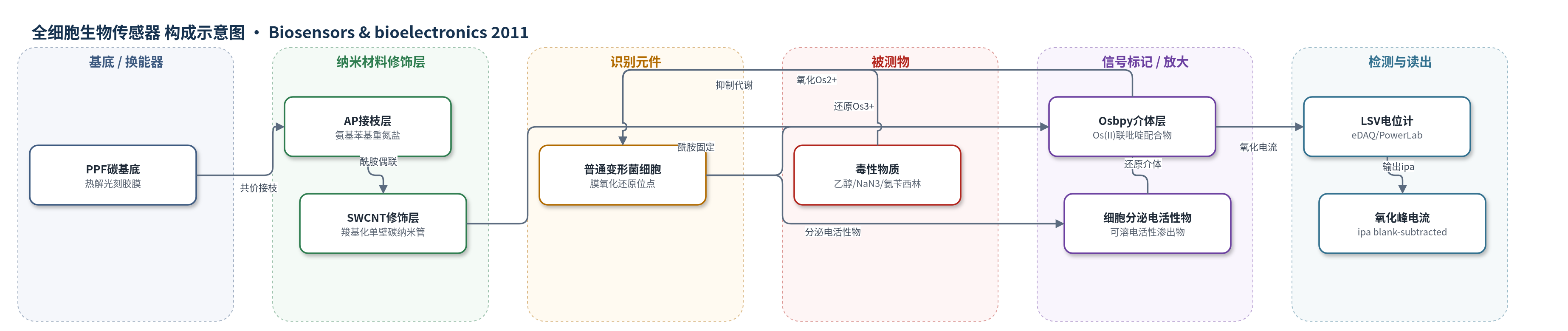
点击图片查看大图 · 依据论文自动绘制
传感器类型
全细胞生物传感器
检测对象
乙醇(ethanol)、叠氮化钠(sodium azide, NaN3)、氨苄西林(ampicillin);样品基质为含普通变形菌(P. vulgaris)和1 mM葡萄糖的50 mM PBS pH 7培养液/电化学池样品
检测原理
普通变形菌全细胞在PPF-SWCNT-Osbpy电极表面孵育,细胞膜氧化还原位点与表面固定的锇(II)联吡啶介体接触。线性扫描伏安法正向扫描时,电极将Osbpy中的Os2+氧化为Os3+;活细胞以葡萄糖为代谢底物,通过膜上氧化还原中心将Os3+还原回Os2+,形成EC'催化循环,使氧化峰电流增大。电流大小取决于细胞代谢率和电子转移能力。毒性物质如乙醇破坏膜完整性、叠氮化钠抑制代谢、氨苄西林抑制细胞壁合成,会降低细胞活性并减少电子转移,同时细胞分泌的可溶电活性物也参与还原介体,因此氧化峰电流随毒性物质浓度和作用强度下降。
检测灵敏度
未报告LOD、线性范围、灵敏度斜率或相关系数。
效应效果
该传感器以1小时电化学孵育替代至少16小时平板计数,结果与标准菌落存活率测定高度一致。12.5%乙醇使电化学信号降低70%,活菌数降低72%;25%、50%和70%乙醇下仍测得小信号,平板计数分别为4.33×10^5、1.33×10^5和6.67×10^5 cells/mL。叠氮化钠低浓度毒性高于高浓度,氨苄西林结果与平板计数一致。一个电极在96天/约4个月内完成约1000次测量,空白初始电流507 nA、CoV 6.0%,20天后响应稳定、CoV 9.3%。作者认为可用于抗菌药物高通量筛选、环境毒性评估和BOD监测。
传感器的构成
- 基底/换能器电极:热解光刻胶膜(pyrolysed photoresist film, PPF)碳类工作电极,表面电阻18–25 Ω cm−1,提供导电基底
- 共价接枝层:4-氨基苄胺重氮盐电接枝形成的氨基苯基(aminophenyl, AP)层,通过C–C键连接PPF,为SWCNT提供锚定位点
- 纳米材料修饰层:羧基化单壁碳纳米管(carboxylated single-walled carbon nanotubes, SWCNTs),经DCC偶联到AP层,提供导电通道和界面
- 信号标记/电子介体层:锇(II)联吡啶配合物(osmium(II) bipyridine complex, Osbpy;Os(bpy)2Cl(4-aminomethylpyridine)+),经EDCI/NHS与SWCNT羧基酰胺键固定,作为表面氧化还原介体
- 识别元件:普通变形菌(Proteus vulgaris, P. vulgaris)全细胞,OD600=1,其膜氧化还原位点与Osbpy介体接触并转移电子
- 代谢底物:葡萄糖(glucose, 1 mM),在50 mM PBS pH 7中驱动细胞代谢,维持电子产生
中文摘要
本文报道了一种由化学组装在碳表面上的单壁碳纳米管(SWCNTs)并功能化锇(II)联吡啶配合物(Osbpy)构成的电极的制备与应用。该电极能够将普通变形菌(Proteus vulgaris)生物代谢产生的电流转换为可测电化学信号。研究表明,电流由两部分贡献:一部分来自细胞分泌到溶液中的电活性物质,另一部分来自细胞膜氧化还原位点与电极的直接电子转移。该修饰电极可监测细胞代谢,从而作为全细胞生物传感器。作者将其用于1小时毒性检测,评估乙醇、叠氮化钠和抗生素氨苄西林对普通变形菌的毒性,所得定量结果与标准平板菌落存活率测定高度一致。结果证明该全细胞生物传感器可用于抗菌活性高通量筛选。一个修饰电极在约4个月内完成约1000次测量,表明系统具有良好的稳健性。
英文摘要
We report the fabrication and use of electrodes constructed from single walled carbon nanotubes (SWCNTs) chemically assembled on a carbon surface and functionalised with an osmium(II) bipyridine complex (Osbpy). The ability of the electrodes to transduce biologically generated currents from Proteus vulgaris has been established. Our investigations show that there are two contributions to the current: one from electroactive species secreted into solution and another from cell redox sites. The modified electrode can be used to monitor cell metabolism, thereby acting as a whole cell biosensor. The biosensor was used in a 1-h assay to investigate the toxicity of ethanol, sodium azide and the antibiotic ampicillin and gave quantitative data that were closely correlated with standard cell plate viability assays. The results provide proof of principle that the whole cell biosensor could be used for high throughput screening of antimicrobial activity. One of the modified electrodes was used for approximately 1000 measurements over four months demonstrating the robustness of the system.