组成图示
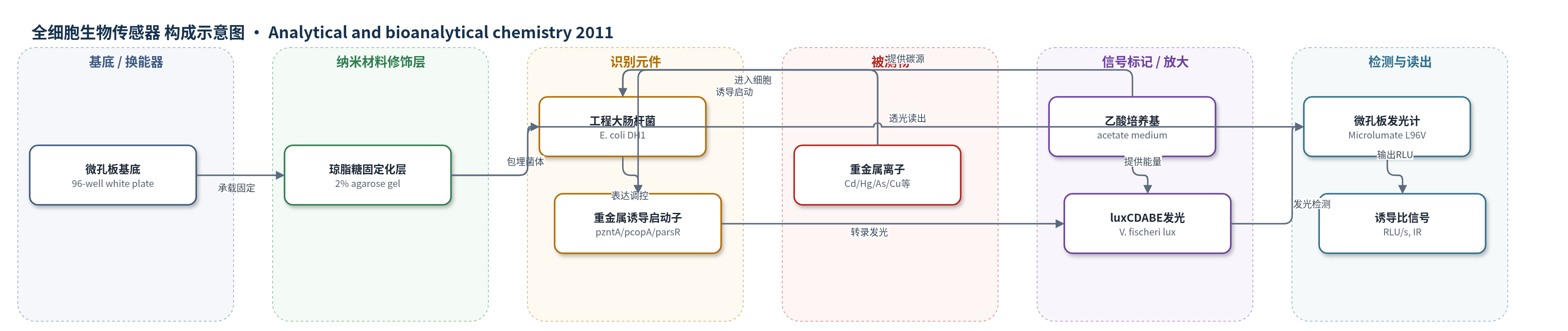
点击图片查看大图 · 依据论文自动绘制
传感器类型
全细胞生物传感器
检测对象
镉(Cd, CdCl2)、汞(Hg, HgCl2)、铅(Pb, PbCH3CH2O)、锡(Sn, SnCl2)、砷(As, As2O3/As2O5)、锌(Zn, ZnCl2)、镍(Ni, NiSO4)、钴(Co, CoCl2)、铬(VI)(Cr(VI), K2Cr2O7)、铜(Cu, CuSO4)、银(Ag, AgNO3);样品基质:水样/酸化蒸馏水重金属标准溶液。
检测原理
重金属离子进入包埋于琼脂糖凝胶中的工程大肠杆菌后,与细胞内 MerR 家族调控蛋白 ZntR/CopR 或 SmtB/ArsR 家族 ArsR 结合,引起调控蛋白构象和启动子亲和力变化,从而激活或解除 pzntA、pcopA、parsR 等诱导启动子。启动子驱动 Vibrio fischeri luxCDABE 操纵子转录翻译,表达荧光素酶及辅因子合成酶;乙酸碳源培养基提供代谢能量。荧光素酶催化生物发光反应,在约490和590 nm产生光信号。金属浓度越高,诱导的 lux 表达和发光强度通常越强,微孔板发光计记录相对光单位/秒(RLU/s),并以诱导比 IR=(RLUs−1)i/(RLUs−1)o 表征响应。不同菌株对金属的交叉响应形成多通道指纹,用于区分 Cd、Hg 等金属。
检测灵敏度
LOD: 5 nM(镉和汞,原文:Cadmium and mercury were detected by all the strains with a detection limit of 5 nM);LOD: 5 nM(As2O3,E. coli pBarslux,原文:The detection limit (5 nM) for As2O3 with the E. coli pBarslux was very low);LOD: DLliquid=0.005 μM、DLPVA=0.05 μM、DLagarose=0.005 μM(CdCl2,E. coli DH1 pBzntlux)。
效应效果
该全细胞发光生物传感器可检测12种重金属,并利用三种菌株的交叉响应缩小候选金属范围,例如三株同时响应可提示 Cd 或 Hg。乙酸碳源使 E. coli DH1 pBzntlux 在 5 μM 和 0.05 μM CdCl2 下的诱导比分别达 1700 和 45,显著优于其他碳源。固定化比较显示,PVA 使诱导比下降 99%,最大信号时间由悬浮菌 41 min 延长至 117 min,且 CdCl2 检出限由 0.005 μM 升至 0.05 μM;琼脂糖使诱导比下降 43%,最大信号时间为 67 min,但检出限保持 0.005 μM。文中未报告 RSD、实际样品回收率或加标实验;作者认为其检出限接近或低于欧洲水污染标准,适合发展为多通道 Lumisens3 在线重金属/毒性检测系统。
传感器的构成
- 换能/读出基底:96孔白色微孔板(96-well white microtiter plate),承载固定化菌胶并用于微孔板发光计测量。
- 固定化基质:2% 琼脂糖(agarose, Type VII-A Low Gelling Temperature 26°C)水凝胶,包埋活菌、允许重金属扩散并保持细胞活性。
- 识别/传感元件:工程大肠杆菌 E. coli DH1,携带 pBzntlux、pBarslux、pBcoplux 质粒,分别含重金属诱导启动子 pzntA、parsR::arsR、pcopA。
- 调控识别元件:MerR 家族 ZntR/CopR 与 SmtB/ArsR 家族 ArsR 调控蛋白,结合重金属后改变启动子活性。
- 信号报告系统:Vibrio fischeri luxCDABE 发光操纵子,表达荧光素酶及辅因子合成酶,产生约490/590 nm生物发光。
- 代谢底物/电子供体:乙酸碳源培养基(acetate medium, C/N/P=100/10/1,含乙酸、NH4Cl、K2HPO4、NaCl、酵母提取物、胰蛋白胨),提供能量支持发光。
- 被测物输入:重金属溶液(CdCl2、HgCl2、PbCH3CH2O、SnCl2、As2O3/As2O5、ZnCl2、NiSO4、CoCl2、K2Cr2O7、CuSO4、AgNO3等),加入微孔板诱导菌体。
- 信号读出:微孔板发光计 Microlumate L96V(EGG Berthold),30 °C记录相对光单位/秒(RLU/s)并计算诱导比(IR)。
中文摘要
本研究通过基因工程构建可诱导发光的工程大肠杆菌菌株,并对其进行表征与优化,用于重金属在线检测。首先比较丙酮酸、葡萄糖、柠檬酸、稀释Luria–Bertani和乙酸等碳源,发现乙酸培养基可获得最佳诱导比。所构建的三种诱导型菌株E. coli DH1 pBzntlux、pBarslux和pBcoplux在30 °C过夜培养14 h后可用于生物测定。利用这些发光细菌传感器可检测12种重金属,并存在多种交叉响应;各金属检出限常接近甚至低于欧洲水污染标准。为在未来多通道Lumisens3生物传感器测量池中保持敏感细菌活性,比较了琼脂糖与聚乙烯醇(PVA)固定化基质;由于PVA使信号和检出限明显下降,而琼脂糖不影响检出限,最终选择琼脂糖。本研究确定的特异响应与交叉响应范围将为多通道重金属检测系统奠定基础。
英文摘要
This study describes the construction of inducible bioluminescent strains via genetic engineering along with their characterization and optimization in the detection of heavy metals. Firstly, a preliminary comparative study enabled us to select a suitable carbon substrate from pyruvate, glucose, citrate, diluted Luria-Bertani, and acetate. The latter carbon source provided the best induction ratios for comparison. Results showed that the three constructed inducible strains, Escherichia coli DH1 pBzntlux, pBarslux, and pBcoplux, were usable when conducting a bioassay after a 14-h overnight culture at 30 °C. Utilizing these sensors gave a range of 12 detected heavy metals including several cross-detections. Detection limits for each metal were often close to and sometimes lower than the European standards for water pollution. Finally, in order to maintain sensitive bacteria within the future biosensor-measuring cell, the agarose immobilization matrix was compared to polyvinyl alcohol (PVA). Agarose was selected because the detection limits of the bioluminescent strains were not affected, in contrast to PVA. Specific detection and cross-detection ranges determined in this study will form the basis of a multiple metals detection system by the new multi-channel Lumisens3 biosensor.