组成图示
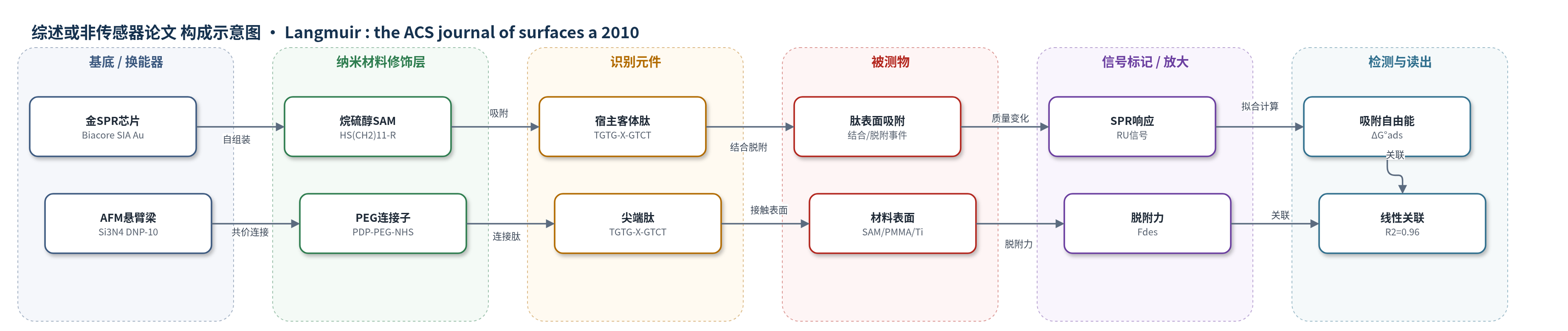
点击图片查看大图 · 依据论文自动绘制
传感器类型
综述或非传感器论文
检测对象
肽-表面吸附自由能(peptide-surface adsorption free energy, ΔG°ads)、肽-表面脱附力(peptide-surface desorption force, Fdes);样品基质:PBS缓冲液中的金-SAM、聚合物、金属、玻璃表面。
检测原理
SPR分支中,溶液中的宿主-客体肽TGTG-X-GTCT吸附到金膜上的烷硫醇SAM表面,表面吸附质量与局部折射率变化使SPR共振信号以RU形式改变;通过多浓度等温线拟合Q、K和bulk-shift参数m,并基于化学势模型扣除肽-肽相互作用影响,计算吸附自由能ΔG°ads。AFM分支中,肽经PDP-PEG-NHS连接在硅氮化物尖端,接触SAM或材料表面后发生吸附;回缩时测得脱附力Fdes,其大小反映肽-表面结合强度。由于Fdes与SPR测得的ΔG°ads呈线性相关,可用标准化AFM力谱估计SPR无法表征表面的ΔG°ads。方法未使用酶催化或核酸放大,主要依赖SPR质量传感和单分子/少分子力谱。
检测灵敏度
相关系数: R^2 = 0.96(AFM Fdes 与 SPR ΔG°ads);R^2 = 0.98(TGTG-X-GTCT 与 TGTG-X-GTGT ΔG°ads 比较)
效应效果
AFM力谱采用60次重复(3个位置×2个表面×10条曲线,N=6)获得可重复力曲线,最大分离距离接近理论轮廓长度31.0 nm。对TGTG-V-GTCT,SAM-CH3表面Fdes为0.107±0.015 nN,而SAM-OH表面Fdes<0.02 nN,差异显著(p<0.001),说明方法可区分不同疏水性表面。AFM Fdes与SPR ΔG°ads线性相关(R2=0.96),并据此估计Teflon、Nylon 6/6、玻璃、钛、AR-PMMA表面的ΔG°ads分别为-3.85±0.83、-4.03±0.84、-0.86±0.82、-1.30±0.81、-2.68±0.81 kcal/mol;spin-coated PMMA的SPR值为-2.44±0.50 kcal/mol。作者认为该方法可扩大肽-表面相互作用基准数据集,用于蛋白质吸附机理和分子模拟力场验证。
传感器的构成
- SPR基底:金膜SPR传感芯片(Biacore SIA Au kit),提供表面等离子共振换能基底。
- SAM修饰层:烷硫醇自组装单分子层(HS(CH2)11-R,R=CH3/OH/NH2/NHCOCH3/OCH2CF3/EG3OH),提供不同表面功能基团。
- 吸附/识别元件:宿主-客体肽TGTG-X-GTCT(X=L/V/D)或TGTG-X-GTGT,作为吸附分子产生SPR质量响应。
- 样品环境:1×PBS(140 mM NaCl,pH 7.4),维持生理条件并用于SPR进样与清洗。
- AFM换能基底:硅氮化物悬臂梁(DNP-10,尖端半径约32 nm),用于力谱测量。
- 尖端氨基化层:乙醇胺氯化物/DMSO处理形成的氨基化表面,用于共价连接PEG连接子。
- PEG连接子:PDP-PEG-NHS(3.4 kDa),通过NHS端连接尖端氨基、PDP端连接肽半胱氨酸。
- AFM识别元件:TGTG-X-GTCT肽,经半胱氨酸连接于PEG末端,用于表面脱附力测量。
中文摘要
表面等离子共振(SPR)光谱可用于热力学表征肽-表面相互作用,但其应用受限于能在金属生物传感器基底上形成均匀纳米薄层的表面类型。原子力显微镜(AFM)可用于任何微观平坦表面,因而更具普适性,但力谱数据解释常受探针尖端肽分子密度不确定性的影响。若标准化 AFM 方法测得的脱附力能与 SPR 测得的吸附自由能建立关联,则可将 AFM 方法推广到 SPR 难以表征的表面。本文开发并应用了一种标准化 AFM 方法,测量不同功能烷硫醇自组装单分子层(SAM)表面上宿主-客体肽序列的吸附/脱附力。结果表明,AFM 测得的脱附力与 SPR 测得的吸附自由能 ΔG°ads 呈线性相关。该方法可用于更广泛表面的肽吸附热力学表征,为理解蛋白质吸附行为以及评估、修改和验证分子模拟力场参数提供实验数据库。
英文摘要
Surface plasmon resonance (SPR) spectroscopy is a useful technique for thermodynamically characterizing peptide-surface interactions; however, its usefulness is limited to the types of surfaces that can readily be formed as thin layers on the nanometer scale on metallic biosensor substrates. Atomic force microscopy (AFM), on the other hand, can be used with any microscopically flat surface, thus making it more versatile for studying peptide-surface interactions. AFM, however, has the drawback of data interpretation due to questions regarding peptide-to-probe-tip density. This problem could be overcome if results from a standardized AFM method could be correlated with SPR results for a similar set of peptide-surface interactions so that AFM studies using the standardized method could be extended to characterize peptide-surface interactions for surfaces that are not amenable for characterization by SPR. In this article, we present the development and application of an AFM method to measure adsorption forces for host-guest peptides sequence on surfaces consisting of alkanethiol self-assembled monolayers (SAMs) with different functionality. The results from these studies show that a linear correlation exists between these data and the adsorption free energy (ΔG(o)(ads)) values associated with a similar set of peptide-surface systems available from SPR measurements. These methods will be extremely useful to characterize thermodynamically the adsorption behavior for peptides on a much broader range of surfaces than can be used with SPR to provide information related to understanding protein adsorption behavior to these surfaces and to provide an experimental database that can be used for the evaluation, modification, and validation of force field parameters that are needed to represent protein adsorption behavior accurately for molecular simulations.