组成图示
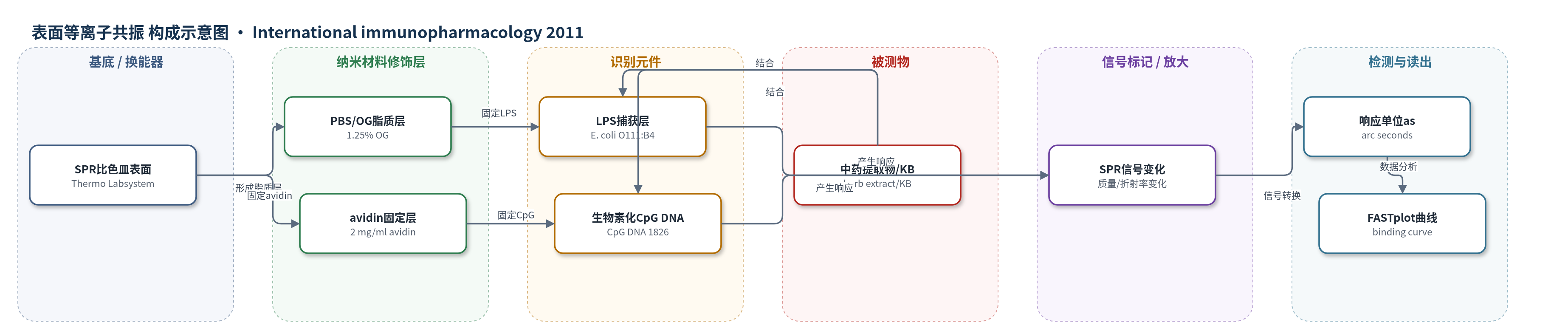
点击图片查看大图 · 依据论文自动绘制
传感器类型
表面等离子共振(SPR)生物传感器
检测对象
中药水提物(aqueous herbal extracts)、分离组分(fractions, 如 Fr. CL-4b)、枸杞苦素B(Kukoamine B, KB);样品基质:PBS稀释的中药水提物/组分/单体溶液(检测其对LPS和CpG DNA的亲和结合活性)。
检测原理
该传感器为基于表面等离子共振(SPR)的无标记亲和生物传感器。LPS通过PBS/OG在non-derivatized比色皿表面形成脂质涂层后固定;生物素化CpG DNA经avidin固定于biotin比色皿表面。将中药水提物、分离组分或KB加入含PBS的比色皿中,若样品含有能与LPS或CpG DNA结合的分子,则发生亲和结合,使传感器表面质量/折射率改变,SPR共振信号随之变化,以响应单位arc seconds(as)记录。结合量越大,响应曲线越高,从而反映样品对双靶点的亲和力。反应后用PBS和0.01 M HCl清洗再生。
检测灵敏度
原文未报告 LOD、线性范围、灵敏度斜率或 R^2。
效应效果
该SPR亲和传感器用于114味中药水提物快速筛选,3 min内完成结合检测,并可与色谱联用指导分离。筛选出16味对LPS、22味对CpG DNA高亲和中药,其中6味双靶点高亲和,Cortex lycii最高。传感器亲和力与LAL中和、ELISA细胞因子检测及动物实验一致:Fr. CL-4b显著中和LPS(p<0.01),抑制TNF-α和IL-6,将热灭活大肠杆菌攻击小鼠死亡率从90%降至50%(p<0.05);KB抑制TNF-α/IL-6、TLR4/TLR9/MyD88 mRNA表达和NF-κB p65核转位,使小鼠存活率从0%升至40%(p<0.01)。作者认为该方法可高效发现双靶点抗脓毒症单体。
传感器的构成
- 换能器基底:SPR比色皿反应表面(Thermo Labsystem),用于固定靶分子并检测结合信号
- 脂质修饰层:PBS/OG(0.01 M PBS, pH 7.4, 1.25% OG)在non-derivatized比色皿形成脂质涂层,用于固定LPS
- LPS捕获层:LPS(E. coli O111:B4, 2 mg/ml)固定于脂质涂层,作为识别/捕获分子
- 亲和固定层:avidin(2 mg/ml)固定于biotin比色皿表面,用于捕获生物素化CpG DNA
- CpG DNA捕获层:biotinylated CpG DNA 1826(400 μg/ml)固定于avidin层,作为识别/捕获分子
- 样品层:中药水提物、分离组分或Kukoamine B(KB)溶于PBS,与固定靶标结合
- 再生清洗层:PBS(0.02 M, pH 7.4)和HCl(0.01 M)用于清洗与再生
- 信号读出:SPR响应以arc seconds(as)记录,由FASTplot软件分析结合曲线
中文摘要
脓毒症治疗仍具挑战。细菌脂多糖(LPS)和细菌DNA/CpG DNA是脓毒症的重要致病分子和药物靶点,发现能同时中和两者的化合物具有治疗价值。本研究展示基于生物传感器的双靶点(LPS和CpG DNA)导向药物发现策略,从传统中药中筛选和分离抗脓毒症活性组分及单体。首先将LPS或CpG DNA固定在生物传感器比色皿表面建立筛选平台,从114味中药中筛选出对两者亲和力最高的枸杞皮(Cortex lycii)。随后采用色谱法并与生物传感器联用,纯化对LPS和CpG DNA亲和力更高的组分。这些组分在体内外可中和LPS和CpG DNA并抑制其活性。最后纯化出贡献单体枸杞苦素B(Kukoamine B, KB)。KB在体外中和LPS和CpG DNA,抑制LPS和CpG DNA上调的TLR4、TLR9和MyD88 mRNA表达,并减弱RAW264.7细胞中NF-κB p65核转位。KB还保护小鼠免受热灭活大肠杆菌(LPS和CpG DNA混合物)致死攻击。结论:生物传感器技术与色谱方法结合可双靶点导向发现新型抗脓毒症化合物KB。
英文摘要
Treating sepsis remains challenging at present. Bacterial lipopolysaccharide (LPS) and bacterial DNA/CpG DNA are important pathogenic molecules and drug targets for sepsis. It is thus a promising strategy to treat sepsis by discovering agents that neutralize LPS and CpG DNA simultaneously. In this study, we present evidences of the biosensor based screening and isolation of active anti-sepsis fractions and monomers from traditional Chinese herbs using dual targets (LPS and CpG DNA) guided drug discovery strategy. Firstly, LPS or CpG DNA was immobilized on surfaces of cuvettes in the biosensor to establish a screening platform. Then, Cortex lycii with both highest affinities was selected out from one hundred and fourteen traditional Chinese herbs. In subsequent experiments, chromatography was utilized and coupled with the biosensor to purify fractions with a higher affinity for LPS and CpG DNA. In line with affinity assay, these fractions were shown to neutralize LPS and CpG DNA and inhibit their activity in vitro and in vivo. Lastly, the contributing monomer Kukoamine B (KB) was purified. KB neutralized LPS and CpG DNA in vitro. It inhibited TLR4, TLR9 and MyD88 mRNA expressions up-regulated by LPS and CpG DNA, and also attenuated the LPS and CpG DNA elicited nuclear translocation of NF-κB p65 protein in RAW264.7 cells. It also protected mice from lethal challenge of heat-killed E. coli, a mixture of LPS and CpG DNA. In conclusion, we presented a dual target guided discovery of a novel anti-sepsis agent KB from traditional Chinese herbs via combination of biosensor technology and chromatography methods.