组成图示
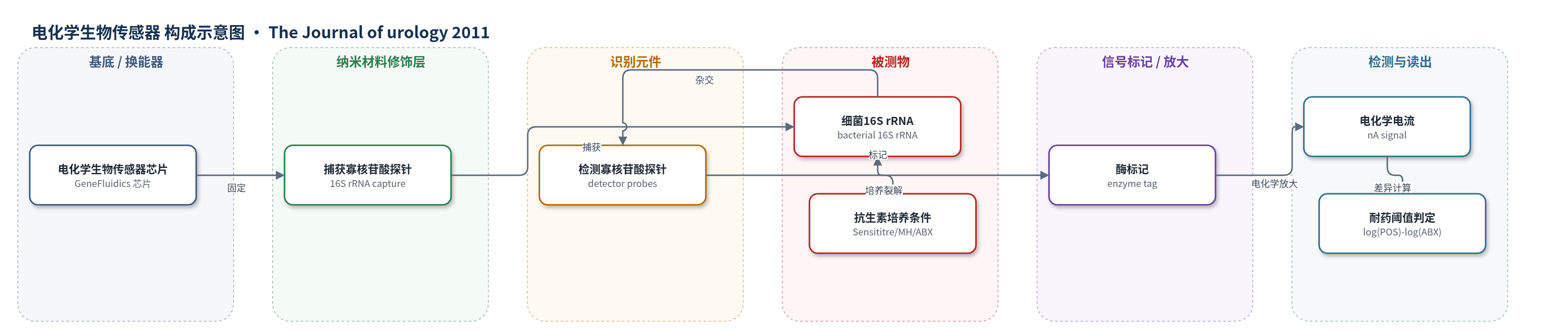
点击图片查看大图 · 依据论文自动绘制
传感器类型
电化学生物传感器
检测对象
细菌 16S rRNA(bacterial 16S rRNA,细菌生长标志物)、尿路致病菌(uropathogens,如大肠杆菌 E. coli、肺炎克雷伯菌 K. pneumoniae、奇异变形杆菌 P. mirabilis、铜绿假单胞菌 P. aeruginosa、肠杆菌科 Enterobacteriaceae)及其抗生素敏感性(antimicrobial susceptibility, AST);样品基质:临床尿液(urine)及 MH 肉汤培养物
检测原理
尿液与 MH 培养基混合后接种至含不同抗生素或无抗生素对照的 Sensititre 微孔板,37℃孵育 2.5 小时。敏感菌在抗生素中生长受抑,耐药菌生长接近无药对照,导致裂解后释放的 16S rRNA 量不同。传感器表面固定物种特异性捕获寡核苷酸,与细菌 16S rRNA 杂交;再加入物种特异性检测探针形成夹心识别,酶标记催化产生电化学信号。电流(nA)随 16S rRNA 量/菌量增加而增加,可在 4 个数量级范围内反映生长。通过比较无药 POS 与含药 ABX 的 log10 电流差,低于预设阈值判为耐药,从而直接获得药敏结果。
检测灵敏度
线性范围: 4-log unit range, from 5 × 10^5 to 1 × 10^9 cfu/ml
效应效果
在 252 份临床尿液样本中,215 份有可比数据,157 份(73%)含菌。病原菌鉴定以通用探针阳性为指标,敏感性 92%、特异性 97%、阳性预测值 99%、阴性预测值 81%。b-AST 对 72 株病原菌、368 项病原菌-抗生素组合与标准微生物学药敏比较,总符合率 94%,VME 1%、ME 4%;各抗生素符合率分别为 AMP 93%、CIP 90%、SXT 96%、AXO 98%、GEN 94%、FEP 97%。主要病原菌符合率均≥92%。与标准方法需 24–72 小时相比,本方法 3.5 小时完成培养与药敏,作者认为可支持床旁快速抗生素决策。原文未报告 RSD、稳定性或回收率。
传感器的构成
- 换能器/基底:GeneFluidics 电化学生物传感器芯片,提供电化学信号读出
- 捕获探针修饰层:物种特异性寡核苷酸捕获探针(capture oligonucleotides),固定于传感器表面,靶向大肠杆菌、肺炎克雷伯菌、奇异变形杆菌、铜绿假单胞菌、粪肠球菌、肠杆菌科及通用真细菌 16S rRNA
- 识别元件:物种特异性检测寡核苷酸探针(detector probes),与捕获的细菌 16S rRNA 杂交
- 信号标记/放大:酶标记(enzyme tag),用于杂交事件后的电化学信号放大
- 阴性对照:negative control 探针/通道,用于背景校正
中文摘要
标准微生物学方法从样本采集到细菌培养和药敏报告通常需要24–72小时,导致经验性抗生素使用和耐药菌增加。作为开发尿路致病菌床旁药敏检测装置的关键步骤,作者报道了一种基于生物传感器的抗菌药物敏感性测试(b-AST)。方法上,细菌在含或不含抗生素条件下培养,通过活菌计数和电化学生物传感器测量细菌16S rRNA来定量生长;直接从患者尿液检测时,尿液在抗生素板上培养2.5小时,用电化学方法测量细菌16S rRNA。验证阶段收集252份尿液样本,对含革兰阴性菌的样本完成b-AST,并将病原菌鉴定和药敏结果与标准微生物学分析比较。结果显示,直接生物传感器定量细菌16S rRNA可用于监测b-AST中的细菌生长;临床验证表明,与标准微生物学分析相比,该测试在368项病原菌-抗生素检测中准确率为94%。结论:该b-AST与作者先前报道的病原菌鉴定方法联用,可在3.5小时内直接从尿液样本提供培养和药敏信息。
英文摘要
PURPOSE: A significant barrier to efficient antibiotic management of infection is that the standard diagnostic methodologies do not provide results at the point of care. The delays between sample collection and bacterial culture and antibiotic susceptibility reporting have led to empirical use of antibiotics, contributing to the emergence of drug resistant pathogens. As a key step toward the development of a point of care device for determining the antibiotic susceptibility of urinary tract pathogens, we report on a biosensor based antimicrobial susceptibility test.
MATERIALS AND METHODS: For assay development bacteria were cultured with or without antibiotics, and growth was quantitated by determining viable counts and electrochemical biosensor measurement of bacterial 16S rRNA. To determine antibiotic susceptibility directly from patient samples, urine was cultured on antibiotic plates for 2.5 hours and growth was determined by electrochemical measurement of bacterial 16S rRNA. For assay validation 252 urine samples were collected from patients at the Spinal Cord Injury Service at Veterans Affairs Palo Alto Health Care System. The biosensor based antimicrobial susceptibility test was completed for samples containing gram-negative organisms. Pathogen identification and antibiotic susceptibility results were compared between our assay and standard microbiological analysis.
RESULTS: A direct biosensor quantitation of bacterial 16S rRNA can be used to monitor bacterial growth for a biosensor based antimicrobial susceptibility test. Clinical validation of a biosensor based antimicrobial susceptibility test with patient urine samples demonstrated that this test was 94% accurate in 368 pathogen-antibiotic tests compared to standard microbiological analysis.
CONCLUSIONS: This biosensor based antimicrobial susceptibility test, in concert with our previously described pathogen identification assay, can provide culture and susceptibility information directly from a urine sample within 3.5 hours.