组成图示
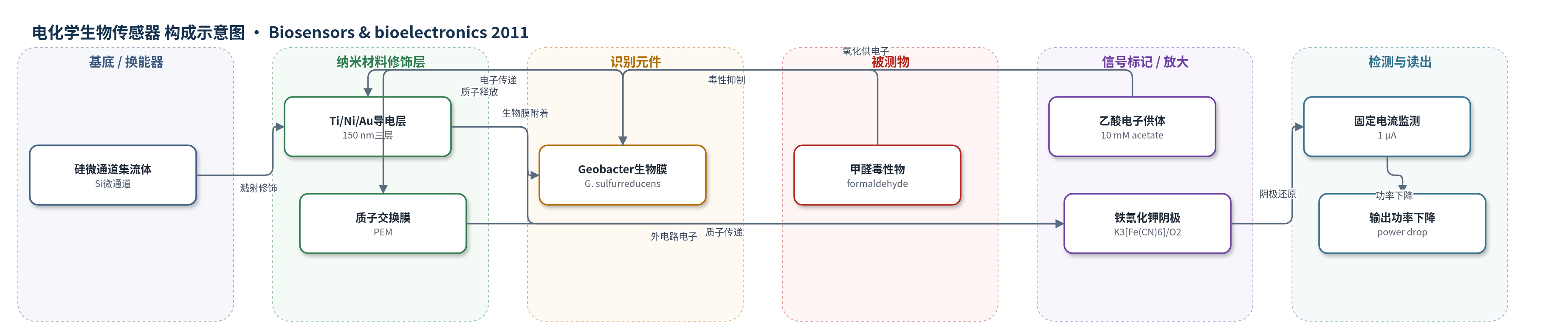
点击图片查看大图 · 依据论文自动绘制
传感器类型
电化学生物传感器
检测对象
有毒化合物(toxic compounds),具体测试甲醛(formaldehyde);样品基质:阳极室水相乙酸培养液/环境水样
检测原理
该传感器以 Geobacter sulfurreducens 生物膜作为生物识别与催化元件。阳极室中,菌膜氧化乙酸钠产生电子和质子;由于厌氧条件,电子通过直接电子传递机制转移到 Au 集流体,质子经质子交换膜迁移至阴极室。阴极室含氧磷酸盐缓冲液和铁氰化钾促进氧还原,电子经外电路从阳极流向阴极,形成电流和功率输出。检测时器件固定电流运行,监测输出电压/功率。当甲醛等毒性物质进入阳极室,会抑制菌膜代谢和电子传递,导致输出功率迅速下降;毒性越强或浓度越高,功率下降越明显。该过程无需外加识别探针,依靠活菌整体生理响应实现毒性检测。
检测灵敏度
原文未报告LOD、线性范围、灵敏度斜率或R^2;仅报告最低测试甲醛浓度为0.1%且可检测到。
效应效果
微器件作为MFC的最大功率密度为6.5 μW cm−2,高于同条件大规模MFC的4.4 μW cm−2;最大电流密度为0.014 mA cm−2,低于大规模器件的0.08 mA cm−2。去除悬浮菌后功率由6.53降至5.17 μW cm−2,说明悬浮菌贡献约20%。固定电流模式下输出电压24 h内变化小于5%。加入4%甲醛后功率立即下降,最低0.1%甲醛也能引起明显电压下降,且各浓度均不可逆抑制生物膜。与Kim等报道相比,相同电流密度范围内功率密度提高约3000倍。器件紧凑、平面,可单片或阵列用于高通量毒性监测。
传感器的构成
- 基底/集流体:双面抛光硅片(Si wafer)经光刻与深反应离子刻蚀(DRIE)形成方形垂直微通道阵列,作为阳极/阴极集流体并促进质子扩散
- 导电修饰层:150 nm Ti/Ni/Au 溅射三层,Ti增强粘附、Ni提供导电、Au防氧化并作为电子传递界面
- 离子交换层:质子交换膜(PEM)置于两硅板之间,分隔阳极室与阴极室并允许质子传递
- 生物识别层:Geobacter sulfurreducens(G. sulfurreducens)生物膜附着于Au表面及通道壁,作为生物催化/识别元件
- 电子供体:10 mM 乙酸钠(sodium acetate)在阳极室被菌膜氧化,提供电子和质子
- 阴极介质:含氧磷酸盐缓冲液(100 mM phosphate buffer)与50 mM 铁氰化钾(K3[Fe(CN)6])促进氧还原
- 储液腔:有机玻璃(perspex)储液件,每腔工作体积144 μL,用于容纳阳极/阴极液并实现液流
- 读出接口:外部电路固定电流并监测输出电压/功率变化,用于毒性响应检测
中文摘要
微生物燃料电池(MFC)多年来被用作检测生化需氧量和水质毒性等环境参数的生物传感器。本研究报道了一种新型硅基微加工MFC毒性传感器,用于检测有毒物质。与现有MFC毒性传感器类似,该器件能够检测有毒化合物存在时电池输出电流的变化。该MFC旨在获得结构简单、紧凑且平面的器件,便于进一步作为毒性监测设备中的生物传感器。器件由置于两块微加工硅板之间的质子交换膜组成,硅板作为集流体;硅板上定义了80 μm×80 μm、深300 μm的方形垂直微通道阵列,面积6 mm×6 mm。最终测试组件在硅板上加装两块有机玻璃储液腔,每腔工作体积144 μL。通过与同条件下较大规模MFC比较,验证了该微器件作为直接电子传递MFC的运行性能。将其固定电流运行并监测输出功率变化,向阳极室加入有毒化合物后功率下降。紧凑设计使其可作为单个器件或传感器阵列用于高通量毒性监测。
英文摘要
Microbial fuel cells (MFCs) have been used for several years as biosensors for measuring environmental parameters such as biochemical oxygen demand and water toxicity. The present study is focused on the detection of toxic matter using a novel silicon-based MFC. Like other existing toxicity sensors based on MFCs, this device is capable of detecting the variation on the current produced by the cell when toxic compounds are present in the medium. The MFC approach presented in this work aims to obtain a simple, compact and planar device for its further application as a biosensor in the design and fabrication of equipment for toxicity monitoring. It consists on a proton exchange membrane placed between two microfabricated silicon plates that act as current collectors. An array of square 80 μm × 80 μm vertical channels, 300 μm deep, have been defined trough the plates over an area of 6 mm × 6 mm. The final testing assembly incorporates two perspex pieces positioned onto the plates as reservoirs with a working volume of 144 μL per compartment. The operation of the microdevice as a direct electron transfer MFC has been validated by comparing its performance against a larger scale MFC, run under the same conditions. The device has been tested as a toxicity sensor by setting it at a fixed current while monitoring changes in the output power. A drop in the power production is observed when a toxic compound is added to the anode compartment. The compact design of the device makes it suitable for its incorporation into measurement equipment either as an individual device or as an array of sensors for high throughput processing.