组成图示
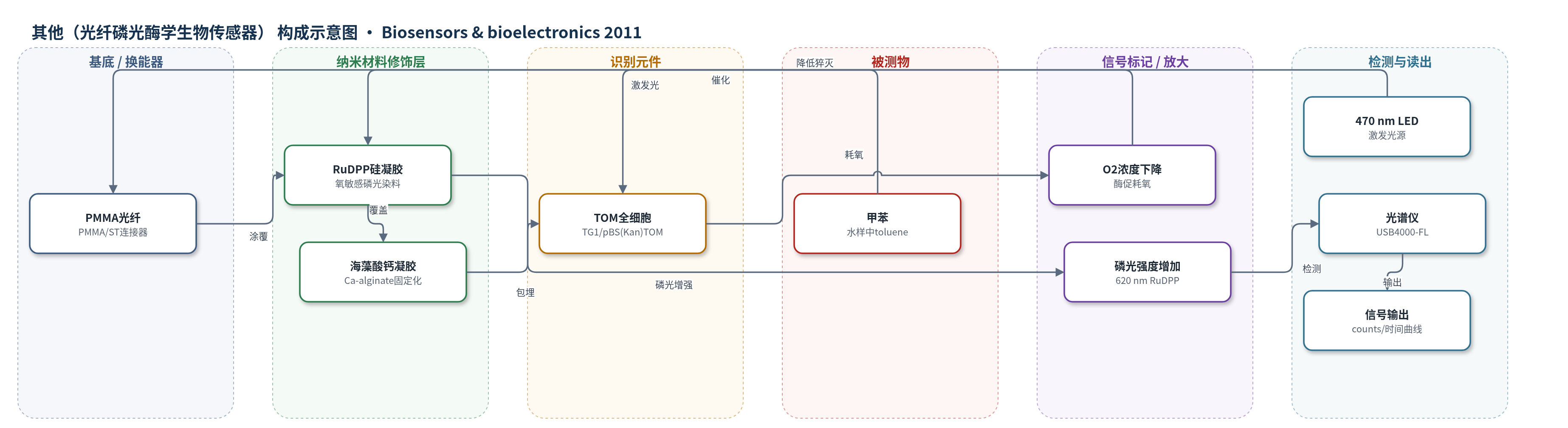
点击图片查看大图 · 依据论文自动绘制
传感器类型
其他(光纤磷光酶学生物传感器)
检测对象
甲苯(toluene, C7H8);样品基质:水样/环境水样(测量溶液、湖水加标)
检测原理
传感器以表达甲苯邻位单加氧酶(TOM)的大肠杆菌全细胞为识别元件,固定于海藻酸钙凝胶中并置于光纤氧传感器尖端。甲苯扩散进入凝胶层后,被细胞内 TOM 催化发生邻位羟基化:C7H8 + O2 + NADH + H+ → C7H7OH + NAD+ + H2O,该反应消耗 O2 和 NADH。凝胶层内 O2 浓度下降,使 RuDPP 磷光受分子氧动态猝灭的程度降低,磷光强度增加。470 nm LED 经光纤激发 RuDPP,620 nm 磷光被光谱仪积分读取。稳态时甲苯浓度决定酶促耗氧速率与扩散平衡,从而决定 O2 浓度和磷光信号,信号随甲苯浓度升高而增大。NADH 消耗会限制寿命,甲酸可部分再生 NADH。
检测灵敏度
LOD: 3 μM;线性范围: 3–100 μM;R^2 = 0.996
效应效果
传感器重现性良好:同批 8 支 RSD=7.4%,15 支批间 RSD=6.0%。在 11 μM 下对甲苯、TCE 和苯的信号分别为 210±30、110±20 和 40±20 counts,显示对甲苯选择性较好;1 mM 乙酸无显著干扰,pH 5–7 基本稳定。湖水加标样品与 GC/MS 比较,偏差为 0.2±0.5 μM(95% CI,n=18)。与 GC/MS(LOD 0.001 μM)、免疫分析(0.02 μM)和诱导型生物传感器(7.5–11 μM)相比,其 LOD 为 3 μM,但线性范围更宽(3–100 μM)且可连续监测。活性随使用和储存下降,每次使用约降 40%,4 ℃ 优于 20 ℃;甲酸再生可部分恢复信号。
传感器的构成
- 基底/换能器:PMMA 光纤(polymethylmethacrylate optical fiber,ST 连接器),传输 470 nm 激发光并回传 620 nm 磷光。
- 信号换能层:RuDPP(Tris(4,7-diphenyl-1,10-phenanthroline)ruthenium(II) complex)溶于氯仿后与硅凝胶混合,涂覆于光纤端,作为氧敏感磷光指示剂。
- 固定化基质:2.5% 海藻酸钠(sodium alginate)凝胶,经 0.47 M CaCl2 交联成海藻酸钙,用于包埋全细胞并维持结构。
- 识别元件:表达 TOM 的大肠杆菌 TG1/pBS(Kan)TOM 全细胞,催化甲苯邻位羟基化并消耗 O2 与 NADH。
- 测量/储存介质:0.15 M NaCl + 0.025 M CaCl2(pH 7.0),维持细胞活性和凝胶稳定。
- 可选再生组分:甲酸(formate)和硝酸铵(ammonium nitrate),用于再生细胞内 NADH 并部分恢复活性。
- 光学读出模块:470 nm LED、450/60 nm 带通滤光片、分叉光纤和 Ocean Optics USB4000-FL 光谱仪,检测 615–625 nm 磷光。
中文摘要
对甲苯等污染物的测定对污染场地表征、修复过程监测和废水排放监控至关重要。光纤酶学生物传感器有望实现低成本、实时、连续的原位测量。本研究构建并表征了一种用于水溶液中甲苯浓度测定的光纤酶学生物传感器。其生物识别元件为表达于携带 pBS(Kan)TOM 质粒的大肠杆菌 TG1 中的甲苯邻位单加氧酶(TOM),换能器为涂覆氧敏感钌基磷光染料的光纤。甲苯检测基于 TOM 催化的酶促反应:甲苯邻位羟基化消耗氧气,使磷光强度发生变化。该传感器检出限为 3 μM,线性信号范围可达 100 μM,响应时间为 1 h;不同传感器之间重现性良好(RSD=7.4%,n=8)。传感器活性随测量次数和储存时间下降,高温下尤为明显;用甲酸处理可部分恢复活性,表明 NADH 消耗是限制寿命的主要因素。这是首个酶促甲苯传感器和单加氧酶型生物传感器的报道,该设计有望拓展环境监测应用。
英文摘要
Measurements of pollutants such as toluene are critical for the characterization of contaminated sites and for the monitoring of remediation processes and wastewater treatment effluents. Fiber optic enzymatic biosensors have the potential to provide cost-effective, real time, continuous, in situ measurements. In this study, a fiber optic enzymatic biosensor was constructed and characterized for the measurement of toluene concentrations in aqueous solutions. The biological recognition element was toluene ortho-monooxygenase (TOM), expressed by Escherichia coli TG1 carrying pBS(Kan)TOM, while an optical fiber coated with an oxygen-sensitive ruthenium-based phosphorescent dye served as the transducer. Toluene was detected based on the enzymatic reaction catalyzed by TOM, which resulted in the consumption of oxygen and changes in the phosphorescence intensity. The biosensor was found to have a limit of detection of 3 μM, a linear signal range up to 100 μM, and a response time of 1 h. The performance was reproducible with different biosensors (RSD=7.4%, n=8). The biosensor activity declined with each measurement and with storage time, particularly at elevated temperatures. This activity loss could be partially reversed by exposure to formate, suggesting that NADH consumption was the primary factor limiting lifetime. This is the first report of an enzymatic toluene sensor and of an oxygenase-based biosensor. Since many oxygenases have been reported, the design concept of this oxygenase-based biosensor has the potential to broaden biosensor applications in environmental monitoring.