组成图示
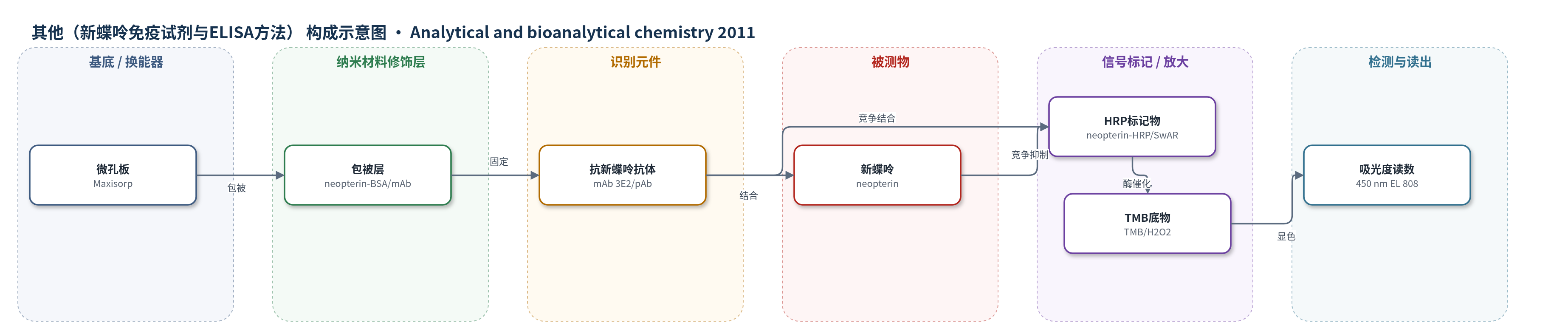
点击图片查看大图 · 依据论文自动绘制
传感器类型
其他(新蝶呤免疫试剂与ELISA方法)
检测对象
新蝶呤(neopterin);样品基质:血浆、血清(患者与健康志愿者)
检测原理
该文采用竞争酶联免疫吸附试验(ELISA)检测新蝶呤。直接法将抗新蝶呤抗体或兔抗鼠IgG包被于微孔板,样品中的新蝶呤与HRP标记新蝶呤偶联物竞争结合固定抗体;间接法将新蝶呤-BSA偶联物包被,样品新蝶呤与待测抗体竞争结合包被抗原,再加入HRP标记二抗。结合量随新蝶呤浓度升高而降低。HRP催化TMB与H2O2发生氧化显色反应,加入硫酸终止后在450 nm测定吸光度。信号为酶促显色,无额外核酸或酶催化沉积放大,灵敏度依赖抗体亲和力和HRP催化显色。
检测灵敏度
LOD: 0.18 μgL−1;LOD: 0.45 μgL−1;LOD: 0.05 μgL−1;R=0.874; n=40;R=0.819; n=40;R=0.991; n=9;R=0.961; n=40
效应效果
抗体对结构类似物交叉反应低,最高为7,8-二氢-D-新蝶呤:多克隆直接ELISA 9.1%,单克隆直接4.8%,单克隆间接4.4%,其余多低于1%。临床血浆/血清中,健康志愿者新蝶呤约1.1–4.2 μg/L,患者可达24.2–102.9 μg/L;单克隆ELISA结果约为多克隆ELISA的两倍,两者相关良好(R=0.991,n=9;R=0.961,n=40)。与IBL试剂盒相比,多克隆ELISA在0.5–16 μg/L内R=0.874(n=40),单克隆R=0.819(n=40)。作者认为mAb 3E2灵敏度和材料可获得性更优,可与其他识别元件整合用于多分析物生物芯片和智能医学诊断。
传感器的构成
- 固相载体:Maxisorp微孔板(NUNC),提供ELISA包被表面。
- 包被层:新蝶呤-BSA偶联物(neopterin-BSA,NHS/DCC或NHS/EDC偶联)或抗新蝶呤抗体(mAb 3E2/pAb No.3)/兔抗鼠IgG(RAM),用于固定抗原或识别元件。
- 识别元件:抗新蝶呤单克隆抗体mAb 3E2(IgG1 κ)或多克隆抗体pAb No.3,特异性识别新蝶呤。
- 信号标记物:HRP标记新蝶呤偶联物(neopterin-HRP)用于直接竞争ELISA;HRP标记猪抗兔IgG(SwAR)用于间接ELISA。
- 底物/显色:TMB与H2O2在HRP催化下生成有色产物,450 nm读数。
- 洗涤/封闭缓冲液:PBS-T20(PBS加0.1% Tween 20),用于洗涤和抑制非特异结合。
- 终止液:2 mol/L H2SO4,终止酶促显色反应。
中文摘要
新蝶呤是细胞免疫的有价值生物标志物,与病毒感染、细菌感染、自身免疫、心血管、神经退行性和恶性疾病等多种病理状态相关。为快速多生物标志物诊断制备特异性抗新蝶呤抗体,作者合成了新型半抗原衍生物并将其偶联到载体蛋白上。经充分表征的偶联物用于免疫BALB/c小鼠和兔。所制备的单克隆抗体在直接和间接酶联免疫吸附试验(ELISA)格式中分别达到0.18和0.45 μg/L的检出限,并在检测灵敏度和材料可获得性方面成为进一步生物传感器开发的优越免疫试剂。最佳多克隆抗体在直接ELISA中略为敏感,检出限为0.05 μg/L。优化后的ELISA方法用于评价肾功能障碍、脓毒症、未确诊患者和健康志愿者血液样本。在血浆样本中,单克隆ELISA可测定3.2–103 μg/L的新蝶呤浓度,而多克隆ELISA结果约为其一半。多克隆ELISA与IBL新蝶呤ELISA试剂盒在0.5–16 μg/L范围内相关性良好(R=0.874;n=40),单克隆ELISA相关性略低(R=0.819;n=40)。这些数据表明所生成抗体可作为功能性分析试剂,用于整合到多分析物生物芯片检测系统中。
英文摘要
Neopterin is a valuable biomarker of cellular immunity associated with various pathological situations such as viral and bacterial infections, autoimmune, cardiovascular, neurodegenerative and malignant disorders. To produce specific antibodies against neopterin for a rapid multi-biomarker-based diagnosis, a novel hapten derivative was synthesized and attached to carrier proteins. The thoroughly characterized conjugates were used for immunization of BALB/c mice and rabbits. The produced monoclonal antibody reached in both direct and indirect enzyme-linked immunosorbent assay (ELISA) format LoD of 0.18 and 0.45 μg L(-1), respectively, and was a superior immunoreagent for further biosensor developments with regard to assay sensitivity and material availability. The best polyclonal antibody was somewhat more sensitive in direct ELISA with LoD of 0.05 μg L(-1). The optimized ELISA method was evaluated with blood samples collected from patients with renal insufficiency, patients with sepsis, patients without confirmed clinical diagnosis, and healthy volunteers. In plasma samples, neopterin concentrations ranging from 3.2 to 103 μg L(-1) could be determined with the monoclonal ELISA whereas twofold lower results were obtained with the polyclonal ELISA. A satisfactory correlation of results was found between the polyclonal ELISA and IBL Neopterin ELISA kit within the concentration range 0.5-16 μg L(-1) (R = 0.874; n = 40), and slightly lower correlation was found for monoclonal-based ELISA (R = 0.819; n = 40). These data show that the generated antibodies may be used as functional analytical reagents for the integration into multianalyte biochip detection systems.