组成图示
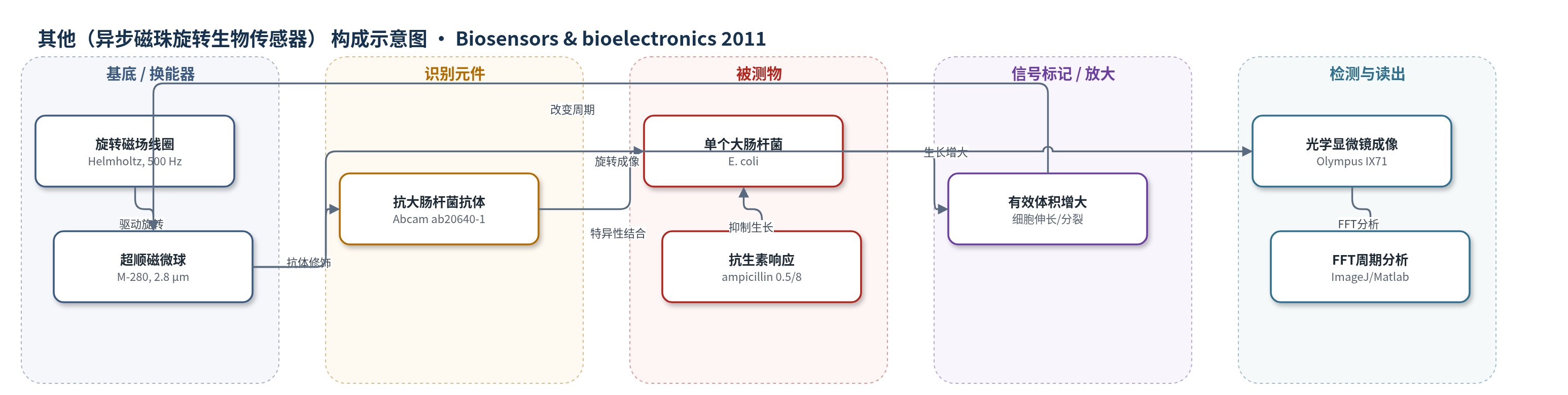
点击图片查看大图 · 依据论文自动绘制
传感器类型
其他(异步磁珠旋转生物传感器)
检测对象
单个大肠杆菌(Escherichia coli, E. coli)的生长/分裂及氨苄西林(ampicillin)药敏响应;样品基质:Mueller-Hinton II(MH)肉汤(含1% Pluronic F-68、0.1% BSA)
检测原理
抗大肠杆菌抗体修饰的超顺磁微球在样品中特异性捕获单个E. coli。将磁珠置于500 Hz旋转磁场中,磁珠以异步方式旋转;在超顺磁扭矩与流体黏滞阻力平衡下,旋转角速度与有效体积成反比,旋转周期T正比于Veff。细菌附着、伸长或分裂会改变磁珠-细胞复合体的有效体积,使T发生可测变化:生长使T增大,分裂或子细胞重取向使T骤降。光学显微镜拍摄磁珠旋转,强度剖面经FFT得到旋转频率/周期,从而以约80 nm细胞长度灵敏度监测生长、世代时间和抗生素抑制。
检测灵敏度
未报告LOD、线性范围、灵敏度斜率或R^2;原文报告灵敏度为80-nm sensitivity to the cell length,误差为(80 ± 38) nm change in bacterium length。
效应效果
传感器通过抗体实现特异性识别,无细菌或固定E. coli对照未出现显著旋转周期变化。固定细胞120 min内旋转响应CV为6.0%,无细菌单探针20 h内波动低于10%,显示长期稳定性。AMBR旋转周期与光学显微镜测得的细胞长度呈良好线性一致,光学长度误差约270 nm,而AMBR对应80 nm灵敏度。在0.5 μg/mL氨苄西林下单个E. coli持续生长,在8 μg/mL(MIC)下生长被抑制。作者认为该方法可缩短传统约24 h浊度法药敏检测时间,并有望用于药物筛选和微流控高通量单细胞药敏。
传感器的构成
- 驱动换能层:自制空气芯Helmholtz线圈、放大器与NI PCI-6221数据采集板,产生500 Hz、0.9 mT旋转磁场,驱动磁珠异步旋转
- 传感微球层:2.8 μm超顺磁性磁珠(Invitrogen M-280),作为旋转换能体,其旋转周期T正比于有效体积Veff
- 识别元件层:抗大肠杆菌抗体(Anti-E. coli,Abcam ab20640-1)功能化磁珠表面,特异性捕获单个E. coli
- 样品介质层:Mueller-Hinton II(MH)肉汤,含1% Pluronic F-68和0.1% BSA,用于重悬磁珠-细菌复合物并维持检测环境
- 样品制备单元:PickPen 1-M磁分离器,用于分离磁珠-细菌复合物并重悬于检测介质
- 光学读出层:倒置光学显微镜Olympus IX71(100×/1.3油镜)与Basler piA640-210gm数字相机,拍摄磁珠旋转视频
- 信号处理读出层:ImageJ强度剖面与Matlab FFT分析,提取旋转频率/周期,换算细胞长度变化
中文摘要
单细菌连续生长以往主要依靠光学成像直接观察,但光学显微镜受衍射极限限制,且能连续监测的单个细胞数量有限。本文报道异步磁珠旋转(AMBR)生物传感器,用于在不受衍射限制条件下测量单个细菌的纳米尺度生长动态,并可跨越多个世代。该基于扭矩的磁珠传感器通过监测单个细菌附着与生长引起的流体阻力变化,实现了对单个大肠杆菌生长和分裂的连续观察,细胞长度灵敏度达80 nm。在一个细胞生命周期内,由于细胞体积增加,传感器旋转周期最多增加300%。研究还观察到单个细菌对抗生素的生长响应。结果表明,AMBR生物传感器可用于监测单个细胞伸长、世代时间、滞后时间、分裂及其抗生素敏感性,为快速微生物鉴定和药敏检测提供新途径。
英文摘要
Continuous growth of individual bacteria has been previously studied by direct observation using optical imaging. However, optical microscopy studies are inherently diffraction limited and limited in the number of individual cells that can be continuously monitored. Here we report on the use of the asynchronous magnetic bead rotation (AMBR) sensor, which is not diffraction limited. The AMBR sensor allows for the measurement of nanoscale growth dynamics of individual bacterial cells, over multiple generations. This torque-based magnetic bead sensor monitors variations in drag caused by the attachment and growth of a single bacterial cell. In this manner, we observed the growth and division of individual Escherichia coli, with 80-nm sensitivity to the cell length. Over the life cycle of a cell, we observed up to a 300% increase in the rotational period of the biosensor due to increased cell volume. In addition, we observed single bacterial cell growth response to antibiotics. This work demonstrates the non-microscopy limited AMBR biosensor for monitoring individual cell growth dynamics, including cell elongation, generation time, lag time, and division, as well as their sensitivity to antibiotics.