组成图示
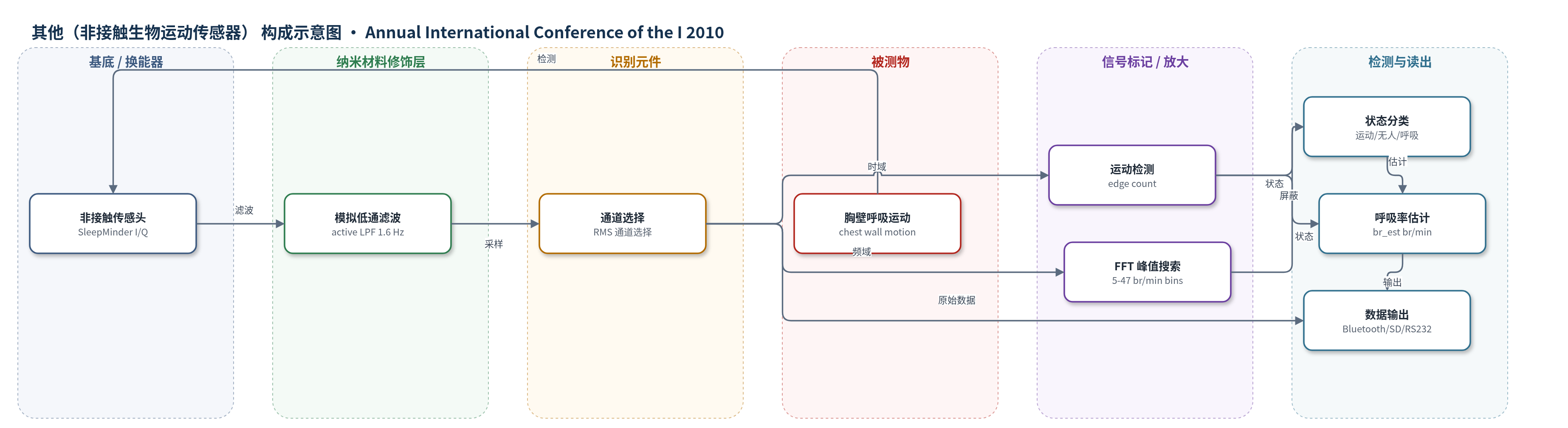
点击图片查看大图 · 依据论文自动绘制
传感器类型
其他(非接触生物运动传感器)
检测对象
呼吸率(respiratory rate / breathing rate, br/min);样品基质:人体卧床睡眠状态下的非接触胸壁生物运动信号
检测原理
被测物为人体呼吸引起的胸壁周期性运动。非接触 I/Q 生物运动传感器将胸壁微小位移转换为同相/正交电信号,呼吸运动使信号在 5–47 br/min 频段出现周期性峰值。系统每 1 s 处理 15 s 数据块:先以 RMS 选择较强通道,再用边缘计数识别大幅运动;随后对 240 个样本零填充至 512 点做 FFT,在呼吸频段搜索峰值并插值频率 f_interp。若边缘计数高则判为运动并屏蔽呼吸率;若呼吸频段能量过低或高频噪声主导则判为无人;否则判为呼吸,呼吸率 br=60*f_interp,并用一阶平滑 br_est[n]=br_est[n-1]-br_est[n-1]/10+br[n]/10。呼吸越快,FFT 峰值频率越高,输出 br/min 越大。
检测灵敏度
原文未报告 LOD、线性范围、灵敏度斜率或相关系数。
效应效果
系统在 10 名成人、2180 个专家标注呼吸上验证,可区分运动、无人和呼吸状态,运动时屏蔽呼吸率输出。正文报告 1 s 平均 MAE 0.5 br/min、30 s 0.3 br/min;表 2 平均为 0.4 和 0.2 br/min。1 s 尺度 96% 估计值与专家评分相差 1 br/min 以内,99% 相差 2 br/min 以内;30 s 平均后超过 99% 相差 1 br/min 以内,100% 相差 2 br/min 以内。与文献非接触设备 95% 一致性界限 ±5 br/min 相比更好。作者认为其可用于家庭睡眠呼吸率监测,后续需评估运动、腿动和呼吸暂停下的可靠性。
传感器的构成
- 换能器/传感头:SleepMinder 非接触 I/Q 生物运动传感器,检测 0.3–1.5 m 内胸壁运动并输出同相/正交信号
- 模拟前端:传感器板上的有源低通滤波器(active LPF),3 dB 截止频率 1.6 Hz,用于抑制高频噪声
- 数据采集/存储:Microchip PIC 数字信号控制器、12 位采样、64 Hz 采样率与 SD 卡,用于数字化、存储和离线读取
- 无线/接口模块:Class 1 Bluetooth 模块与 RS232 串口,用于实时数据流和 PC/手机读取
- 处理单元:PIC 微控制器运行 C 算法,执行通道选择、运动检测、FFT 和呼吸率估计
- 识别元件:无化学识别元件;以人体胸壁呼吸运动(chest wall motion)作为生物运动信号源
中文摘要
本文提出一种基于非接触生物运动传感器的自动化实时呼吸率检测方法,适用于低功耗微控制器实现。系统采用 SleepMinder 双通道同相/正交(I/Q)非接触生物运动传感器,检测 0.3–1.5 m 范围内人体胸壁运动,数据经 1.6 Hz 有源低通滤波、64 Hz 采样和 12 位量化后,在 PIC 微控制器上以 15 s 数据块进行处理。算法结合时域边缘计数区分运动状态,并通过 FFT 在 5–47 br/min 呼吸频段搜索峰值、插值频率,将信号分类为运动、无人或呼吸,进而估计呼吸率。在 10 名成人 2180 个专家标注呼吸上验证,1 s 尺度 96% 的估计值与专家评分相差 1 br/min 以内,99% 相差 2 br/min 以内;按 30 s 平均后,超过 99% 的估计值与专家评分相差 1 br/min 以内。方法计算和内存需求低,适合实时、低功耗部署。
英文摘要
An automated real time method for detecting human breathing rate from a non contact biosensor is considered in this paper. The method has low computational and RAM requirements making it well-suited to real-time, low power implementation on a microcontroller. Time and frequency domain methods are used to separate a 15s block of data into movement, breathing or absent states; a breathing rate estimate is then calculated. On a 1s basis, 96% of breaths were scored within 1 breath per minute of expert scored respiratory inductance plethysmography, while 99% of breaths were scored within 2 breaths per minute. When averaged over 30s, as is used in this respiration monitoring system, over 99% of breaths are within 1 breath per minute of the expert score.