组成图示
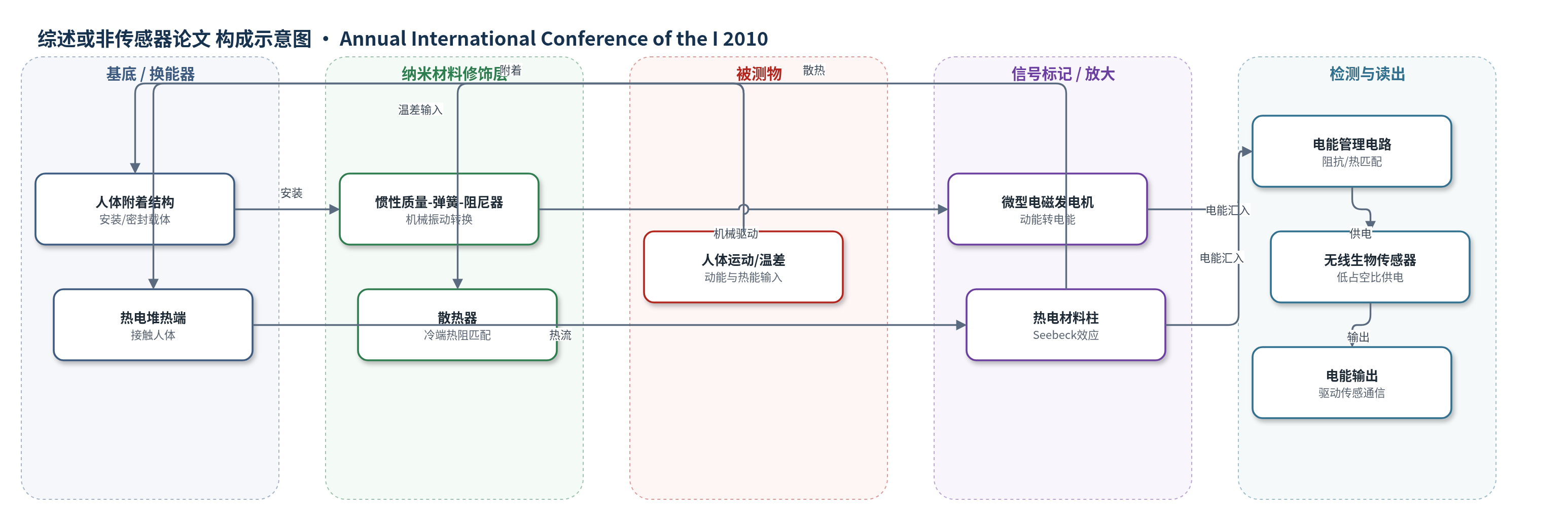
点击图片查看大图 · 依据论文自动绘制
传感器类型
综述或非传感器论文
检测对象
不适用:人体运动动能与体表-环境温差(非生物分析物;样品基质为人体体表/运动状态)
检测原理
本文不报道生物识别传感信号,而是分析为无线生物传感器供电的能量收集机制。惯性动能收集器将人体行走或跑步产生的周期性位移转化为惯性质量相对基底的振动,通过电磁感应或压电效应产生电能;理论功率随驱动位移幅值、频率、质量与体积增大而提高。热电收集器利用人体核心或皮肤与外界环境之间的温差,使 N/P 型热电材料柱产生 Seebeck 电压;最大输出功率取决于热电材料 Seebeck 系数、电/热阻以及人体与散热器热阻匹配。文中比较了不同体积下两种收集器的功率极限,并引入原型效率修正实际性能。
检测灵敏度
无:原文未报告LOD、线性范围、灵敏度斜率或相关系数。
效应效果
本文未评估生物传感器选择性、抗干扰、稳定性或实际样品回收率,而是比较能量收集器功率密度。理论极限下,跑步时惯性动能收集器约300 µW/cm3,热电约20 µW/cm3;步行时分别约30 µW/cm3和10 µW/cm3。考虑文献原型效率后,热电装置效率约70%,惯性动能装置约1%;跑步时热电在小体积下功率密度更有竞争力,步行时热电明显优于动能收集器。作者认为热电收集器更适合作为可气密封装、低占空比无线生物传感器的电源,但需解决频率或热阻自适应问题。
传感器的构成
- 论文类型:综述/理论分析,讨论可穿戴与植入式无线生物传感器的能量收集供电方案
- 能量源:人体运动动能与体表-环境温差,作为微型发电机的输入能量
- 惯性收集器:惯性质量-弹簧-阻尼器结构,将人体运动转换为机械振动
- 动能换能器:微型电磁发电机(如动能手表机构),将机械振动转换为电能
- 热电收集器:热电堆(N/P 型热电材料柱),利用体表与环境温差产生电压
- 热管理:热端接触人体、冷端连接散热器,形成热阻匹配以最大化功率
- 供电对象:无线生物传感器节点,由收集电能驱动传感与通信
中文摘要
可穿戴与植入式无线生物传感器在功能、电池寿命和电池体积之间存在明显权衡,能量收集装置可能克服这些限制。可靠能量收集已在机器状态监测中实现,并应用于化工、炼油和水处理。然而,能从人体收集足够能量为无线生物传感器供电的实用微型装置仍处起步阶段。本文综述人体能量收集方案,以确定由收集器供电的人体传感器网络的可用功率。人体能量收集的主要竞争技术是惯性动能收集装置和热电装置;它们可气密封装,优于某些类型。本文比较这些装置在人体行走和跑步时输出功率随发电机体积变化的基本极限。结果表明,动能装置在两种情况下具有最高基本功率极限。但采用文献中已演示原型的装置效率进行比较时,跑步时热电装置与动能收集装置具有竞争力,步行时热电装置达到最高功率密度。
英文摘要
There are clear trade-offs between functionality, battery lifetime and battery volume for wearable and implantable wireless-biosensors which energy harvesting devices may be able to overcome. Reliable energy harvesting has now become a reality for machine condition monitoring and is finding applications in chemical process plants, refineries and water treatment works. However, practical miniature devices that can harvest sufficient energy from the human body to power a wireless bio-sensor are still in their infancy. This paper reviews the options for human energy harvesting in order to determine power availability for harvester-powered body sensor networks. The main competing technologies for energy harvesting from the human body are inertial kinetic energy harvesting devices and thermoelectric devices. These devices are advantageous to some other types as they can be hermetically sealed. In this paper the fundamental limit to the power output of these devices is compared as a function of generator volume when attached to a human whilst walking and running. It is shown that the kinetic energy devices have the highest fundamental power limits in both cases. However, when a comparison is made between the devices using device effectivenesses figures from previously demonstrated prototypes presented in the literature, the thermal device is competitive with the kinetic energy harvesting device when the subject is running and achieves the highest power density when the subject is walking.