组成图示
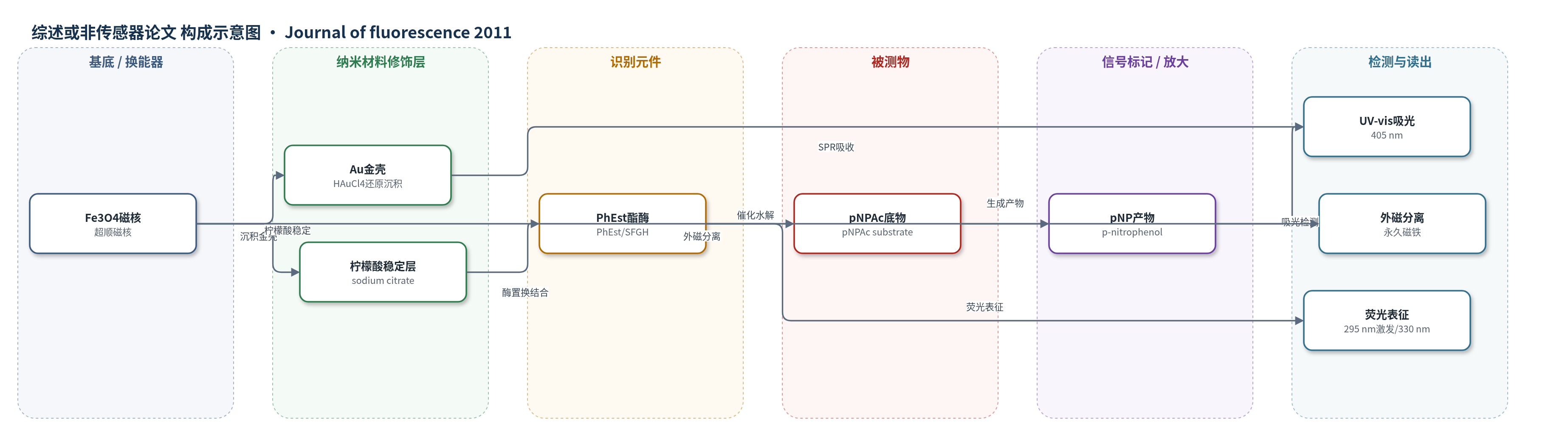
点击图片查看大图 · 依据论文自动绘制
传感器类型
综述或非传感器论文
检测对象
无明确生物传感分析物;酶活测定底物:p-硝基苯乙酸 (pNPAc),样品基质:20 mM 磷酸盐缓冲液 pH 8
检测原理
该文并非分析物传感方法,而是酶-纳米粒子偶联物的制备与酶活表征。Fe3O4 磁核提供超顺磁性,Au 壳经柠檬酸还原沉积形成核壳结构,表面 citrate 可被 PhEst 中可及 Cys 残基置换,形成 Au-S 键固定酶。固定化 PhEst 催化 pNPAc 水解生成 p-nitrophenol;产物在 405 nm 的吸光度随时间增加,酶活以每分钟释放 1 μmol p-nitrophenol 的 U/ml 表示。金壳 SPR 吸收位于 534 nm,可确认核壳结构;外磁场可驱动磁核聚集实现分离。若扩展为传感,产物吸光可反映底物或酶量变化。
检测灵敏度
原文未报告 LOD、线性范围、灵敏度斜率或 R^2。
效应效果
论文未报告选择性、抗干扰、RSD、实际样品回收率或与 ELISA/HPLC/qPCR 的对比。Fe3O4@Au 粒径 SEM 为 22±5 nm,DLS 为 37.1±20 nm;PhEst 为 49.4±30 nm,偶联物为 74.6±25 nm,证实酶结合。EDS 检出 C、O、Fe、Na、Si、Au、Cl;SPR 峰由 520 nm 红移至 534 nm。固定化酶浓度 0.986 μM,粒子/蛋白摩尔比约 1:1.2。酶活为固定化 0.12 U/ml、游离 0.25 U/ml,作者称按 U/ml 固定化酶约高 2 倍。蛋白衍生粒子离心后可再分散,未衍生粒子两次离心后聚沉不再分散。
传感器的构成
- 磁核/换能基底:Fe3O4 磁铁矿纳米核,提供超顺磁性,用于外磁场分离与导向
- 纳米修饰层:Au 金壳,由 HAuCl4 经 sodium citrate 还原沉积,提供 Au-S 结合位点并产生 534 nm SPR 吸收
- 稳定/配体层:sodium citrate,稳定 Fe3O4 与 Fe3O4@Au 分散,可被酶表面 Cys 置换
- 催化/识别元件:PhEst(S-formylglutathione hydrolase/putative feruloyl esterase),通过可及 Cys 残基结合金表面,催化 pNPAc 水解
- 反应底物/信号前体:pNPAc(p-nitrophenyl acetate),被 PhEst 水解生成 p-nitrophenol
- 信号产物:p-nitrophenol,在 405 nm 产生吸光度,用于酶活测定
- 缓冲介质:phosphate buffer pH 8,维持酶活性与纳米粒子分散稳定
中文摘要
医学对纳米技术的兴趣源于人们相信可在人体内构建并导向靶点的纳米治疗装置。此类纳米装置可通过将超顺磁纳米粒子与生物医学活性蛋白偶联来构建。本文报道了将来自嗜冷菌 P. haloplanktis TAC125 的 S-甲酰谷胱甘肽水解酶 PhEst 固定化到经修饰的超顺磁核壳纳米粒子(Fe3O4@Au)的金涂层表面,并报道了该纳米粒子的合成。S-甲酰谷胱甘肽水解酶是一类广泛存在的酶,在真核和原核生物甲醛解毒中起关键作用。PhEst 最初被注释为假想阿魏酸酯酶,可释放阿魏酸(一种可清除活性氧自由基的抗氧化剂)。动态光散射、扫描电镜-能量色散 X 射线谱、紫外-可见吸收、荧光光谱、磁分离和酶催化实验证实了金包覆超顺磁纳米粒子的化学组成,以及酶在纳米粒子上的结合与活性。以 U/ml 表示的活性数据表明,固定化酶比溶液中游离酶活性约高 2 倍。此类粒子可借助外磁场导向,用于生物分离、靶向治疗及生物传感器应用。
英文摘要
Medical interest in nanotechnology originates from a belief that nanoscale therapeutic devices can be constructed and directed towards its target inside the human body. Such nanodevices can be engineered by coupling superparamagnetic nanoparticle to biomedically active proteins. We hereby report the immobilization of a PhEst, a S-formylglutathione hydrolase from the psychrophilic P. haloplanktis TAC125 onto the gold coated surface of modified superparamagnetic core-shell nanoparticles (Fe(3)O(4)@Au). The synthesis of the nanoparticles is also reported. S-formylglutathione hydrolases constitute a family of ubiquitous enzymes which play a key role in formaldehyde detoxification both in prokaryotes and eukaryotes. PhEst was originally annotated as a putative feruloyl esterase, an enzyme that releases ferulic acid (an antioxidant reactive towards free radicals such as reactive oxygen species) from polysaccharides esters. Dynamic light scattering, scanning electron microscopy with energy dispersive X-ray spectroscopy, UV-visible absorption spectroscopy, fluorescence spectroscopy, magnetic separation technique and enzyme catalytic assay confirmed the chemical composition of the gold covered superparamagnetic nanoparticles, the binding and activity of the enzyme onto the nanoparticles. Activity data in U/ml confirmed that the immobilized enzyme is approximately 2 times more active than the free enzyme in solution. Such particles can be directed with external magnetic fields for bio-separation and focused towards a medical target for therapeutical as well as bio-sensor applications.