组成图示
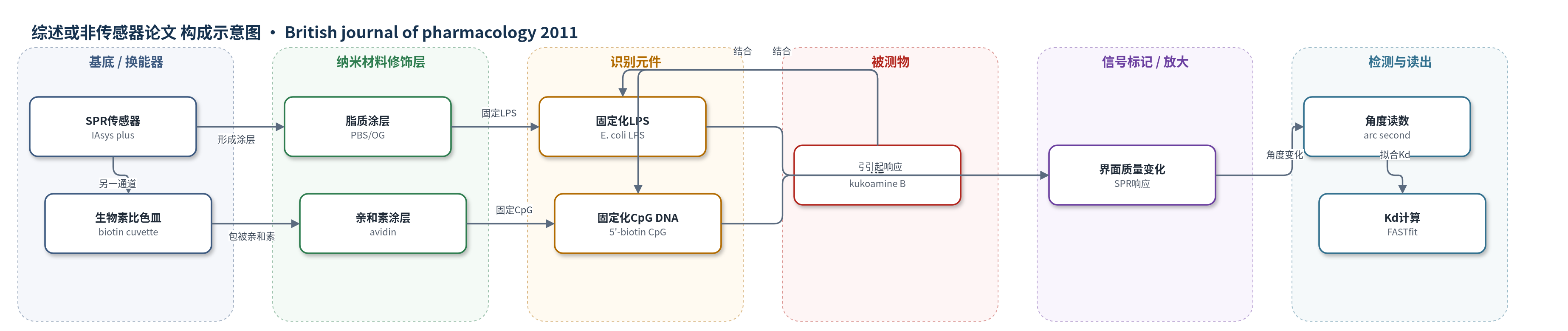
点击图片查看大图 · 依据论文自动绘制
传感器类型
综述或非传感器论文
检测对象
kukoamine B(KB),样品基质为PBS;固定识别物为LPS和CpG DNA
检测原理
该研究采用基于表面等离子共振(SPR)的亲和生物传感器检测KB与LPS或CpG DNA的结合。LPS通过PBS/OG形成的脂质涂层固定于非衍生化比色皿表面;5′-生物素化CpG DNA通过亲和素固定于生物素比色皿表面。将不同浓度KB的PBS溶液加入反应池,KB与表面固定分子结合后改变界面质量/折射率,引起SPR角度响应变化。结合量随KB浓度增加而增加,经洗涤和0.01 M HCl再生后重复检测。利用FASTplot处理结合曲线,并用FASTfit按系列浓度(0.25、0.5、1、2、4 mM)拟合得到Kd。该方法为无标记直接结合检测,无酶或核酸扩增放大。
检测灵敏度
未报告LOD、线性范围、灵敏度斜率或相关系数。
效应效果
KB对LPS和CpG DNA均显示高亲和力,Kd分别为1.23 mM和0.66 mM;多粘菌素B(PMB)对LPS亲和力更高(25.8 nM),但不结合CpG DNA。LAL实验中KB剂量依赖性中和2 ng/mL LPS,最高中和率70.26%,IC50为14.93 mM,PMB为4.80 mM。细胞实验中KB抑制LPS和CpG DNA诱导的TNF-α、IL-6释放及mRNA表达,对Pam3CSK4、Poly I:C、TNF-α、IL-1β诱导的释放无显著影响,显示选择性;MTT显示25–800 mM KB无细胞毒性。小鼠热灭活大肠杆菌模型中,KB降低死亡率并降低循环LPS和TNF-α,提示其作为脓毒症候选药物的价值。
传感器的构成
- 基底/换能器:IAsys plus 亲和生物传感器(SPR光学传感器),提供表面结合响应读出。
- 修饰层:PBS/OG(0.02 M PBS, pH 7.4 / 1.25% OG w/v)形成脂质涂层,用于固定LPS。
- 修饰层:生物素比色皿表面包被亲和素(avidin),用于固定5′-生物素化CpG DNA。
- 识别元件:固定化LPS(Escherichia coli O111:B4 LPS),作为捕获LPS结合配体的表面分子。
- 识别元件:固定化5′-生物素化CpG DNA 1826,作为捕获CpG DNA结合配体的表面分子。
- 样品/配体:kukoamine B(KB),溶于PBS,与固定化LPS或CpG DNA结合产生SPR响应。
- 再生剂:PBS和0.01 M HCl,用于洗脱结合物并恢复表面。
- 读出:SPR角度响应(arc second),经FASTplot/FASTfit分析计算Kd。
中文摘要
脂多糖(LPS)和含CpG基序的寡脱氧核苷酸(CpG DNA)是诱导脓毒症的重要病原相关分子,也是治疗靶点。现有药物通常只针对LPS或CpG DNA之一,而二者在脓毒症中常协同作用,疗效有限。本研究报道天然生物碱kukoamine B(KB)可同时抑制LPS和CpG DNA。作者采用生物传感器技术评估KB与LPS和CpG DNA的亲和力,并用中和实验评价其直接相互作用;通过细胞实验分析KB对LPS和CpG DNA诱导的促炎信号转导和细胞因子表达的选择性抑制;在小鼠热灭活大肠杆菌脓毒症模型中,通过存活率及循环LPS和肿瘤坏死因子-α(TNF-α)水平评价其保护作用。结果显示,KB对LPS和CpG DNA均具有高亲和力,可中和二者并阻止其与小鼠巨噬细胞相互作用;在不干扰巨噬细胞信号通路和细胞活力的情况下,选择性抑制LPS和CpG DNA诱导的信号转导及促炎介质表达;KB可保护受攻击小鼠并降低循环LPS和TNF-α水平。该研究首次报道一种LPS和CpG DNA双抑制剂,提示KB可作为脓毒症治疗的潜在候选药物。
英文摘要
BACKGROUND AND PURPOSE: Lipopolysaccharides (LPS) and oligodeoxynucleotides containing CpG motifs (CpG DNA) are important pathogenic molecules for the induction of sepsis, and thus are drug targets for sepsis treatment. The present drugs for treating sepsis act only against either LPS or CpG DNA. Hence, they are not particularly efficient at combating sepsis as the latter two molecules usually cooperate during sepsis. In this study, a natural alkaloid compound kukoamine B (KB) is presented as a potent dual inhibitor for both LPS and CpG DNA.
EXPERIMENTAL APPROACH: The affinities of KB for LPS and CpG DNA were assessed using biosensor technology. Direct interaction of KB with LPS and CpG DNA were evaluated using neutralization assays. Selective inhibitory activities of KB on pro-inflammatory signal transduction and cytokine expression induced by LPS and CpG DNA were analysed by cellular assays. Protective effects of KB in a sepsis model in mice were elucidated by determining survival and circulatory LPS and tumour necrosis factor-alpha (TNF-α) concentrations.
KEY RESULTS: KB had high affinities for LPS and CpG DNA. It neutralized LPS and CpG DNA and prevented them from interacting with mouse macrophages. KB selectively inhibited LPS- and CpG DNA-induced signal transduction and expression of pro-inflammatory mediators without interfering with signal pathways or cell viability in macrophages. KB protected mice challenged with heat-killed Escherichia coli, and reduced the circulatory levels of LPS and TNF-α.
CONCLUSIONS AND IMPLICATIONS: This is the first report of a novel dual inhibitor of LPS and CpG DNA. KB is worthy of further investigation as a potential candidate to treat sepsis.