组成图示
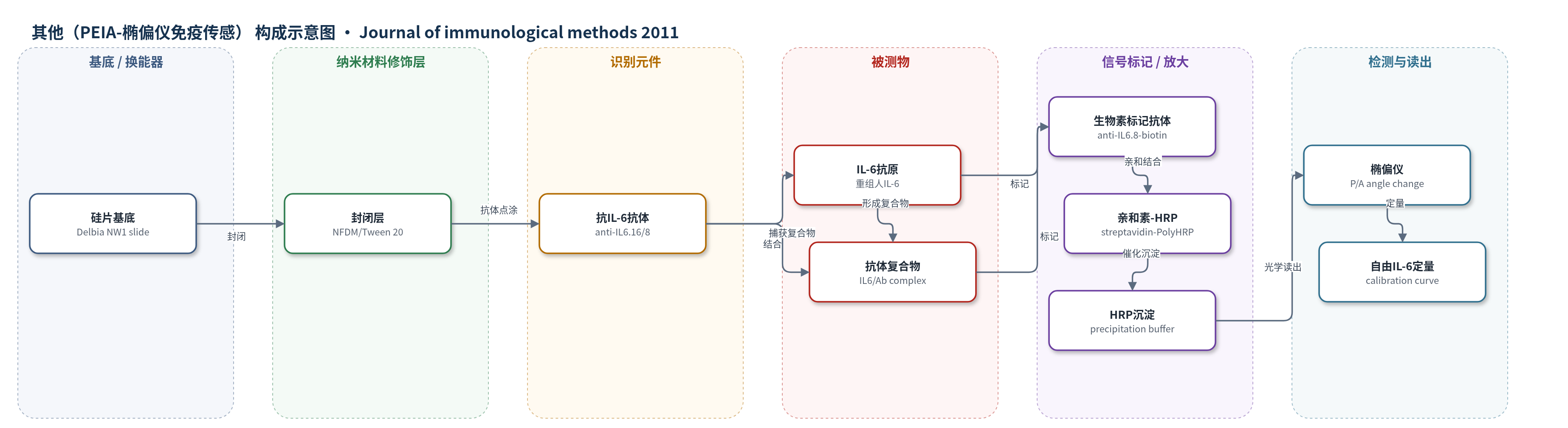
点击图片查看大图 · 依据论文自动绘制
传感器类型
其他(PEIA-椭偏仪免疫传感)
检测对象
白介素-6(IL-6,重组人 IL-6)、抗 IL-6 抗体(anti-IL6.16、anti-IL6.8),样品基质为 Tris 缓冲液/溶液
检测原理
PEIA-椭偏仪法将抗 IL-6 抗体点涂于硅片,先让 IL-6 与抗体在溶液中达到结合平衡,再把硅片插入混合液,使未结合 IL-6 及 IL-6/抗体复合物被表面抗体捕获。随后用生物素化抗 IL-6 抗体标记已吸附 IL-6,再结合链霉亲和素-多聚 HRP;HRP 在沉淀缓冲液中催化形成沉淀,使表面质量显著增加。椭偏仪通过偏振器与分析器角度变化实时读出沉淀量,经标准曲线换算为自由 IL-6 浓度,再用 Langmuir 方程拟合 Kd。SPR 法则将抗体共价固定于 CM5 芯片,IL-6 流过时表面质量变化引起共振单位(RU)变化;但高亲和体系平衡慢且固定化可产生低亲和群体。
检测灵敏度
未报告 LOD、线性范围、灵敏度斜率或相关系数。
效应效果
PEIA-椭偏仪法与生物测定一致:anti-IL6.16 平衡 Kd 47±10 pM,anti-IL6.8 3.7±0.8 pM;动力学 Kd 51(40–62)pM 和 6.2(4.5–7.1)pM。SPR 在 1 nM 以下 4 h 未达平衡,仅估计 Kd <400 pM 和 <200 pM;动力学显示固定化后出现低亲和群体,Kd 约 500(400–1200)pM 和 700(600–1100)pM。方法用 NFDM/Tween 20 抑制非特异结合,SPR 用转铁素阴性对照,作者认为 PEIA-椭偏仪适合皮摩尔级高亲和结合常数测定。
传感器的构成
- 基底/换能器:Delbia NW1 硅片(silicon slides),用于椭偏仪实时监测表面质量与偏振变化
- 封闭层:无脂奶粉(NFDM)或 Tween 20,抑制非特异蛋白吸附
- 识别元件:抗 IL-6 单克隆抗体 anti-IL6.16 或 anti-IL6.8,点涂于硅片以捕获 IL-6
- 信号标记物:抗 IL-6.8/生物素偶联物(anti-IL6.8/biotin conjugate)或生物素化多克隆抗 IL-6 抗体,标记已吸附 IL-6
- 信号放大元件:链霉亲和素-多聚辣根过氧化物酶(streptavidin-Poly HRP),结合生物素并催化沉淀
- 沉淀底物:HRP 沉淀缓冲液(precipitation buffer),在 HRP 催化下形成沉淀以增强表面质量
- 读出装置:椭偏仪(ellipsometer),通过偏振器 P 与分析器 A 的角度变化定量沉淀/表面质量
中文摘要
高亲和抗体–抗原结合参数的测定对治疗性抗体筛选、牛体内激素检测及临床免疫分析很重要。无标记测定常将一种结合伙伴固定在生物传感器芯片上,再监测另一伙伴的结合平衡;但当解离常数达皮摩尔或更低时,平衡时间过长,只能分析吸附/解离动力学。本文评估一种新方法:沉淀增强免疫检测–椭偏仪(PEIA-ellipsometry),利用溶液中结合平衡比固相表面更快建立的特点,通过抗体点涂硅片捕获未结合抗原,并用 HRP 催化沉淀放大信号,测定两种高亲和抗白介素-6 抗体 anti-IL6.16 和 anti-IL6.8 的结合参数,并与基于 IL-6 依赖细胞生长的生物测定及标准 SPR 技术比较。生物测定得到 anti-IL6.8 和 anti-IL6.16 的高亲和值分别为 5 和 50 pM,PEIA-椭偏仪可方便测得;SPR 平衡测量耗时过长,动力学分析显示抗体固定于芯片后出现不同亲和性群体。
英文摘要
Assessment of high-affinity antibody-antigen binding parameters is important in such diverse areas as selection of therapeutic antibodies, detection of unwanted hormones in cattle and sensitive immunoassays in clinical chemistry. Label-free assessment of binding affinities is often carried out by immobilization of one of the binding partners on a biosensor chip, followed by monitoring the binding equilibrium of the other partner. However, for the measurement of high-affinity binding, with dissociation constants in the picomolar range or lower, equilibration times exceed practical limits and one has to resort to the measurement of sorption kinetics. Here we evaluate a new technique, using PEIA(1)-ellipsometry and establishment of equilibrium in solution. Binding parameters are determined for two high-affinity anti-interleukin 6 antibodies, anti-IL6.16 and anti-IL6.8, and compared with values obtained by a bioassay, based on IL6-dependent cell growth, and with values obtained by a standard technique based on SPR.(2) The high affinities of both antibodies as found with the bioassay (5 and 50pM for anti-IL6.8 and anti-IL6.16, respectively), could be conveniently measured by PEIA-ellipsometry. Using SPR, equilibrium measurements indeed proved too time-consuming and analysis of adsorption/desorption kinetics revealed that the binding of the antibodies on the chip caused the appearance of different populations of antibodies with different affinities.