组成图示
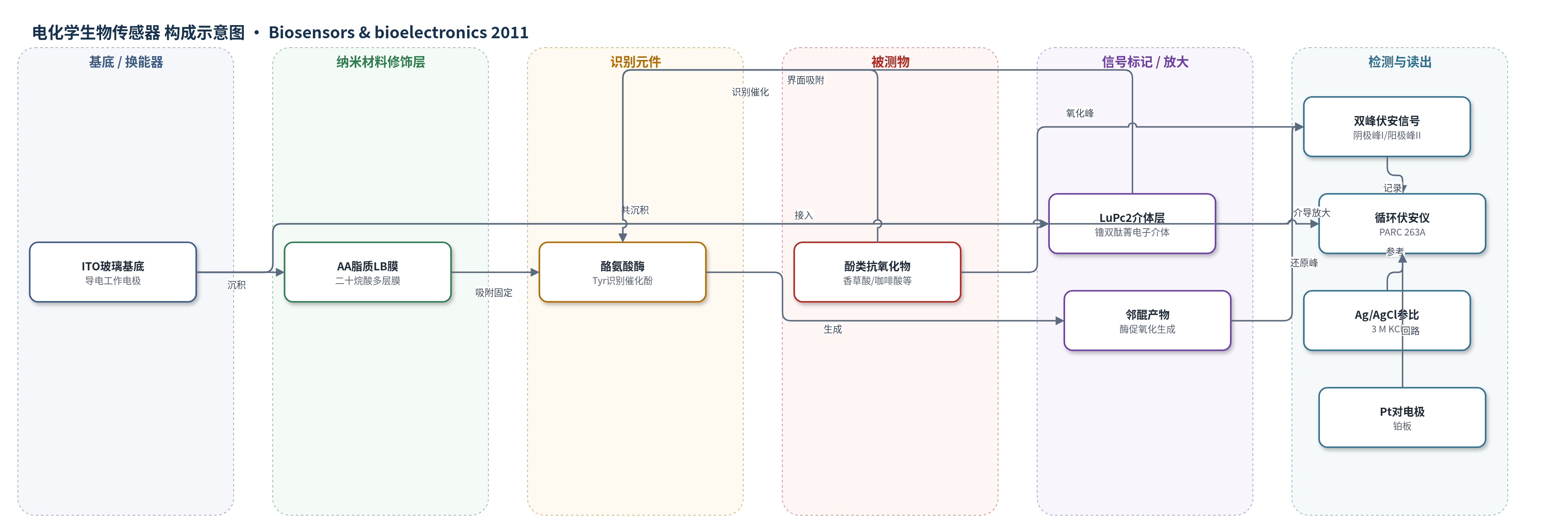
点击图片查看大图 · 依据论文自动绘制
传感器类型
电化学生物传感器
检测对象
香草酸(vanillic acid)、儿茶酚(catechol)、咖啡酸(caffeic acid)、没食子酸(gallic acid)、没食子酚(pyrogallol);样品基质:0.01 M磷酸盐缓冲液(pH 7),咖啡酸为12%乙醇水溶液。
检测原理
传感器以ITO/LB膜为工作电极。酚类抗氧化物进入仿生AA/LuPc2膜后,被固定其中的酪氨酸酶催化氧化为邻醌。循环伏安中,阴极峰I对应酶促生成的邻醌被还原回酚,电流随酚浓度升高而增大;LuPc2作为电子介体促进邻醌还原,产生显著信号放大。同时,阳极峰II对应酚类在电极表面的电化学氧化,LuPc2的电催化作用使氧化电位负移,例如咖啡酸在0.38 V氧化,低于碳电极的0.45 V,其电流也随浓度线性增加。酶促峰受电子转移控制,与扫描速率线性相关;电化学峰受扩散控制,与扫描速率平方根线性相关。两个氧化还原过程共存形成双模响应,提高对酚类化合物的选择性。
检测灵敏度
LOD: 1.98 μM(咖啡酸峰I)、2.09 μM(咖啡酸峰II);1.98 × 10⁻⁶–27.49 × 10⁻⁶ M(酶促过程);1.67 × 10⁻⁶–21.46 × 10⁻⁶ M(电化学氧化);线性范围: 10–400 μM(咖啡酸);灵敏度: 0.093 μA/μM(峰I)、0.162 μA/μM(峰II);R^2 = 0.9973(扫描速率依赖拟合)
效应效果
传感器对五种酚类均产生响应,且峰位和强度不同,双氧化还原过程提高了选择性;酶促峰受酶催化选择性控制,灵敏度顺序为二酚>三酚>单酚。在2.0×10⁻⁴ M咖啡酸中,平均稳态电流25.22 μA,七次测定RSD为2.6%;六个独立制备传感器RSD为2.9%。LB膜可连续循环50次,信号衰减低于4%。表观Michaelis常数KM为62.31–144.87 μM,低于游离酶的2.30 mM,表明脂质仿生环境保持酶构象并提高亲和力。LuPc2的电催化氧化能力优于CoPc(CoPc对儿茶酚氧化峰约0.65 V且无明显电催化)。作者认为该传感器适合薄层池中酚类检测。
传感器的构成
- 基底/工作电极:ITO玻璃(indium tin oxide, ITO),导电基底与换能器。
- 脂质修饰层:二十烷酸(arachidic acid, AA)Langmuir–Blodgett多层膜,提供仿生脂质环境并固定酶。
- 电子介体层:镥双酞菁(lutetium bisphthalocyanine, LuPc2)与AA共沉积,介导电子转移并电催化酚类氧化。
- 识别元件:蘑菇酪氨酸酶(tyrosinase, Tyr),催化酚类氧化生成邻醌。
- 交联固定层:戊二醛(glutaraldehyde),与酶氨基形成席夫碱以增强固定。
- 参比电极:Ag|AgCl/KCl 3 M,提供稳定电位参考。
- 对电极:铂板(platinum, Pt),完成电化学回路。
中文摘要
本文报道了一种仿生Langmuir–Blodgett(LB)膜的制备与应用:将蘑菇酪氨酸酶(tyrosinase, Tyr)包埋于二十烷酸(arachidic acid, AA)脂质层中,并引入镥双酞菁(lutetium bisphthalocyanine, LuPc2)作为电子介体,用于酚类衍生物的电化学伏安检测。检测对象包括一种单酚香草酸(vanillic acid)、两种二酚儿茶酚(catechol)和咖啡酸(caffeic acid),以及两种三酚没食子酸(gallic acid)和没食子酚(pyrogallol)。伏安响应中的第一个氧化还原过程对应酶促生成的邻醌被还原,LuPc2可促进该过程并显著放大信号;第二个过程对应抗氧化物的电化学氧化,在电子介体存在下于更低电位发生。该生物传感器具有低检出限(1.98×10⁻⁶–27.49×10⁻⁶ M)、良好重现性和对抗氧化物的高亲和力(KM为62.31–144.87 μM)。仿生固定化保持了酶的优良功能,酶催化提供选择性,LuPc2介体增强信号,两个氧化还原过程共存提高了曲线选择性,使其特别适合酚类化合物检测。
英文摘要
This paper describes the preparation of a biomimetic Langmuir-Blodgett film of tyrosinase incorporated in a lipidic layer and the use of lutetium bisphthalocyanine as an electron mediator for the voltammetric detection of phenol derivatives, which include one monophenol (vanillic acid), two diphenols (catechol and caffeic acid) and two triphenols (gallic acid and pyrogallol). The first redox process of the voltammetric responses is associated with the reduction of the enzymatically formed o-quinone and is favoured by the lutetium bisphthalocyanine because significant signal amplification is observed, while the second is associated with the electrochemical oxidation of the antioxidant and occurs at lower potentials in the presence of an electron mediator. The biosensor shows low detection limit (1.98×10(-6)-27.49×10(-6) M), good reproducibility, and high affinity to antioxidants (K(M) in the range of 62.31-144.87 μM). The excellent functionality of the enzyme obtained using a biomimetic immobilisation method, the selectivity afforded by enzyme catalysis, the signal enhancement caused by the lutetium bisphthalocyanine mediator and the increased selectivity of the curves due to the occurrence of two redox processes make these sensors exceptionally suitable for the detection of phenolic compounds.