组成图示
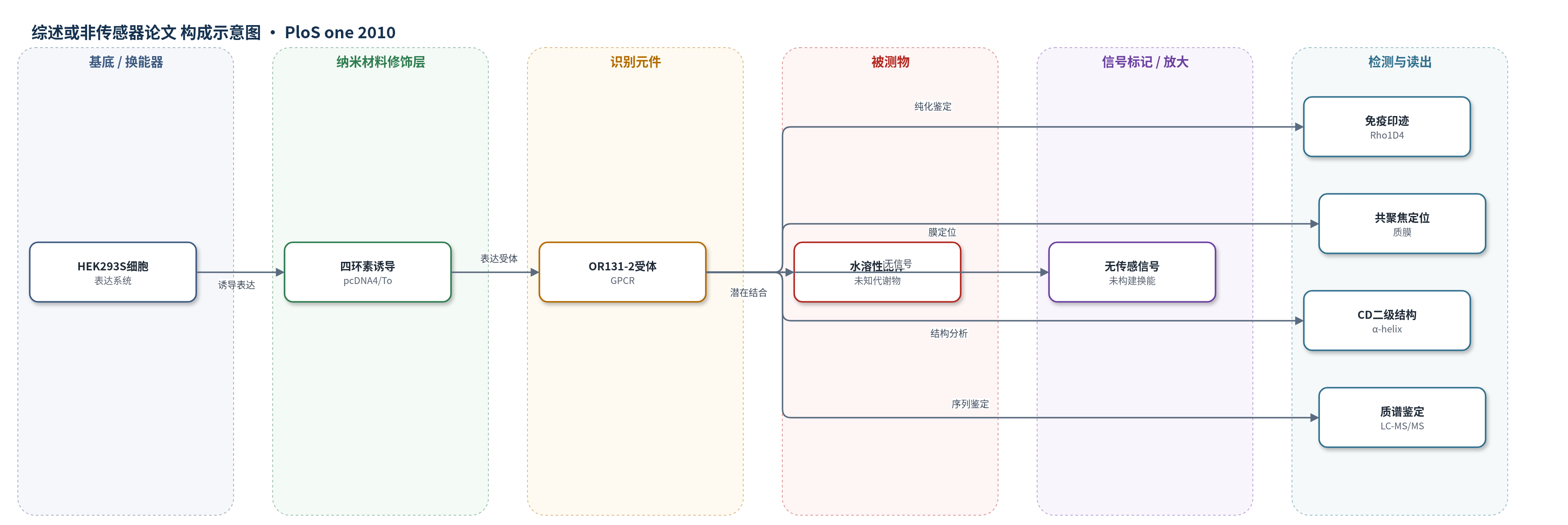
点击图片查看大图 · 依据论文自动绘制
传感器类型
综述或非传感器论文
检测对象
未知水溶性配体(water-soluble ligands)、水溶性代谢物(water-soluble metabolites);样品基质:水样(本文未实际检测)
检测原理
本文未建立实际生物传感器,因此没有可随被测物浓度变化的传感信号。研究仅证明重组斑马鱼嗅觉受体OR131-2可在HEK293S细胞中表达、转运至质膜并被纯化。OR131-2属于A类G蛋白偶联受体(GPCR),具有七跨膜α螺旋结构;若未来用于传感,其识别事件应为水溶性配体与受体结合,引起受体构象变化并可能激活下游G蛋白信号。但该过程需要耦合到电化学、光学或压电换能器才能产生可读出信号。本文通过免疫印迹、共聚焦显微镜、圆二色性光谱和质谱验证蛋白表达、定位、折叠和身份,未涉及信号放大或定量检测。
检测灵敏度
未报告
效应效果
本文未评价传感器选择性、抗干扰、稳定性或实际样品回收率。主要结果为蛋白表达与纯化:从HEK293S细胞中经免疫亲和纯化获得约290 mg/g培养细胞的OR131-2蛋白,纯度高于85%,回收率约90%。Western blot显示单体、二聚体及更高寡聚体;共聚焦显微镜显示受体位于质膜及胞内区。CD分析显示α螺旋含量约30–35%,与预测跨膜螺旋约43%相符,随机卷曲约25–30%,β转角约15–20%。质谱确认蛋白身份。作者认为该方案可为其他GPCR表达纯化提供参考,并可能支持未来水相嗅觉/化学传感器件设计。
传感器的构成
- 基底或换能器:无,本文未报道传感器基底或换能器材料。
- 识别元件:OR131-2(GPCR),重组斑马鱼嗅觉受体,潜在识别水溶性配体。
- 纯化/验证材料:Rho1D4抗体、Sepharose 4B、FC14,用于受体纯化与稳定。
中文摘要
鱼类如何在大体积水体中检测痕量分子尚不清楚,推测其可能利用嗅觉受体识别水溶性化合物。斑马鱼仅有98个功能嗅觉受体,却能选择性检测并识别水中多种化合物,这一现象仍难以解释。本文研究鱼类嗅觉的生化与分子机制,报道了一种生物工程斑马鱼嗅觉受体OR131-2的研究。该受体从HEK293S四环素诱导表达系统中亲和纯化获得。共聚焦显微镜显示,受体在细胞中表达并转运至质膜。圆二色性光谱表明,纯化的斑马鱼受体折叠为α螺旋结构,与其他G蛋白偶联受体(GPCR)一致。该研究表明可以制备具有活性的斑马鱼嗅觉受体蛋白,不仅有助于开展详细结构与功能分析,也有助于设计用于检测与人类健康相关的水溶性代谢物或其中间体的生物传感器装置。
英文摘要
How fishes are able to detect trace molecules in large bodies of water is not understood. It is plausible that they use olfactory receptors to detect water-soluble compounds. How the zebra fish Danio Rerio, an organism with only 98 functional olfactory receptors, is able to selectively detect and recognize numerous compounds in water remains a puzzling phenomenon. We are interested in studying the biochemical and molecular mechanisms of olfaction in fish. Here, we report on the study of a bioengineered zebra fish olfactory receptor OR131-2, affinity-purified from a HEK293S tetracycline-inducible system. This receptor was expressed and translocated to the cell plasma membrane as revealed by confocal microscopy. Circular dichroism spectroscopy showed that the purified zebra fish receptor folded into an α-helical structure, as observed for other G-protein coupled receptors (GPCRs). Our study shows that it is possible to produce viable quantities of the zebra fish olfactory receptor. This will not only enable detailed structural and functional analyses, but also aid in the design of biosensor devices in order to detect water-soluble metabolites or its intermediates, which are associated with human health.