组成图示
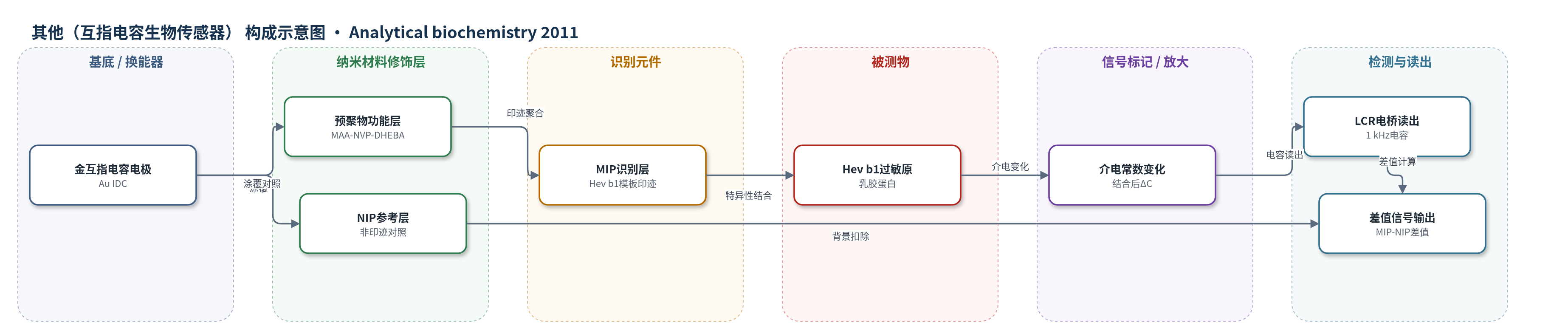
点击图片查看大图 · 依据论文自动绘制
传感器类型
其他(互指电容生物传感器)
检测对象
Hev b1 乳胶过敏原(Hev b1,rubber elongation factor);样品基质:橡胶手套蛋白提取物、天然橡胶乳胶提取物(磷酸盐缓冲液 pH 7.4)
检测原理
该传感器以Hev b1(G)为模板,在Au IDC电极表面进行溶液法表面印迹聚合。MAA和NVP作为功能单体,DHEBA作为交联剂,经UV固化后水洗去除模板,形成含互补空腔的poly(MAA–NVP–DHEBA)识别层。当Hev b1进入印迹空腔时,通过形状/构象匹配及多点位非共价相互作用结合,改变聚合物/电极界面的取向极化和介电常数。由于互指电容的几何尺寸不变,介电特性变化直接引起电容值变化,实验中表现为电容下降;LCR电桥在1 kHz、100 mV下测量ΔC,ΔC随Hev b1浓度增加而变化。NIP参考层用于扣除非特异吸附。该方法无标记、无酶催化放大,灵敏度主要来自表面印迹高亲和位点和IDC微电极的高界面电容响应。
检测灵敏度
LOD: 10 ng ml−1;线性范围: 10–400 ng ml−1,R^2 = 0.9969;400–900 ng ml−1,R^2 = 0.9888
效应效果
该传感器对Hev b1具有良好选择性:对Hev b2、Hev b3交叉反应为47%和43%,对溶菌酶、卵白蛋白和BSA约25%和20%;摘要选择性因子为4和2,低浓度下选择性因子约6,400–900 ng/ml下约10。室温连续使用稳定性达180天,再生50次后保留结合效率>95%。加标回收率95–100%,RSD 4%。实际样品中,含粉乳胶手套Hev b1含量为25±6 μg/g,无粉手套为3.1±0.5 μg/g。与夹心ELISA相比,该法无标记、快速、低成本,适用于橡胶手套等复杂基质中乳胶过敏原筛查。
传感器的构成
- 基底/换能器电极:玻璃芯片上的金互指电容微电极(Au IDC),指隙10 μm,空气电容约5–10 pF,用于形成互指电容并读出电容变化
- 预聚物功能层:MAA–NVP–DHEBA水溶性预聚物(MAA:NVP=6:2,DHEBA 15 mol%,AIBN/过硫酸铵引发,UV固化),提供羧基/酰胺基识别位点与交联网络
- 分子印迹识别层:以Hev b1(G)为模板的表面印迹poly(MAA–NVP–DHEBA)薄膜,厚约200 nm,印迹坑深约70 nm,特异性结合Hev b1
- 参考对照层:非印迹聚合物(NIP)涂层,用于评估非特异结合和背景扣除
- 信号读出模块:Agilent 4284A LCR电桥与流式微池(100 μL),在1 kHz、100 mV下测量ΔC
中文摘要
本文报道了一种基于表面分子印迹聚合物(MIP)与互指电容(IDC)换能器相结合的无标记乳胶过敏原检测方法。以橡胶手套中提取的Hev b1为模板,将甲基丙烯酸(MAA)、N-乙烯基吡咯烷酮(NVP)和N,N'-二羟基乙撑双丙烯酰胺(DHEBA)共聚物涂覆于IDC微电极表面,形成水溶性印迹识别层,可避免蛋白变性。该传感器在pH 7.4缓冲液中产生与乳胶蛋白浓度(10–900 ng/mL)明显相关的电容响应,可在数分钟内检测Hev b1,检出限为10 ng/mL。印迹材料可根据蛋白尺寸和构象区分天然橡胶乳胶中的Hev b1、Hev b2和Hev b3,选择性因子为4;对Hevea乳胶蛋白的识别优于溶菌酶、卵白蛋白和牛血清白蛋白等非Hev b蛋白,选择性因子为2。传感器在室温连续使用时具有长达180天的良好操作稳定性。
英文摘要
Allergen protein detection was performed by a surface imprinted layer combined with an interdigitated capacitance (IDC) transducer that allowed label-free measurements. The immobilized imprinted polymers are the probes that bind to rubber allergen proteins extracted from products such as rubber gloves. Copolymers made from methacrylic acid-vinylpyrrolidone-dihydroxyethylene-bisacrylamide (MAA-NVP-DHEBA) are soluble in aqueous solution and eliminate the denaturation of protein. When deposited as a coating onto an IDC microelectrode transduction system, such materials lead to sensors that produce capacitance responses that are clearly dependent on the concentration of the latex protein (10-900 ng ml(-1)) in pH 7.4 buffer. The biosensor can detect Hev b1 within minutes and with a detection limit of 10 ng ml(-1). Different but related hevein allergenic proteins isolated from natural rubber latex from the rubber tree (Hev b1, Hev b2, and Hev b3) were distinguished by the imprinted material, depending on the dimension and conformation of these proteins with a selectivity factor of 4. They recognized Hevea latex proteins better than non-Hev b proteins, such as lysozyme, ovalbumin, and bovine serum albumin, by a factor of 2. Moreover, the sensor exhibited good operational stability of up to 180 days when used continuously at room temperature.