组成图示
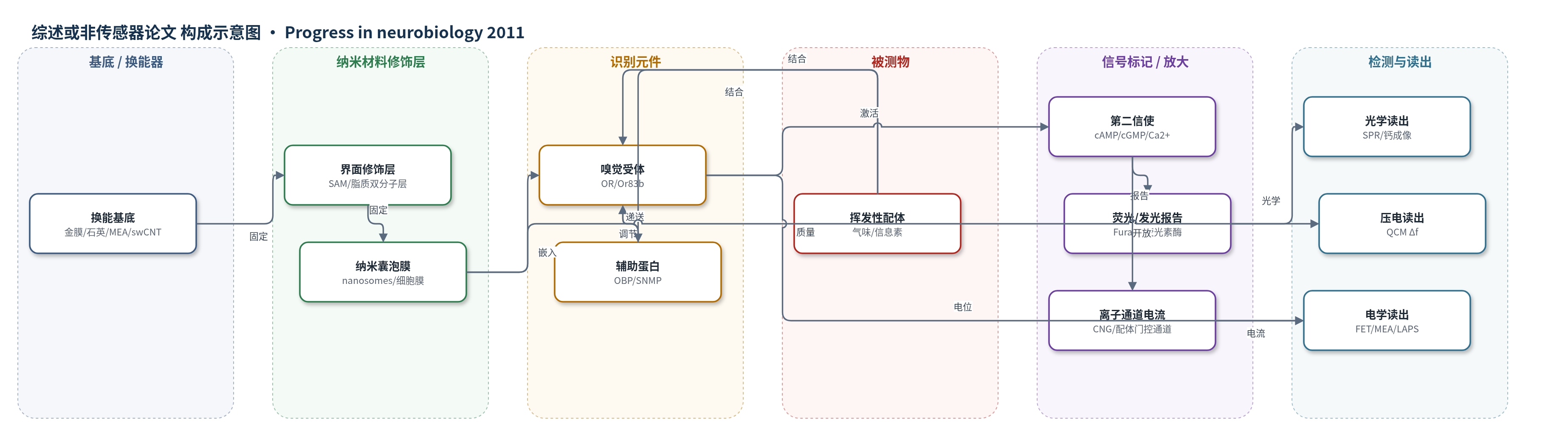
点击图片查看大图 · 依据论文自动绘制
传感器类型
综述或非传感器论文
检测对象
挥发性化合物(volatile compounds)、气味配体(odorant ligands)、昆虫信息素(pheromones,如 bombykol、cVA);样品基质:气相/空气、食品与葡萄酒挥发物、农业/环境样品、爆炸物或生物战剂相关气相。
检测原理
挥发性配体进入传感界面后,先由气味结合蛋白(OBP)等辅助蛋白结合或递送,再与表达在细胞膜、纳米囊泡或脂质双分子层上的嗅觉受体(OR)结合。脊椎动物 OR 激活 Gαolf,刺激腺苷酸环化酶(AC)升高 cAMP,cAMP 打开环核苷酸门控(CNG)通道,引起 Ca2+ 内流和膜电位变化;无脊椎动物 OR 常与辅助受体 Or83b 形成复合物,可能作为配体门控离子通道,也可能经 G 蛋白/cAMP 途径转导。细胞内 Ca2+、cAMP 或 G 蛋白活化可被 Fura-2/Fluo-4 荧光、荧光素酶、磷酸酶或 GTPγS 结合体系报告;膜电位、离子电流或界面质量/折射率变化则可由 MEA、FET、LAPS、SPR 或 QCM 读出。配体浓度升高时受体激活比例增加,信号增强直至饱和。
检测灵敏度
原文未报告 LOD、线性范围、灵敏度斜率或相关系数。
效应效果
综述指出,嗅觉受体相比化学电子鼻和气相色谱–质谱(GC–MS)在检测挥发性配体时具有数量级更高的灵敏度与特异性,可应用于非侵入疾病诊断、食品与葡萄酒过程监控、农业与环境监测、爆炸物及生物战剂检测等场景。现有概念验证研究采用 SPR、QCM、FET、MEA、LAPS、钙成像、荧光素酶和化学发光等技术,证明 OR–配体相互作用可被转换为可读信号。但作者强调,当前生物识别元件在现场条件下的稳定性不足、便携性有限,尚无商业化、可现场使用的嗅觉生物传感器;未来需提高受体/细胞膜稳定性、微型化换能器并实现多路复用。
传感器的构成
- 换能基底:金膜 SPR 芯片、石英晶体 QCM、微电极阵列 MEA、单壁碳纳米管场效应晶体管 swCNT-FET,用于将界面变化转为光、频率或电信号。
- 界面修饰层:自组装单分子层 SAM、脂质双分子层、酵母纳米囊泡 nanosomes,用于固定 OR 或细胞膜并维持功能。
- 识别元件:表达嗅觉受体 OR 的细胞或细胞膜/提取物,如 HEK-293、Sf9、酵母 Saccharomyces cerevisiae、嗅感觉神经元 OSN、OR:Or83b 复合物,用于识别挥发性配体。
- 信号报告元件:钙离子荧光染料 Fura-2/Fluo-4、绿色荧光蛋白 GFP、荧光素酶 luciferase、磷酸酶 phosphatase、GTPγS 结合体系,用于报告 OR 激活后的 cAMP/钙信号。
- 辅助识别/调节蛋白:气味结合蛋白 OBP、辅助受体 Or83b、嗅觉神经元膜蛋白 SNMP,用于增强或调节配体结合与信号。
- 读出系统:SPR 临界角/反射光强、QCM 频率变化 Δf 与耗散、FET/MEA/LAPS 电位或电流,用于输出可量化信号。
中文摘要
生物体如何检测环境中的特定挥发性化合物,以及由此产生感知和行为反应的神经处理机制,长期以来是科学研究的热点。早期嗅觉研究主要依赖对完整动物进行电生理测量。人类嗅觉受体(OR)基因家族的发现推动了多种细胞学检测体系的发展,这些体系主要用于对哺乳动物和昆虫嗅觉受体进行“去孤儿化”鉴定。相关研究显著深化了对嗅觉分子基础的认识;目前对脊椎动物和线虫嗅觉信号级联已有较好共识,但昆虫嗅觉信号转导机制仍存在争议。嗅觉受体固有的高特异性和高灵敏度使其成为生物传感器中检测挥发性配体的理想生物识别元件,具有多种潜在应用。过去十年,研究者探索了多种将 OR–配体相互作用转换为可读信号的技术,以构建保留体内 OR 分辨能力的嗅觉生物传感器(或生物电子鼻)。本文综述并比较了脊椎动物与无脊椎动物嗅觉的分子机制,总结了利用亚组织水平传感元件(细胞和细胞提取物)进行 OR 去孤儿化及生物传感器研究的检测技术。尽管目前尚无商业化、可现场使用的此类嗅觉生物传感器,但已有若干技术概念验证研究,预示其有望在未来十年内出现。
英文摘要
The way in which organisms detect specific volatile compounds within their environment, and the associated neural processing which produces perception and subsequent behavioural responses, have been of interest to scientists for decades. Initially, most olfaction research was conducted using electrophysiological techniques on whole animals. However, the discovery of genes encoding the family of human olfactory receptors (ORs) paved the way for the development of a range of cellular assays, primarily used to deorphan ORs from mammals and insects. These assays have greatly advanced our knowledge of the molecular basis of olfaction, however, while there is currently good agreement on vertebrate and nematode olfactory signalling cascades, debate still surrounds the signalling mechanisms in insects. The inherent specificity and sensitivity of ORs makes them prime candidates as biological detectors of volatile ligands within biosensor devices, which have many potential applications. In the previous decade, researchers have investigated various technologies for transducing OR:ligand interactions into a readable format and thereby produce an olfactory biosensor (or bioelectronic nose) that maintains the discriminating power of the ORs in vivo. Here we review and compare the molecular mechanisms of olfaction in vertebrates and invertebrates, and also summarise the assay technologies utilising sub-tissue level sensing elements (cells and cell extracts), which have been applied to OR deorphanization and biosensor research. Although there are currently no commercial, "field-ready" olfactory biosensors of the kind discussed here, there have been several technological proof-of-concept studies suggesting that we will see their emergence within the next decade.