组成图示
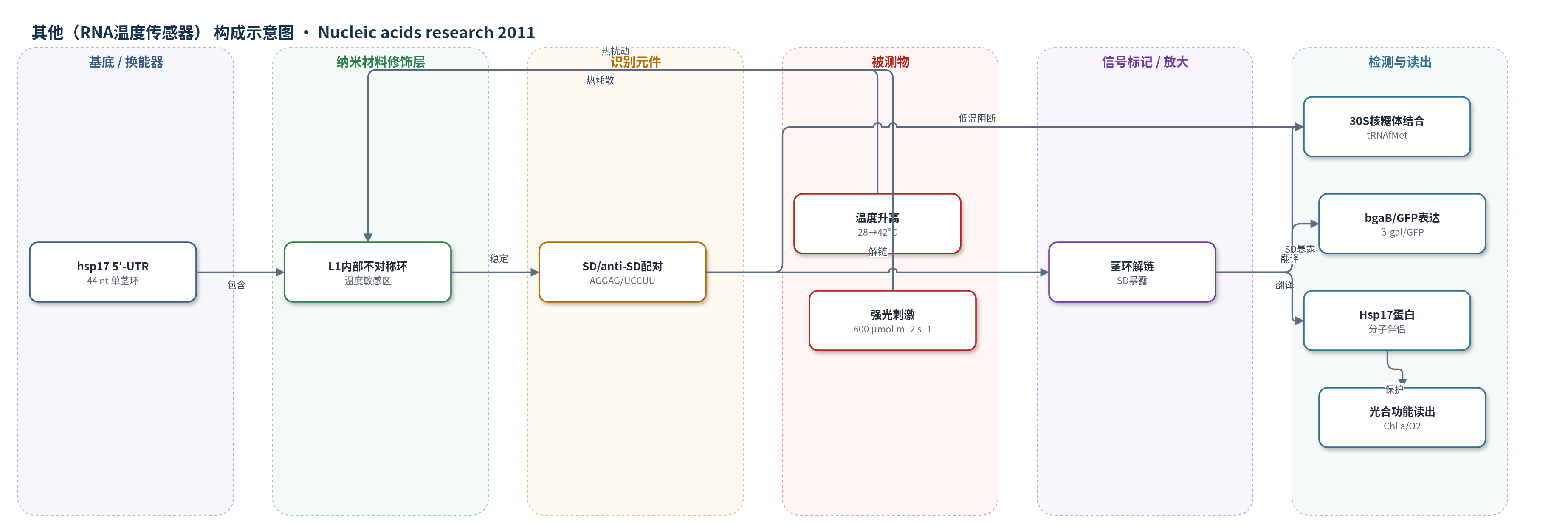
点击图片查看大图 · 依据论文自动绘制
传感器类型
其他(RNA温度传感器)
检测对象
温度(temperature, °C,28–42°C);样品基质:Synechocystis sp. PCC 6803 细胞培养液/细胞内环境;高光照(high light, 600 μmol photons m−2 s−1)作为辅助刺激。
检测原理
该 RNA 温度计以温度作为输入。低温下,hsp17 5′-UTR 的 44 nt 茎环通过 Watson–Crick 配对将 SD 序列 AGGAG 与 anti-SD UCCUU 互补结合,并部分掩埋 AUG,使 30S 核糖体无法形成翻译起始复合物,报告蛋白或 Hsp17 表达处于低水平。当培养温度从 28°C 升至 42°C 或经历强光诱导的局部热耗散时,茎区氢键和碱基堆积被热扰动破坏,L1 内部环附近先解链,SD 序列暴露。暴露的 SD 与 16S rRNA 配对,30S 亚基和 tRNAfMet 结合,翻译起始效率升高,bgaB/GFP 或 Hsp17 蛋白积累。降温后茎环重新折叠,SD 再次被掩埋,即使 mRNA 仍高表达也关闭翻译。信号随温度升高而增强,随温度下降而关闭,无外源酶或纳米材料放大。
检测灵敏度
未报告 LOD、线性范围、灵敏度斜率或相关系数。
效应效果
在 E. coli 中,WT bgaB 融合 28°C 为 30 MU,42°C 为 180 MU,诱导约 6 倍;derep 为 200 和 790 MU,诱导降至 2.5–3.9 倍;rep 无活性。GFP Western 与荧光显微一致。CD 显示 WT Tm 50.2°C,derep 45.1°C,rep 56.9°C,且可逆。Toeprinting 证实 42°C 促进 30S 结合。Synechocystis 中,WT 受保护,Rep 类似 Δhsp17,Derep 持续表达 Hsp17;热胁迫后 Δhsp17 与 Rep 的 Chl a 为 1.0 和 1.5 mg/ml,WT 为 6.0 mg/ml。光系统热稳定:WT 48°C、Rep 42°C、Derep 55°C;光稳定 200、140、300 min。放氧:WT 热休克后下降约 30%,Rep 降至 20%,Derep 几乎不受影响但恢复延迟。作者主张其可作绿色生物技术温度响应基因调控元件。
传感器的构成
- 识别元件:Synechocystis hsp17 5′-UTR(44 nt 单茎环,含 L1 内部不对称环与 L2 环)
- 温度感应层:Watson–Crick 碱基配对茎区与内部环/凸起,升温导致茎环解链
- 翻译起始元件:Shine–Dalgarno (SD) 序列 AGGAG、anti-SD UCCUU 与 AUG 起始密码
- 报告信号元件:bgaB(β-半乳糖苷酶)或 gfp(GFP)融合基因,用于表达读出
- 天然效应元件:hsp17 编码区,翻译产生 Hsp17 分子伴侣
- 换能/读出元件:30S 核糖体亚基、tRNAfMet 形成翻译起始复合物;Chl a 荧光与 O2 释放作为细胞表型读出
中文摘要
本文报道了蓝细菌 Synechocystis sp. PCC 6803 热休克基因 hsp17 的 mRNA 5′-非翻译区(5′-UTR)内建一个 RNA 温度计,对胁迫下光合活性至关重要。该 5′-UTR 仅约 44 个核苷酸,形成含内部不对称环 L1 和顶部大环 L2 的单茎环结构;在正常生长条件下,茎环将 Shine–Dalgarno(SD)序列和 AUG 起始密码部分掩埋,抑制 hsp17 翻译;升温或强光胁迫使结构解链,释放 SD 序列并允许翻译起始;恢复期结构重新关闭,停止 Hsp17 合成。稳定或破坏 RNA 结构的点突变在体内使报告基因表达失调,并在体外改变核糖体结合。将 rep 和 derep 突变整合到 Synechocystis 基因组后产生严重表型缺陷。可逆的开/关构象有利于细胞存活、光系统完整性和放氧能力;持续产生 Hsp17 在胁迫下降后有害。作者认为这是一种简单生物传感器,可将分子伴侣水平精确匹配生理需求。
英文摘要
Structured RNA regions are important gene control elements in prokaryotes and eukaryotes. Here, we show that the mRNA of a cyanobacterial heat shock gene contains a built-in thermosensor critical for photosynthetic activity under stress conditions. The exceptionally short 5'-untranslated region is comprised of a single hairpin with an internal asymmetric loop. It inhibits translation of the Synechocystis hsp17 transcript at normal growth conditions, permits translation initiation under stress conditions and shuts down Hsp17 production in the recovery phase. Point mutations that stabilized or destabilized the RNA structure deregulated reporter gene expression in vivo and ribosome binding in vitro. Introduction of such point mutations into the Synechocystis genome produced severe phenotypic defects. Reversible formation of the open and closed structure was beneficial for viability, integrity of the photosystem and oxygen evolution. Continuous production of Hsp17 was detrimental when the stress declined indicating that shutting-off heat shock protein production is an important, previously unrecognized function of RNA thermometers. We discovered a simple biosensor that strictly adjusts the cellular level of a molecular chaperone to the physiological need.