组成图示
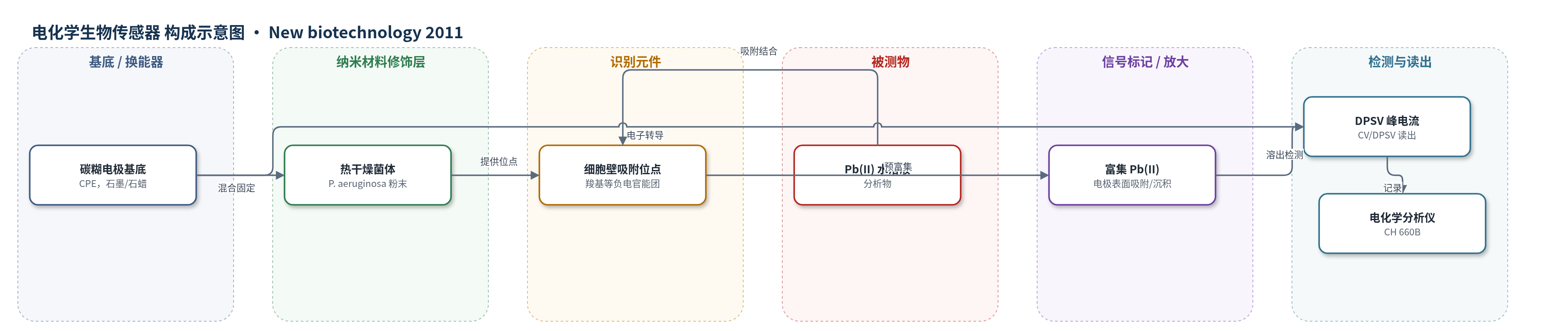
点击图片查看大图 · 依据论文自动绘制
传感器类型
电化学生物传感器
检测对象
铅离子(Pb(II));样品基质:水溶液(0.05 M 醋酸钠缓冲液)
检测原理
热干燥铜绿假单胞菌细胞壁含有羧基等负电官能团,在开路预富集阶段从水溶液中吸附 Pb(II),使金属离子富集于修饰碳糊电极表面。随后将电极转入 0.05 M 醋酸钠缓冲液,在 -1.4 V 沉积电位下将吸附的 Pb(II) 还原/沉积,再通过差分脉冲溶出伏安法(DPSV)或循环伏安法(CV)扫描,使 Pb 发生阳极溶出并产生特征峰电流。峰电流大小取决于电极表面富集的 Pb(II) 量,在 1.0×10^-6–2.0×10^-5 M 范围内与浓度呈线性关系;超过该范围后因吸附位点饱和而趋于平台。该方法以生物吸附实现预浓缩,以溶出伏安实现电化学换能。
检测灵敏度
LOD: 6.0 × 10^-7 M Pb(II);线性范围: 1.0 × 10^-6–2.0 × 10^-5 M Pb(II);R^2 = 0.9916;校准方程: y = 1.6283x - 0.6058(斜率 1.6283)
效应效果
该传感器重现性较好,对 1.5×10^-5 M Pb(II) 连续测定 7 次,平均峰电流 25.63 mA,标准差 1.06,变异系数(CV)为 4%。干扰试验表明,Co(II)、Cu(II)、Ni(II)、Zn(II) 单独存在时均无可追踪峰;与 Pb(II) 二元或多元共存时,Cu(II)、Ni(II) 主要产生拮抗作用,Zn(II) 产生明显协同增强;等浓度五金属共存时 Pb(II) 峰电流约为 59%,极端干扰浓度下约为 22%,但仍可观察和定量。与香蕉组织、Pennisetum setosum、BSA、HClO4、橙皮精油、Phormididum 等 Pb(II) 传感器相比,本方法线性范围 0.2–4.0 ppm,预富集 12 min,无需复杂固定化,成本低、操作简便,适用于水样中 Pb(II) 检测。
传感器的构成
- 电极本体:自制 5.0 mm 直径电极体,用于容纳碳糊并构成工作电极
- 基底/换能器电极:碳糊电极(CPE),由石墨粉和石蜡液组成,提供导电基底与电子转导界面
- 生物吸附/识别层:热干燥铜绿假单胞菌(P. aeruginosa)非活细胞粉末(5.0 mg,5% w/w),通过细胞壁羧基等负电官能团吸附 Pb(II)
- 支持电解质:0.05 M 醋酸钠缓冲液(sodium acetate buffer,pH 5.0),维持离子强度并优化 Pb(II) 吸附与溶出
- 参比电极:Ag/AgCl(饱和 KCl),提供稳定电位参考
- 对电极:铂丝(Pt),构成三电极体系并传递电流
中文摘要
本研究以热干燥铜绿假单胞菌(Pseudomonas aeruginosa)细胞作为生物材料构建微生物生物传感器,用于水溶液中铅离子(Pb(II))的电化学测定。将热干燥菌体与石墨粉、石蜡液混合制成修饰碳糊电极(CPE),在开路条件下对含 Pb(II) 溶液进行预富集,随后在 0.05 M 醋酸钠缓冲液中采用循环伏安法(CV)和差分脉冲溶出伏安法(DPSV)检测从电极表面溶出的 Pb(II)。系统优化了支持电解质、pH、离子强度、预富集时间、沉积电位和沉积时间等参数,并考察了 Co(II)、Cu(II)、Ni(II)、Zn(II) 等干扰离子的影响。结果表明,热干燥菌体可有效吸附 Pb(II),在最佳条件下获得 1.0×10^-6–2.0×10^-5 M 的线性范围(R^2=0.9916),检出限为 6.0×10^-7 M。该方法无需复杂固定化步骤,操作简便、耗时短,适用于水样中 Pb(II) 的测定。
英文摘要
In this research, thermally dried Pseudomonas aeruginosa cells were used as a biological material for the construction of a microbial biosensor. The preparation, optimization and application of the developed microbial biosensor, which analyzed Pb(II), are presented. The method was based on stripping of adsorbed metal ions from the modified electrode surface. Modified carbon paste electrodes were preconcentrated at open circuit, and then electrochemically measured by using cyclic voltammetry (CV) and differential pulse stripping voltammetry (DPSV) techniques. It was found that the thermally dried cells were capable of adsorbing Pb(II) ions from aqueous solutions and could determine the ions prominently at optimum experimental conditions. Many important parameters to acquire the best electrochemical response were carried out, including effect of different electrolyte solutions, pH, deposition potential, deposition time, ionic strength, preconcentration time, and effect of interference ions. Finally, a calibration graph was obtained with a linear range from 1.0×10(-6) to 2.0×10(-5) M Pb(II) (R(2)=0.9916) and detection limit was found as 6.0×10(-7) M Pb(II) by using 3×S(b)/m formula. Other analytical properties of the developed microbial biosensor were also investigated. The suggested usage format of P. aeruginosa for the determination of Pb(II) does not require complicated immobilization procedure, easy to handle, and not time consuming.